Showing posts with label in defense of. Show all posts

Wednesday, December 21, 2016

Why Rogue One Is the Star Wars Movie We Need

This post contains slight suggested spoilers for Rogue One.

The Star Wars franchise has always been a pivotal point of pop culture and the film industry since its inception in 1977. It could be argued that Star Wars is the reason the science-fiction genre took off, especially in film. Star Wars has always been progressive, from its mind-blowing special effects to its strong female characters and iconic villains. With the release of Rogue One, Star Wars continues to impact the film industry, and I believe that Rogue One does it more so than any other Star Wars movie to date. While I have mixed feelings about the film and its execution, I still think Rogue One did some things right. It's those aspects that make Rogue One the Star Wars movie our world needs today.

1. It's diverse
From Princess Leia to Obi-Wan Kenobi to Ahsoka Tano, Star Wars thrives off of strong characters. While the Original Trilogy reveals that female characters can be strong and fight just as well as male characters and while The Force Awakens has three diverse leads, Rogue One rules the pack with the most diverse cast of Star Wars so far.


The main core of the cast consists of one woman and four men (and a sassy, reformed Imperial droid): Jyn Erso, Cassian Andor, Chirrut ÃŽmwe, Baze Malbus, and Bodhi Rook. Of these four men, all of them are people of color. Diego Luna, who plays Cassian Andor, is half-Mexican. Donnie Yen and Wen Jiang, who play Chirrut ÃŽmwe and Baze Malbus respectively, are Chinese. And Riz Ahmed, who plays Bodhi Rook, is Pakistanian. The lead character, Jyn Erso, is female, played by Felicity Jones. She's not your typical female character either: she's strong, smart, and tough. She's been through a lot in her life, and she's learned to adapt and fend for herself. But she also has a caring side, especially when it comes to her family and eventually her comrades. It's inspiring to see such a diverse cast that crosses over stereotypes or tropes. Each character has a rich personality (and potential backstory), giving viewers a reason to care about their mission and fates.


In addition, there is diversity among the rest of the cast, even minor characters or the so-called "background" characters. In scenes with large numbers of people, the faces in the crowd are diverse--and not just because there are aliens. There are people of all races among the ranks of the Rebel Alliance. There are even several female pilots during the Battle of Scarif. The streets of Jedha depict racial diversity and also religious representation since it is a type of "holy land" for Force followers, including priests, scholars, and holy men and women.

Overall, Rogue One did a fantastic job including diversity and representation within its cast. This will pave the way for future Star Wars and science-fiction/fantasy films to do the same.

2. It's realistic
One of the biggest aspects of Rogue One that sets it apart from the other films in the franchise (other than the lack of an opening crawl) is that it's gritty. Rogue One constantly paints people and places that are dark, dirty, and realistic. Gone are the pristine starship walls and dirt-free stormtroopers (despite being on a desert planet for several days). Rebels, stormtroopers, and aliens alike are depicted in a more realistic way. Characters get dirty and drenched in rain, and they die.


After watching the film, I tried to describe to others how Rogue One felt in comparison to the other Star Wars films. It definitely has a different tone to it, a different atmosphere. Not the victorious, optimistic mood that follows Luke wherever he flies. Not the story driven by the return of Jedi and bringing balance to the Force. Sure, there's one character that relies on the Force, but he doesn't wield a lightsaber. Yes, Darth Vader is in the film (and it's glorious), but other than that, Rogue One could pass as any science-fiction film that includes war. It reminded me of Firefly with the rough-around-the-edges feel. The feeling that things could fall apart at any moment. It felt more realistic than previous films.

The characters are mainly rebel soldiers--or recruited by rebels. They do things that are morally gray out of duty to the cause. They run into a chaotic battle without knowing if they'll survive. They win and they lose. This film reveals the underbelly of the Star Wars universe, the side depicted often in the books and not in the movies. Rogue One is the other side of the rebellion.


3. It's about choices
The Star Wars movies have always been about making choices. The Dark Side vs the Light Side. Becoming a Jedi or running away. Confronting your enemy or letting them win. Choices are the forefront of the stories, and Rogue One is no exception. Yet, somehow, the choices made in this film are so much more vital. The ragtag group of wannabe-rebels makes a choice: to be part of something bigger. Most of them don't have to be involved with the rebellion, don't have to sacrifice their safety for the cause. But they do. They all--every single character, including the reformed Imperial droid--make the decision.


Jyn Erso didn't have to agree to help the rebellion; she could have left or gone back to the labor camp without a second thought. Chirrut ÃŽmwe and Baze Malbus could have stayed in Jedha or found a way off the planet to live somewhere else. Bodhi could have stayed employed by the Empire instead of defecting. Galen Erso could have given up and let the Empire take over the galaxy with the Death Star. Even minor, nameless characters volunteer over and over to aid the Rebel Alliance, putting their lives on the line for the hope of a better future. Every character makes a choice, and those choices have weight. They propel the Rebel Alliance forward.

The characters in Rogue One don't sit back and let the Empire take more lives. They act. They make the choice to do something about it, to save the galaxy, to give the Rebel Alliance a sliver of hope in defeating the Empire. Even the most unlikeliest of people--a blind man, a defector, an abandoned girl, a reformed droid--turn out to be heroic and brave, standing up against the evil. Their choices stand out to me because it's about something greater than themselves. Yes, Luke and Leia and Han and Chewbacca chose to risk their lives as well. But they always had hope they would win, that they had greater power on their side. The Rogue One crew never had much hope, but they continued in order to bring hope to others.


And I think that message is something our world needs today. In hopeless situations, we can act, we can make a difference. It might not feel important or as catalytic as becoming a Jedi or leading the entire Rebel Alliance into battle. Maybe you're just the guy that pulled a switch to get communications through or the droid that distracted the enemy troopers from reaching the people retrieving the Death Star plans. But each of those roles are pivotal for the plans to reach the Rebel Alliance.

Every choice is important. Rogue One reveals this in a new way, moving beyond the simplicity of choosing good or evil, light or darkness.


4. It gives weight to the Original Trilogy
The first thing I wanted to do after Rogue One ended was to immediately watch A New Hope. These movies go together seamlessly with the end of Rogue One taking place only hours before A New Hope begins.  Suddenly, everything that occurred in A New Hope became much more important. The words of A New Hope's opening crawl have so much weight to them. The first victory against the Empire is one full of sacrifice and tragedy. And Rogue One finally tells that story, finally shows what it costs for such a victory.


It makes you realize how much was given for the Death Star plans, how much was given to stop the Empire. Rogue One isn't just another tale about the Skywalker family learning to use the Force. It's not a story about restoring balance to the galaxy. It's about the little guys--the characters in the background, the characters you never think about. The ones that have a reason for joining the rebellion, but you haven't been told that reason. It's about the countless "redshirts" that are killed because it's war and that is what happens. It's about people who don't have ancient magic to save the day. It's about the every day people. It's about you and me.


And then you stop and you think about what destroying the Death Star did. Yes, it stopped the Empire from destroying more planets. But it didn't stop the Empire. It took two more movies--several years of spying and fighting and destroying a second Death Star--to finally vanquish the evil from the galaxy. When you think about that after watching Rogue One, it makes you think about whether it was worth it. Was it worth it just for the Empire to continue to rule? To create another planet destroyer?

Star Wars is just a story, you might say. It's old, it helped kickstart science-fiction films. But it's not real and it's just a fun, fantasy story to enjoy. I think Rogue One changes that. It gives the Original Trilogy much more weight. It's no longer your typical "hero's journey." It's about sacrifice and making decisions and the lives that were lost to propel the hero on to his journey. Without the Death Star plans--without Jyn and Cassian and the rest of the Rogue One crew--Luke would never have learned to trust the Force (at least not like he did), the Rebel Alliance would have been destroyed in one blast, and the Empire would have succeeded in wiping out its opposition. Rogue One is the reason the rest of the Original Trilogy is possible, and it comes during a time to revisit the old story and learn from it as we enjoy the new stories in the coming years.

5. It inspires hope
Despite everything, Rogue One inspires hope. After the movie finished, I was angry. Angry at the way it ended, the way the story tore at my heart strings and made me care so much for these characters. How could I possibly feel happy about this film after it ended in such a way?
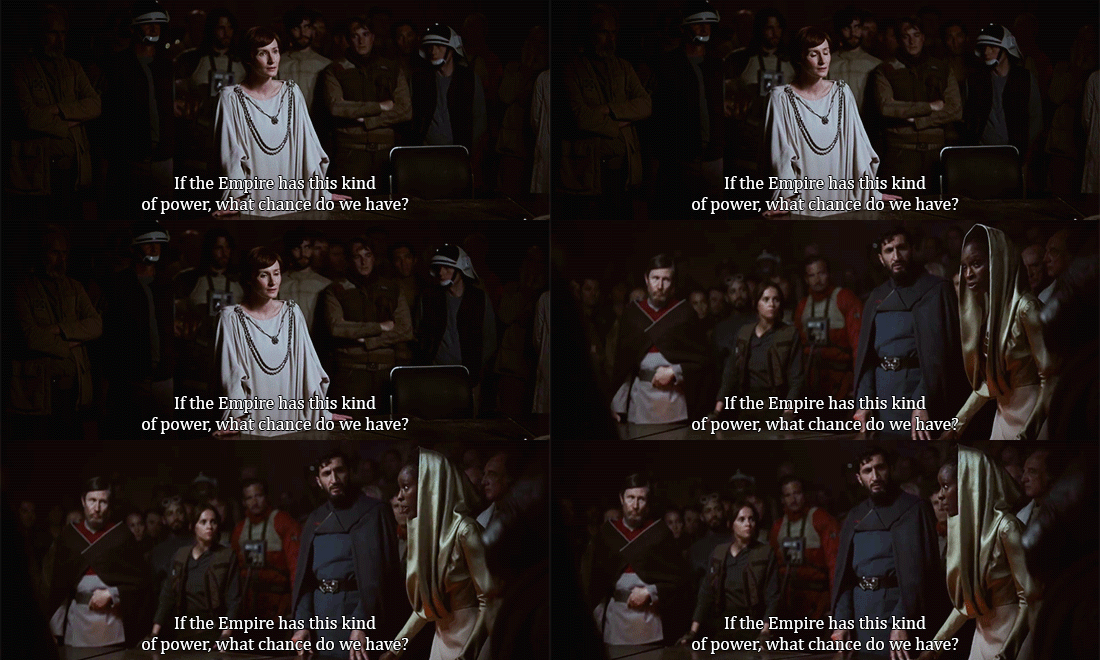

I realized, though, that I could. Yes, I'm still angry, though I'm not surprised at all how it ended. However, I realized that this film inspires hope in a new way than the other Star Wars films. Star Wars has always been balanced on the concept of hope. (I mean, one of the films is called A New Hope.) Hope that the Republic will end the Trade Federation. Hope that the Jedi will stop the Sith. Hope that the Rebel Alliance will defeat the Empire. Hope that the Resistance will finish off the First Order. There is always that underlying hope slipping through every movie, every story.

Rogue One doesn't feel very hopeful. Due to the realistic, gritty tone, it feels void of hope most of the time. How can there be any hope of stopping a space station that can destroy entire planets? How could a handful of wannabe rebels steal the Death Star plans and get them to the Alliance? How can they all survive a chaotic battle with endless stormtroopers and countless starships? It doesn't seem possible, and not all of it is possible. But that doesn't stop them. They don't give up on their mission for fear of death, for fear that they'll fail, for fear that there isn't hope.


And even when there is tragedy or destruction, even when things seem absolutely hopeless or dark, there is that fighting chance of hope. Rogue One amplifies this. It presents characters that are basically on a suicide mission, yet they don't give in and they don't give up. They push through; they do whatever they can. Because if they don't--the Empire wins. If they don't--the galaxy is lost. If they don't--there is absolutely no hope for the rest of the people.


Perhaps the Rogue One crew didn't hold on to hope for themselves. Maybe they had given up that hope, but their actions gave hope to everybody else. It ignited the Rebel Alliance with hope, and that thrust them through to the end of Return of the Jedi and the final battle against the Empire. Without Rogue One, all hope would be lost.

Our world today needs hope more than anything. And Rogue One shows that despite all the tragedy, the grittiness of life, and the evil actions in the world: there is still hope.


Whether you like the movie or not (I myself am on the fence about it), this movie is pivotal for our world right now. It paves new paths for the film industry and for the world. It inspires hope, it amplifies what Star Wars means and always has meant, and it shows that anybody--no matter their social class, personal beliefs, skin color, or gender--can and will make a difference in our world.

Tuesday, May 3, 2016

In Defense of Tony Stark


As we get closer to the approach of Captain America: Civil War, a movie which contains an epic and heartrending battle between two of my all-time favorite characters, I find myself feeling nervous. This movie has the ability to change the landscape of the Marvel Cinematic Universe, as well as our perceptions of its characters, for all time.

The problem is that, with a movie of this nature which contains our heroes fighting against each other, one of those characters is perceived as the villain. I've seen plenty of support for Captain America's team, which is great. Please know that this post isn't meant to bash Steve Rogers in any way. I'm not anti-Steve or anti-Bucky. However, due to the fact that our team is pitted against each other, as well as Tony's questionable actions in Age of Ultron (creating a murderbot), Tony hasn't been getting as much love, and sometimes he's even referred to as a villain. I'd like to prove this isn't the case. Civil War is about two points of view and two characters that happen to clash. Neither of them are better than the other, but unfortunately, our beloved characters have had to choose sides. This is Tony's.


It's not hard for me to see why people find Tony Stark unlikable... at least not at first. In Iron Man, we see a highly immature playboy who really only wants to have a fun time. He sleeps around, drinks quite a bit, and parties. Often he does all three at once. He's also the head of Stark Industries, a company that manufactures weapons, which doesn't exactly lend itself to being perceived as the best kind of guy. But at the same time, he's also incredibly smart. This is supported by comic evidence that states that he graduated from MIT at age 17. Tony Stark is a self-described genius (among other things).


All of this changes when Tony is kidnapped by an extremist group who wants to use his knowledge to help them build a weapon. He's injured by one of his own missiles, and to keep the shrapnel from reaching his heart, his fellow captive Yinsen builds him his very first arc reactor. Yinsen himself changes Tony's life in other ways by becoming a friend to him and ultimately sacrificing himself so Tony could escape. This is one of the first moments we can see Tony really change. He's taken out of his comfort zone. He's lost someone, someone who cared about him, and that makes him look at life a little differently. When he returns, Tony is a different man. After going through hell, he returns and changes the purpose of Stark Industries: they will no longer manufacture weapons. He builds his suit, and one of his first missions as Iron Man is to defend Yinsen's home village. Tony's capture and thus meeting Yinsen were the catalyst to help Tony become a changed man and a better one.


Tony's change is not immediate. Over the course of Iron Man 2, he still regresses several times, and it's a slow process. But eventually, he learns to work as a team player, he learns how to conquer some of his inner demons, and he falls in love with Pepper Potts. While Pepper didn't change Tony singlehandedly, she's still one of the people who consistently keeps him grounded. The Avengers were also a huge part of his character development as they showed him he could have team members... and even friends.


Speaking of the Avengers, one of the biggest turning points for Tony's character was during The Battle of New York. Throughout the movie, Steve insists that Tony isn't willing to make sacrifices.

“I’ve seen the footage. The only thing you really fight for is yourself. You’re not the guy to make the sacrifice play, to lay down on a wire and let the other guy crawl over you… you may not be a threat, but you better stop pretending to be a hero.” 
This culminates when the World Security Council decides to fire a nuke at Manhattan. In order to save the city, Tony flies the nuke up into an alien wormhole, something that could very well be considered a suicide mission. He laid his life down on the line willingly, and he very nearly almost lost it. This is when, in my opinion, Tony truly became one of the most heroic characters I've ever seen.


In Iron Man 3, we see him struggling with the aftereffects of that, complete with PTSD and panic attacks. I appreciate that the movie gave us a chance to see the realistic aftereffects that superheroes deal with from traumatic events. Tony did a good thing, and he saved Manhattan, but it still affected him one movie later (and even into Age of Ultron). I appreciated that your typical action flick delved into this sensitive topic.


Things start to go slightly awry in Age of Ultron when Tony and Bruce accidentally create an artificial intelligence that wants to conquer the world. Tony's actions were completely misguided, but his characterization in this film seemed to turn for the worse. Gone was the mature yet snarky hero we've come to know and love, and instead, we got a bitter, prideful man who made a joke about prima nocta (my irritation with this knows no bounds). He also didn't seem to grieve the loss of Jarvis, his closest--if not his best--friend. All of Tony's character development over three movies and six collective hours seemed to just disappear.


So, between his characterization in Age of Ultron and his undeniable flaws, it's no surprise to me that people considered Tony the villain in Age of Ultron and even Civil War. But Tony's past has proved to me time and time again that while Tony is flawed, he is a hero. Flawed heroes are hard to come by, and I personally believe that Tony Stark is one of the best.


My love for Tony has come from the fact that he is a wounded warrior. He struggled with the death of his parents, alcoholism, the pressures of carrying on his father's legacy, and finally, the kidnapping that resulted in shrapnel embedding itself in his heart. The location of Tony's injury was no coincidence and can in fact be interpreted as a metaphor.

"Here you have this character, who on the outside is invulnerable, I mean, just can't be touched, but inside is a wounded figure. Stan made it very much an in-your-face wound, you know, his heart was broken, you know, literally broken. But there's a metaphor going on there. And that's, I think, what made that character interesting." - Gerry Conway


I have seen Tony's broken heart time and time again over the past few years, and it speaks to my own heart about the challenges each of us face. Even if you are wounded, even if your heart is broken, you can still fight. You can still be a hero. And the things we think are our weaknesses can sometimes be our biggest strengths.

 "You know, I've got a cluster of shrapnel, trying every second to crawl its way into my heart." [points at the mini-arc reactor in his chest] "This stops it. This little circle of light. It's part of me now, not just armor. It's a... terrible privilege."


Tony Stark is our hilarious, snarky hero. His snark is just a part of him, and it's actually a coping mechanism disguising a broken man underneath--a broken man who is slowly learning to build himself up again. Personally, it's been a (sometimes terrible) privilege to watch him do so. Tony Stark is one of my favorite characters to grace my screen--not only because of what he does but because of who he is. He encourages me to keep fighting, to be grateful for my terrible privileges, and to be a hero not in spite of them but because of them.

As we go forth with Civil War, please remember Tony's growth. Remember he's not a bad person. Remember that the Civil War will hurt him, too.


Remember what a hero Tony is and has been over the past few years. And ultimately, remember that you can be a hero too, no matter how broken your heart may be.

What do you think about Tony Stark?


Friday, March 11, 2016

In Defense of Reylo: Part I


Since I'll be delving into the details of the accusations that have been made against the characters' dynamic, trigger warnings for abuse, rape, pedophilia, incest, and sass.

Kylo Ren and Rey. It’s one of the most controversial ships to come out of the Star Wars franchise. It seems that Reylo has just as many haters as it does shippers, and it’s hard to come by a Star Wars fan these days who hasn’t taken part in some heated debate about it, no matter what side they’re on. Some call it beautiful, others call it harmful and problematic. And, of course, as a devoted Reylo shipper myself, I knew I would have to write something in its defense.

My first instinct was to write an article about how amazing the ship is. But no one is going to care about the positive aspects while they are still concerned about the negative ones. And with all the arguments going around about how the ship is harmful, I realized I would need to debunk those first before I moved onto the things I like about Reylo. So, today, in the first installment of my series on Reylo, I’ll be tackling five of the ten most common arguments I’ve seen levied against the ship.

*Ahem* Let’s begin.

1. “We should defeat villains, not fall in love with them. Viewing villains as romantic prospects is unhealthy and sets a bad example.”

I’ve seen many people give this argument, and each person seems to mean something a bit different by it. Some of them just mean they have seen one too many of their friends fangirl over antiheroes/antivillains and are sick of it and want something else. “First Zuko, then Loki, then Bucky Barnes, now Kylo Ren? When does it end?” To those people I would say I’m sorry to be so cliché. (Although, I’m also not sorry. ;) ) Trends can be tiresome, but they are not inherently harmful, and people have the right to like what they like.

Other people give this argument because they believe the popularity of antiheroes in media is a sign of society’s moral decay. “Our culture is quickly embracing moral relativity. And because of that it’s now only politically correct to have morally grey characters. If we want people to know right from wrong, we need heroes who are truly good we can root for, and villains who are truly evil we can despise.” To these people I would say that, while there’s nothing inherently wrong with stories about “true” heroes vs. “true” villains, there is also nothing wrong with stories about grey characters. Regardless of the black and white nature of deities and devils (or even humans in the afterlife), here on earth humanity is very grey. The best people have huge flaws, murderers show kindness, and almost everyone has had their turn being the abuser and the abused at some point. Grey characters are therefore more relatable as well as more interesting because there are more layers of morality and immorality to analyze and discuss. It’s nothing to be afraid of.


The majority of people who give this argument, however, seem to be coming from what is basically social justice’s division of One Million Moms in that they are very concerned for the children. “Heroines falling in love with villains glamorizes abusive relationships and may cause impressionable young girls to enter abusive relationships themselves!” I think we are all familiar with the kind of stories they’re talking about – usually fanfics, erotica, and poorly written YA novels that portray a “sympathetic bad boy” type who stalks, manipulates, or abuses his girlfriend. But because he’s so handsome and tragic, the naïve girlfriend writes off his faults as him being “just misunderstood,” forgives him, and they live happily and unrealistically ever after.

What people don’t seem to realize when they compare this to Reylo is that Star Wars is not a fanfic or a poorly written erotica/YA novel. Kylo Ren is not anyone’s abusive bad boy boyfriend. Rey is not a naïve girl who forgives whatever he does because he’s “misunderstood.” Anyone who thinks they have been or ever will be these things doesn’t understand the Star Wars universe. And anyone who thinks that is what the majority of Reylo shippers want them to be hasn’t been paying attention.

There are two main groups of Reylo shippers: those who ship Kylo Ren and Rey as a Foe Yay relationship and want them to stay that way, and those who ship them as a Foe Yay relationship but hope Rey will redeem Kylo Ren and enter a more traditional romantic relationship with him post-redemption. I don’t know of many who want them to be in an actual romantic relationship pre-redemption. How would that even work anyway? “Alright, honey. It’s time for me to go to work and try to kill your friends.” “Alright, have a good day, sweetie!” Yeah, no. It would be hard to make that work in even a fanfic, let alone the actual movies.


For those of you wondering what Foe Yay is, it is a trope in fiction where two equally powerful archenemies dedicate themselves to defeating the other but also find themselves strangely drawn to each other in ways they might not want to admit. Regardless of the characters’ gender and actual orientation, there will be a purposeful romantic subtext in their interactions. The trope is built on the idea that hate itself is a sort of twisted form of love. After all, no one can spend that much time obsessively thinking about a person – even negatively – and remain apathetic about them and their well-being. In fact, many characters in a Foe Yay relationship will find difficulty in actually killing their nemesis as they’ve always dreamed of once they finally get the chance. They may also find themselves telling others that only they are allowed to kill/harm their nemesis, in a subconscious effort to protect their nemesis from others. And they may also get strangely jealous when their nemesis fights other people.

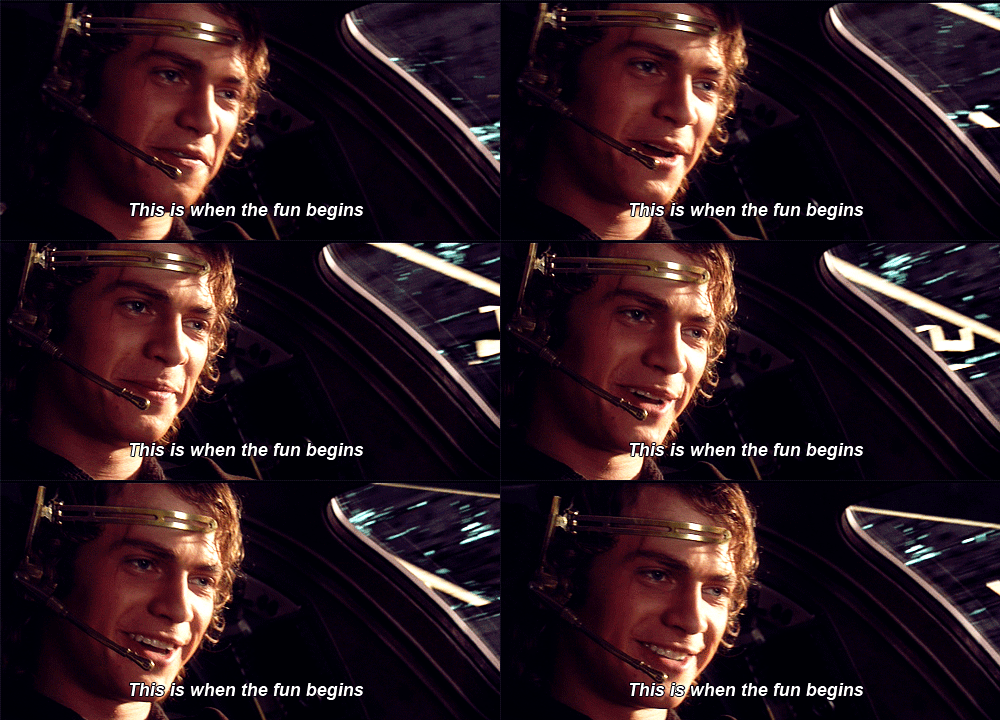
Foe Yay is an extremely common trope that one finds in almost all media. It’s such a well-known trope, it is parodied often, such as in Perry and Doofenshmirtz’ relationship on Phineas and Ferb:


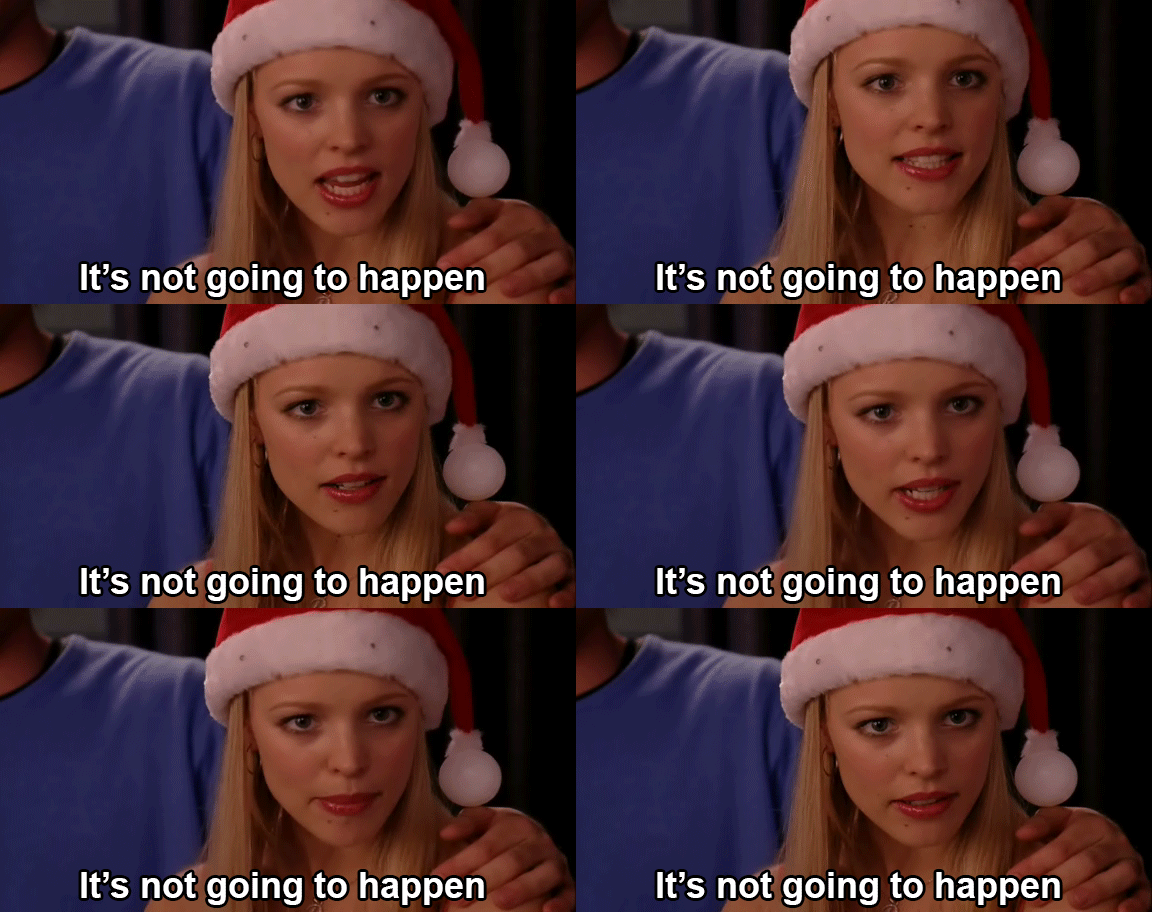
And in the music video to Miike Snow’s "Genghis Khan":


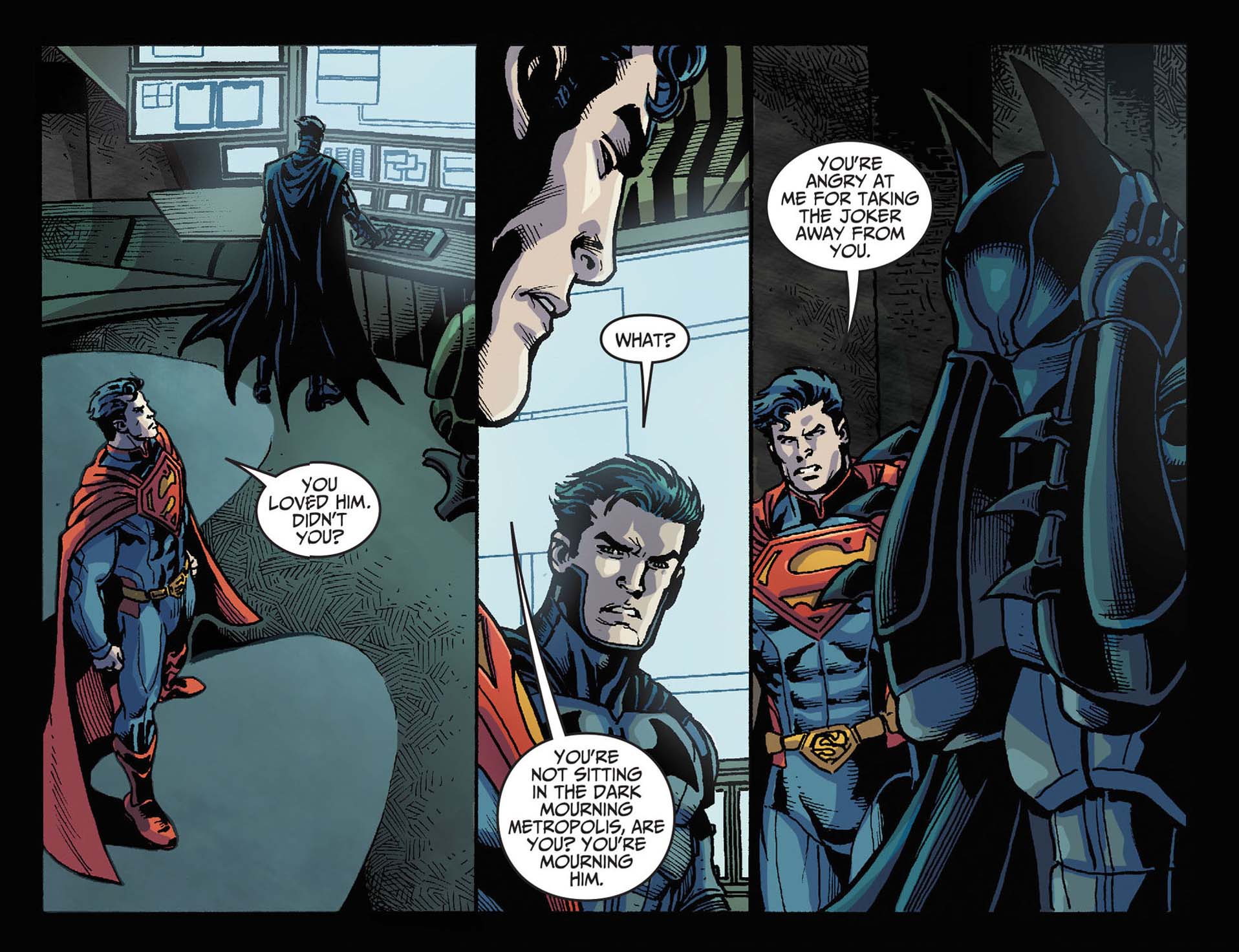
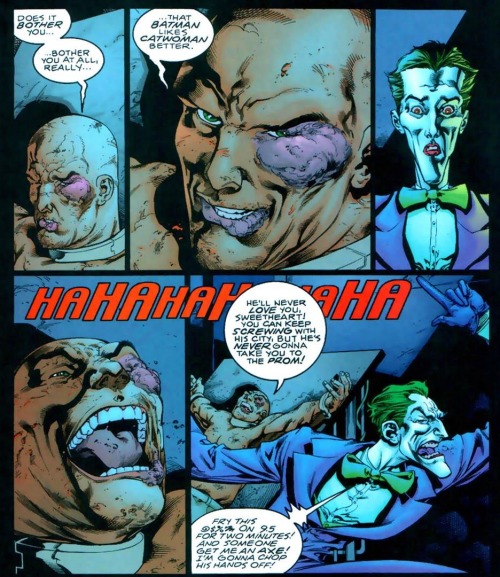
One of the more famous serious examples of this trope is the complicated relationship between Batman and the Joker:


(Source: DC Comics)

When little boys are inspired by Batman and want to become law enforcement officers when they grow up, no one worries that they’ll end up idealizing the criminals they chase because of Batman’s complex love/hate relationship with the Joker. And in the 75 years we’ve watched Batman alternate between fighting and caring about his archenemy, we’ve had no issues with boys putting themselves in dangerous relationships because of it. Whaddy’a know? It’s almost like fiction can actually serve as a safe, consequence-free zone to explore interesting dynamics that are not always 100% vanilla and ideal! Kind of like how, despite what some people say, videogames don’t cause violence and LGBT characters don’t turn straight viewers gay. I guess no matter what they watch, people are in control of their own actions and identities! Imagine! And guess what else? If little boys are smart enough to realize the difference between fiction and reality and are able to watch a love/hate relationship between a good guy and a bad guy, I’m pretty sure the girls can handle it too.


Will some people watch media and be inspired by it to do something harmful? Of course! But it’s like what they say about fiction being a mirror. What you take away from a story depends on what kind of person you are. If you’re a super healthy person, you can read almost anything and grow from the positive elements as well as explore the negative elements without being affected by them in any bad way. If you’re an unhealthy person, you can read anything – the Bible, Emily Dickinson poetry, The Cat in the Hat – and come away from it inspired to ruin your life and/or the lives of other people. Playing it safe as an author or filmmaker will have no effect on whether or not people abuse your work. This is why each person, and no one else, should be accountable for their own actions. This is why it’s wrong to blame media for the actions of audience members. This is why both makers and consumers of media are expected to adhere to the rule that fiction is description, not prescription.

Ultimately, fiction isn’t there to be your role model. It isn’t there to inspire your children or teach them the correct way to live. And it isn’t there to take your ideals and put them on screen. Sometimes fiction does end up doing these things, and that’s great! But when we start viewing fiction through the lens of that being its ultimate purpose, it becomes a problem. That’s when we start holding media up to a standard it is not obligated to meet. Fiction can do many things, but the only thing it is obligated to do is entertain, to explore situations and relationships, both good and bad, healthy and unhealthy. And regardless of whether or not the Reylo dynamic is something that should be imitated in real life, it is interesting in how it explores the similarities between love and hate, the connection the two characters have through the Force, and the possible themes of redemption. It is compelling, and that’s all it needs to be.


2. “Shipping Reylo condones rape. Case in point, the interrogation scene where he forces himself into her mind. And the line ‘You know I can take what I want’ pretty much speaks for itself.”

Let’s get something clear once and for all:

Yes, Kylo Ren did “Mind Rape” Rey.
No, Kylo Ren did not rape Rey.

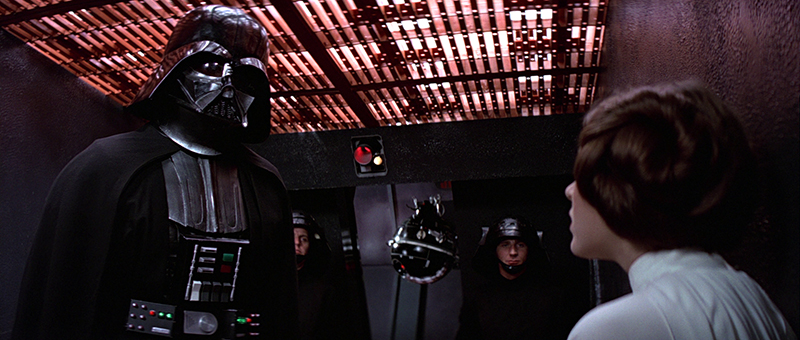
If you’re confused, allow me to explain. “Mind Rape” is the name of a trope that, despite its loaded phrase of a name, is not actually rape. It is called such because it contains an element of violation that reminds people of rape in some cases. There are many variations of the “Mind Rape” trope, some playing on the association with rape more than others. The specific variation used in The Force Awakens is probably the least “rapey” of them all and is known as the Mind Probe. The Mind Probe trope is when any character possesses and uses the ability to sift through someone’s thoughts and memories in order to acquire a needed piece of information. It is often accompanied by head pain or discomfort for the person being probed, the intensity of which varies. This trope is very common to fantasy and sci-fi stories. One well-known example being that of Darth Vader and Leia in Star Wars: A New Hope.


Just like Kylo Ren mind probes Rey in order to find information placed in a droid, Darth Vader mind probed Leia Organa to find information that was placed in a droid as well. In fact, this is most likely one of the many intentional throwbacks to A New Hope that is in The Force Awakens. I don’t think it would be fair to say that Darth Vader raped Leia. Which is why I think, despite the trope name, the rape comparison is a bit too extreme to be accurate in the case of mind probes. They don't really have an equivalent in our world. The closest comparison would be to imagine struggling with a massive migraine while one of your enemies reads your diary in front of you. It’s certainly not an enviable position, and it’s definitely a violation of privacy, but it’s not rape.

I must also emphasize that, while there is some ethical questions around it, mind probing is something done by both villains and heroes in media. It is worth pointing out that Rey also “Mind Rapes” Kylo Ren right back in the interrogation scene. And she, along with most Jedis, take it a step further, using their powers to get into other people’s heads and force them to do things they would never do of their own free will, using Jedi mind tricks. This is much more extreme than a mind probe. And what’s more, it’s never frowned upon in-canon.


All that leaves is the “You know I can take what I want" line which many people have misunderstood. A lot of people interpret this line as Kylo Ren gloating over the fact that he is in power over Rey. But it is actually the opposite. Unlike his interrogation of Poe in which he gloated and made the Mind Probe as painful as he could, Kylo Ren makes it clear he is trying to get through Rey’s interrogation with as little unpleasantness as possible. He calls her his guest, even takes off his mask so they can speak to each other as people, tells her the truth about her friends, and tries to convince her to give him the map of her own free will first. This is why he says that line. He is telling her that, no matter what she chooses, he will have the map by the end of the day, so why not choose to cooperate and avoid all the pain of the mind probe? The novelization delves into this further:

     "I know you've seen the map," he repeated. "It's what I need. At the moment, it is all that I need." When she maintained her silence he almost sighed. "I can take whatever I want."
     Her muscles tightened. "Then you don't need me to tell you anything."
     "True." He rose, resigned. "I would have preferred to avoid this. Despite what you may believe, it gives me no pleasure. I will go as easily as possible–but I will take what I need."

All in all, I think we can conclude that the Mind Probe scene does not make Rey a victim of rape nor does it make Kylo Ren a rapist. It’s simply one of the unpleasant ordeals she (along with Poe Dameron, who suffered far worse than she did) had to face while being held hostage by the enemy. I see nothing unusual or scandalous about this since, considering he is on their enemy’s side, we shouldn’t expect Kylo Ren’s actions toward the heroes to be positive and pleasant at this point. I also see nothing about this that would prevent him from being redeemed. (Darth Vader mind probed Leia, and it never got in the way of his redemption) And I certainly don’t see how it would get in the way of a Foe Yay relationship as his actions toward Rey are quite mild compared to other Foe Yay relationships. (Batman and Joker anyone?)


3. “Shipping Rey with Kylo = shipping a victim with her abuser.”

I can’t count the number of times I’ve been told that if I root for Rey to forgive, care about, and redeem Kylo Ren, then that means I'm “ignoring her trauma,” “triggering victims of abusive relationships,” and “sending a bad message to people who have been in abusive romantic relationships, telling them they need to get back together with their manipulative ex-boyfriends.”

Whenever I see this, I can’t help wondering why these people don’t hate the original trilogy. In the original trilogy of Star Wars, Darth Vader gives Luke plenty of trauma. He fights him, cuts off his hand, gives him a choice of going to the dark side or falling to his doom, kills his mentor and many others Luke cares about, threatens to turn his sister evil, and takes him to the emperor to be toyed with, manipulated, and tortured. Yet viewers root for Luke to redeem Darth Vader, to continue loving his father, and ultimately to forgive him. And Luke does. In fact, if Vader hadn’t died in the end, Luke would have even taken him back and spent as much time with him as he could, forgetting all the trauma his father put him through. And the movies present this as a good thing. What about all the people watching who were abused by their parents? What if it triggers them? What if the story makes them feel like they have to forgive their abusive parents and take them back?


Despite all the backlash against Reylo, it’s been strangely silent on this front. Which strikes me as odd. Not because I think the original trilogy should trigger victims of parental abuse – just like with Reylo, I think it’s an apples and oranges comparison. But at least it makes a little more sense. At least Darth Vader really is Luke’s evil father. Whereas, Kylo Ren is not Rey’s manipulative ex-boyfriend. They are not victim and abuser. If you look at Rey and Kylo and see a poor traumatized girl being abused by some manipulative dudebro, you are not seeing what J.J. Abrams put on screen. They are adversaries. Think Superman and Lex Luthor. Batman and the Joker. Holmes and Moriarty. Tom and Jerry. You get the picture.


They are nemeses fighting on opposing sides of a war. Unless you’ve joined the military and have done combat with the enemy, you haven't experienced a real life equivalent of what they are to each other.


And another thing. If your beef against the Reylo ship is that you see Rey as a victim of Kylo Ren, I want you to say the following sentence out loud: “Rey is not a victim.” Say it. Very good! Now say it again. Yep, out loud. Again. Keep saying it. Say it in the mirror. Say it when you get up in the morning and when you lie down to sleep at night. Say it until it rolls off your tongue. Until it gets in your veins, and you can dance to it like a smooth piece of jazz.


Rey has been in multiple battles with Kylo Ren and has easily won all of them. Look at other heroes like, say, Batman. Batman, with his years of training, his ninja moves, his billions of dollars to create every gadget you could possibly think of. And in each of his fights, he gets more battered and takes more abuse than Rey does with zero training, zero gadgets, while she is restrained to a chair. People don’t call Batman a victim. But they call Rey a victim?

Ohhh, but Rey is a woman. Ohhh, and she’s being placed in a fight with a man. Ohhhhhhhhhhhhh. Well, if a woman – even a strong woman – is placed in a fight with a man, she must automatically be a victim!

Like? What? No? Why are you? the way that? you are?


Also, while I’m sure Rey would totally win in a fight with someone who’s, you know, actually good at fighting, the part about Kylo Ren being Rey’s “abuser” is really, really funny. Like, I’m not sure if you were all watching, but Kylo Ren kind of downright sucks as a fighter? I mean, yes he can stop items in motion using the force, and he can slash the crap out of inanimate objects. But anything involving like…other people? Yeah, he’s going to lose.

(Source: jawd.tumblr.com)

And he couldn’t be someone’s abuser even if he tried really, really hard. You can’t call Rey “Kylo Ren’s victim” when she’s stronger than him and beats him every time they battle.

Your homework for the day is to go to the blackboard and write “Shipping Rey with Kylo = shipping a badass fighter with the flailing, incompetent guy who will never beat her at anything ever” 100 times.


4. “Shipping Reylo condones incest, as they are most likely related to each other.”

The idea that Rey and Kylo Ren are related is just one of many theories out there, not something that has been confirmed. Picking one of the many theories going around, assuming it’s true, and judging fans of a certain ship based on that is a bit silly. What’s more, I think the theory of them being related is not very likely to come true. I definitely don’t think they’re siblings. Han and Leia treat Rey like a stranger, not like someone who could possibly be their long-abandoned daughter. So the most Rey and Kylo Ren could be is cousins.


If they are cousins, the Reylo ship still does not condone incest. Someone dating their own cousin is frowned upon here in America, but this is a highly US-centric view. The taboo nature of cousin relationships is completely subjective and cultural. In other countries, such as in Europe, cousin marriage is legal and considered quite normal. And I have to remind everyone that we don’t know what the rules are concerning cousin marriage in the Star Wars universe.

However, I find the idea of them being cousins also very unlikely. Making Rey Luke’s daughter would just be too obvious to make a good plot twist. Also, Maz Kanata’s advice to Rey was framed in a “you can’t get your real family, but you can have Luke instead” kind of way, which wouldn’t really make sense if Luke is her real family. And being Force-sensitive, I think Maz would have known if that was the case.


5. “Shipping Reylo condones pedophilia, as Rey is only 19 and Kylo is in his early 30s. That’s a ten year age difference.”


Pedophilia means attraction to a child. It doesn’t mean attraction to someone younger than you. I can see how this would be a problem if Rey was underage – say, 16 or 17. But she is 19. She is an adult. If two people are adults, there is nothing immoral in them having any kind of romantic interaction they both want to have.

We've all seen relationships that came across as a bit skeevy due to a massive age difference. Like when a 60 year old starts dating a 20 year old. But ten years apart? You know relationships with that little an age difference are incredibly common, right? In fact, do you know who else had a ten year age difference in their relationship?


That’s right. Not only did Han and Leia have ten years between them, but they were the same ages as Kylo Ren and Rey. Han was in his early 30s. Leia was 19. Like parents, like son. If it didn’t bother you with them, it shouldn’t bother you with Reylo.


Join me next time in Part II of my three-part series on Reylo where I'll tackle the final five arguments made against the ship.

Thursday, February 11, 2016

In Defense of Anakin Skywalker: Part Two


Revenge of the Sith jumps forward a few years after Attack of the Clones. Anakin has better clothes and glorious hair, he's a secretly married man, and he's less prone to incredibly awkward conversations. I personally think Anakin's personality is excellently portrayed just within the first ten minutes of this movie. Look at the first three things he does:
• He sees a Clone Trooper in trouble and leaps to help him before Obi-Wan tells him not to because there's no point. They have a greater mission. This doesn't sit well with Anakin, but he sees the sense in Obi-Wan's words and continues onward.
• When Obi-Wan's ship is attacked by vulture droids, Obi-Wan tells him to continue the mission. "I'm not leaving without you, Master," says Anakin firmly, and proceeds to pull a variety of piloting stunts in order to help free Obi-Wan's ship of the droids and save his Master's life.
• He defends R2D2 to Obi-Wan. When Obi-Wan begins to make a funny - if demeaning - joke about the droid, Anakin interrupts with, "No loose wire jokes," and assures Obi-Wan that R2D2 is doing his best.
These are all selfless acts that put others first. Anakin is often called 'selfish,' but this is simply not the case. Very rarely does Anakin ever do anything for himself alone. In fact, the only thing we actually see him do purely for selfish reasons is marry Padme. (If that can be called a selfish reason.)
In a plot set up by Chancellor Palpatine, Anakin and Obi-Wan rush to free the 'captured' Chancellor from the clutches of Dooku. Anakin easily defeats the older Sith and is fully prepared to show him mercy when the Chancellor encourages him to kill Dooku. He preys on Anakin's passions and rage, and Anakin finally does behead Dooku. He's horrified with what he's done, and herein we see Anakin's largest flaw - not pride, not selfishness, but vulnerability. He is open to persuasion from those he trusts. Pride is not his downfall. Vulnerability is.
When Anakin and Obi-Wan return victorious to Coruscant, Anakin rushes to greet Padme. His wife gives him the news - she's pregnant, and we see several reactions at once from the father-to-be. He's shocked, and he stammers, taken aback, but his emotions finally solidify into joy. He calls the children a blessing and a gift, a reason to celebrate. He's concerned for what this might mean - Padme could lose her seat in the Senate, Anakin could be kicked out of the order - but he makes the decision to view the children as something good.
It's interesting to note that throughout Revenge of the Sith, Anakin repeatedly uses the word save. He wants to save Obi-Wan. He wants to save Padme. He wants to save everyone, but he never gives thought for himself - except when it comes to losing those he loves. He grew up a slave with nothing, and now that he has something to protect, he's terrified of losing it. He wasn't able to save his mother, and that instance has obviously magnified the way he views things now. He made a promise he wasn't able to keep, and that haunts him more than anything else.
Power play is a large theme in the Star Wars universe, and Revenge of the Sith is no exception as Chancellor Palpatine becomes Emperor Palpatine and offers Anakin the power of the Dark Side. Anakin accepts, as everyone knew he would, but this was not a snap decision on Anakin's part. Palpatine has watched, guided, mentored, and manipulated Anakin since he was nine years old, and it's hardly surprising that Anakin would be susceptible to his machinations. When Anakin reveals a further weakness - Padme and the unborn child(ren) - Palpatine seizes the chance to strike while the iron is hot. He uses Anakin's love for his family to complete his manipulation to the Dark Side.
Anakin discovers that Palpatine is actually the Sith the Jedi have been searching for, and his first reaction is that of a Jedi - he tells the council, and the council decides to look into the matter. Anakin has no plans to stand in their way, no matter how much the situation hurts him - but he remembers Palpatine's offer, his promise that he could save Padme's life and with her, their unborn child. He remembers Palpatine's offer of life, and he runs to the citadel where he stops Mace Windu from killing Palpatine (now revealed to be Darth Sidious).
Anakin catches Mace Windu off-guard, and Palpatine uses the opening to kill Windu while Anakin watches, horrified. Clearly, Anakin never meant for this to happen, and he cries, "What have I done?" as he realizes his life can no longer continue the way it was. He has aided in an unforgivable act against the Jedi. His life is over, but Padme's doesn't have to be, and so he swears fealty to Darth Sidious and becomes Darth Vader.
"Anakin wanted power for himself," people say, but there is no basis for that argument. He wants love, recognition, and trust - but power? He only wanted the ability to save his loved ones. While he goes about it in a foolish way and ultimately commits heinous acts to gain what power he can, his motives were pure.
Even after he has been named Darth Vader and is sent to Mustafar to kill some of the Emperor's loose ends, Anakin is full of conflict, struggling with what he has done and what he is currently doing. As he looks out across the soon-to-be battleground, a tear tracks down his face as he comes to terms with who he has become.
In his battle with Obi-Wan, this exchange takes place:

Obi-Wan: Anakin, Chancellor Palpatine is evil!

Anakin: From my point of view, the Jedi are evil.

This argument actually makes complete sense, if you take the Jedi Code that Anakin was brought up to believe. There are no absolutes in the Jedi Code. Much later Obi-Wan tells Luke, "What I told you was true…from a certain point of view," as well as, "You will find many of the truths we cling to depend greatly on our point of view." The Jedi have no solid foundation of belief, and Anakin's response to Obi-Wan would make complete sense from his worldview.
The Emperor finds a destroyed and dying Vader and has a medical team transform him into the Darth Vader audiences knew - 'more machine now than man' - and yet upon awakening, the 'machine's' first inquiry is, "Where is Padme? Is she all right?"
The Emperor, seeing another chance to solidify his hold on Vader, lies and tells him Padme has died. Vader screams in anguish - Padme was his world, and now he has nothing to fight for except the Emperor.
Some eighteen-nineteen years later, we see Vader as a mysterious villain serving a higher cause. He's regarded skeptically by most of the Empire, even those who are familiar with his presence. He's a kind of villainous Merlin, viewed by most as an outdated and superstitious magician with old-fashioned beliefs. I love how Anakin's personality is still very obvious in Vader. He has a bit more chill, he's a bit calmer, but he's still impetuous and sarcastic. He still can't resist getting into his V-Wing and helping out the Imperial fighters, even when he doesn't have to. He's still a hotshot pilot with attitude, and while it's far more subtle, it's obvious if you're paying attention.
One thing I find really interesting is Vader's reaction to the Emperor when the Emperor tells Vader to seek out and destroy Luke Skywalker. His response is unexpected.

                "He's just a boy."

He's incredulous, but there's also a hint of something else, and it's not far-fetched to assume that Vader has sensed his connection to Luke through the Force. While this kind of reluctance to harm Luke fluctuates through the movies, his initial reaction is not the one you would expect from a villain.
Vader's confrontation with Luke is known even by non-Star Wars fans, but my favorite parts about it are not necessarily what's spoken, but the subtext behind the dialogue. Luke informs Vader that he knows enough about his parentage - he knows that Vader killed Anakin. Vader then utters the famous line, "No, Luke. I am your father."
I've always found this scene particularly interesting - not just because it's iconic but because Vader is telling Luke the complete and utter truth. It's something that even Obi-Wan never did - in fact, nobody has ever told Luke the complete truth before. Not his uncle, not his aunt, not his mentor. Nobody except Vader, and it's in keeping with Anakin's hatred of secrets and lies. In fact, Vader never once lies to his son.
I've heard many people compare Luke to Anakin and Leia to Padme, but I think far more similarities are found when you compare Luke to Padme and Leia to Anakin. Padme's last words to Obi-Wan were, "There is still good in him." Luke tells Vader, "There is still good in you."
Vader does not get angry or take offense at this suggestion. He only says, "It is too late for me."
It's interesting to note that Vader is never described as prideful. He never brags about his own power but rather the power of the dark side. He never claims to be invincible. As villains go, he actually presents himself in a fairly understated way.
Darth Vader takes his son to see the Emperor, who intends to persuade Luke to join the Sith. And here we have the famous redemption scene - the scene where Vader becomes Anakin again for the last time. The Emperor sets Luke and Vader against each other, hoping to judge Luke's strength, and Vader preys on Luke's emotions. He preys on his concern for his sister, and here we have a line that wounds me to my core - Vader monologues against Luke, against his concern for, "….Sister. You have a twin sister."

And for the first time, Darth Vader realizes he has a daughter. He, the man who never had a father, is a father not once, but twice. It's after this realization that he starts to waver, and he ends up losing the battle with Luke.
Vader's death scene is one of the most important scenes both in movie history and in my personal history as a film-viewer and storyteller. Even before we had the prequels to give us backstory, it was emotional. With full backstory and knowledge of everything Anakin Skywalker went through before he reached this scene - I'm getting goose bumps just writing it.
Luke Skywalker has lost. The Emperor, convinced that Luke will never turn to the dark side, has decided to kill him. Using his dark force powers, the Emperor stands over Luke and begins to kill him. He doesn't run him through with a lightsaber; he chooses to torture the boy to death while his father looks on. The Emperor is completely confident in Vader's loyalty - family ties don't matter. Not even this can sway Vader.
Except…Anakin Skywalker still resides within the creature that is Darth Vader. He was always there, beneath the surface, and watching his son die in agony before his eyes is the turning point. Darth Vader, one of the most powerful Sith lords in history, does not have the ability to watch his son die.
He has watched people die in front of him before. He held his mother in his arms as she died from wounds inflicted by torture. He suffered sleepless nights full of nightmares where his wife died. He has lived all this time believing that he murdered his wife - that all his efforts, that every single reason he turned to the dark side were for nothing.
For the first time in the entire prequel trilogy, Darth Vader's breathing speeds up. You can hear his respirator working harder than it has before as he experiences emotions he's been suppressing for almost twenty years. You can physically hear his struggle.
Listen. You need to understand why this scene is so important.
Anakin Skywalker was raised a slave with no freedom. A slave with no chance of escape until the Jedi appeared and offered him a way out…but even as a Jedi, he still called someone 'Master.' He had to abide by rules, many of which were foolish or outdated. He broke those rules with misguided intentions and became even more of a slave. Never in his life has Anakin Skywalker been free. Never in his life has he not called someone 'Master.' Never in his life has he had the freedom to make a decision completely free of anyone's judgment.
Which means that the only decision Anakin Skywalker ever made freely in his entire life was to die for his son.
He is victorious in killing the Emperor, but it's a victory with a price. A price he knew he would have to pay, and a sacrifice he knew he was willing to make. He proves his family - his wife, his son, his daughter - right. He proves there was still good in him.
As Luke attempts to drag his father to safety, Vader tells him to stop trying. They both know it's too late. Vader makes a final request - to have both of his helmets removed. The lower half of the helmet simultaneously works as Vader's painkiller, but he doesn't care anymore. It's disconnected, and the pain means nothing as he's able to look at his son's face with his own eyes.
And here he says possibly the most important words in his life - "You were right about me. Tell your sister…you were right."
Not 'I love you.' It isn't enough, and he already committed the ultimate sacrifice. Luke knows his father loves him. Instead, Vader chooses to tell Luke he was right. He chooses to give Luke hope, to encourage his faith in goodness. Essentially, in his last moment, Darth Vader chooses the light side. And not only that, but he sends a message to his daughter - it's too late to fix things with her, but he remembers her. He is thinking only of his children.
Because in that moment, he was not Anakin Skywalker. He was not Darth Vader.
He was Luke Skywalker's father.
And he was a good man.


Saturday, January 16, 2016

In Defense of Anakin Skywalker: Part One


This is not an attempt to excuse Anakin's bad decisions and wrongdoings, but rather an explanation of the psyche behind one of the best-known (and least-known) characters in cinematic history.

Weak. Selfish. Whiny. Arrogant. Badly acted. Immature.

These are the most frequent adjectives I hear used to describe him, and these are the words that gall me. They show a distinct lack of understanding, an inability to grasp the complexity of the character that is Anakin Skywalker. Along with hatred for the prequels, hatred of Anakin runs almost as rampant, as people disparage his characterization and reduce him to a shallow, two-dimensional shadow of himself. I gave myself homework before I sat down to write this article - I re-watched the prequels and took notes to refresh my memory. I take this project very seriously. Why? Because Anakin was the first character I was truly, greatly attached to. I was fourteen when I first saw Revenge of the Sith, and I cried harder over that movie than any movie before. The next time I watched The Return of the Jedi, I sobbed when young Anakin smiled proudly at Luke from the netherworld of the Force. Anakin was the first character to awaken every feeling in me - from I need to write characters this deep to my BABY.

I've always been defensive of Anakin, but I had to face reality: I couldn’t explain my love for him in one conversation without someone's eyes glazing over. As a result, my full defense of Anakin has never been spoken or written - until now. [DRAMATIC MUSIC PLAYS]

The first complaint most people have is about Hayden Christensen's acting. When Hayden explained why he quit acting after the prequels, the majority of responses were, "I thought he quit acting before the prequels." The only thing is that Hayden did nothing wrong where Anakin was concerned. Before the prequels, Hayden's resume included B-list indie films and made-for-TV movies. He had never starred - let alone acted in - anything major, and then suddenly he's cast in something as major as Star Wars. Hayden was a teenager thrust into one of the biggest movie franchises in history, and he was given one of the worst movie scripts ever to grace the silver screen.

The first part of Attack of the Clones shows him as a difficult but well-meaning padawan who exchanges fun one-liners with Obi-Wan. The second part of the movie makes a cringe-worthy stab at romance, and the third part of the movie shows his return to a difficult but well-meaning padawan - this time with a side of darkness and marriage. There's little to no cohesion to his script or his character development, and yet with a script that sounds like an overdramatic high school student wrote it, Hayden did the best he could. You try saying these lines realistically:


"From the moment I met you, all those years ago, not a day has gone by when I haven't thought of you. And now that I'm with you again... I'm in agony. The closer I get to you, the worse it gets. The thought of not being with you- I can't breath. I'm haunted by the kiss that you should never have given me. My heart is beating... hoping that kiss will not become a scar. You are in my very soul, tormenting me... what can I do?- I will do anything you ask."


If that isn't hard enough, try saying them realistically from the perspective of a teenaged boy. One of the most impressive things about the Star Wars movies is that, in spite of perpetually wooden and unrealistic scripts, the actors manage to bring life to the frequently awkward, stiff, and sometimes-plain-ridiculous lines they're given. Hayden was no exception, delivering his lines the only way they could sound even slightly realistic.

Everyone knows Attack of the Clones was a hot mess in many ways, but Revenge of the Sith is another ballgame and my favorite film in the franchise, with The Force Awakens and A New Hope taking second and third place.

The script for Revenge of the Sith is noticeably better, in large part due to the lack of attempted seduction. Anakin and Padme are actually married, and the strain of 'falling in love' (is that what happened in Attack of the Clones? Because it's kind of hard to tell) is gone. Hayden does an excellent job of portraying Anakin's emotional conversion to the Dark Side, even though the script is still flawed.

And even if you still think his acting was poor (and I highly disagree), at least have the courtesy to treat a hardworking, humble young man with a basic little thing called 'decency.' He's human, too.

ON TO ANAKIN

When we first meet nine-year-old Anakin Skywalker, he's a fatherless slave on a desert planet with no hope of having any kind of freedom. Qui-Gon, Obi-Wan, and Jar-Jar walk into Watto's shop, and when Jar-Jar accidentally turns a destructive robot on, Anakin pipes up and instructs, "Hit it on the nose!"

This eager, helpful attitude is characteristic of Anakin. His big heart is clearly demonstrated - he brings the Jedi home and he offers to fly in a pod race. He should be withdrawn and critical considering the life he's led, but he's wide-eyed and hopeful, zealous to please and keenly observant.

We get to know Anakin, whose point of view is both innocent and profound for one so young. "Mom," he says, when Shmi tells him a pod race is too dangerous, "you said the biggest problem in the universe is no one helps each other."

He has listened closely to tales of Jedi and Angels, longing for something beyond what Tatooine has to offer, and yet he never complains about his position as a slave. He has plans to leave someday, after he locates the explosive tracker implanted inside him and his mother.

He tells Padme, "I'm a pilot, you know, and someday I'm going to fly away from this place," but still he never whines or complains about his lot in life. His mother is the one he wishes had it better, caring for her well-being over his own.

When Qui-Gon secures Anakin's freedom, Anakin's first reaction is, "But what about my Mom?" And, upon discovering she can't come with him, he says he isn't going.  Shmi encourages her son to leave, wanting a brighter future for him, but she is still where his heart is. In fact, when Qui-Gon brings Anakin before the Jedi counsel, his mind is still with his mother and not his own new and frightening situation.  

Ki-Adi-Mundi: Your thoughts dwell on your mother.
Anakin: I miss her.
Yoda: Afraid to lose her I think, hmm?
Anakin: What has that got to do with anything?
Yoda: Everything! Fear is the path to the dark side. Fear leads to anger. Anger leads to hate. Hate leads to suffering. I sense much fear in you.

Here we see plenty of foreshadowing - fear of loss will eventually lead to Anakin's downfall and the rise of Darth Vader. However, we also see the reason behind that downfall - Anakin is taught that missing someone - that feeling attachment - is wrong, and yet he can't help himself. Anakin cares deeply about people, as is demonstrated time and time again throughout the prequels.

Obi-Wan is less than thrilled about his Master's decision to mentor Anakin. "The boy is dangerous," he tells him. "They [the Council] all sense it, why can't you?"

Therein lies an interesting aspect of Anakin's character arc. It's a known psychological fact that how you view and treat someone will influence how they turn out. If you tell a child they're worthless, they will believe they are worthless. If you tell a child they're pretty, they will believe they are pretty.

If you treat a child as dangerous, the child will believe they are dangerous. Something to note as Anakin grows up.

When Attack of the Clones starts, we see Anakin has grown into a powerful young man caught in a very awkward place. It's hard, at first glance, to tell where the bad script begins and Anakin ends, but once you've seen it as many times as I have, it becomes easier to untangle the two. Anakin is headstrong, emotional, and reckless; but he still possesses a kind heart and an eagerness to please.

His presence is treated with conflicting reactions: the Jedi Council has never stopped viewing him as a threat and holds him at arm's length, regarding him with a mixture of suspicion and displeasure, while Obi-Wan and Padme treat him with love but also condescension. He is hailed as 'The Chosen One' and simultaneously treated as an outcast.

Obi-Wan constantly refers to Anakin as 'My very young Padawan,' 'My young Padawan,' 'My young Padawan learner,' etc. While at the end of Revenge of the Sith Obi-Wan says, "You were a brother to me, Anakin," Anakin tells Padme, "He (Obi-Wan) is like my father." Clearly, there's some miscommunication happening - Obi-Wan might view Anakin as an equal, but he fails to treat him as such.

In fact, the only person who treats Anakin as an adult is Chancellor Palpatine. Little wonder that Anakin trusts and is drawn to the one man who claims he views him as an equal.

We also see conflict in Obi-Wan's behavior versus the instructions he gives Anakin. While he's quick to call Anakin reckless or impetuous, we see Obi-Wan take a flying leap out a window, where he proceeds to latch onto a droid and take an extremely risky, dangerous, high-speed flight through a busy city at night toward an unknown enemy. He exhibits a 'do as I say, not as I do' attitude, which, while it comes across as very unintentional, is still very obvious.

Anakin is constantly trying to please everyone. He tries to please Obi-Wan, he tries to please the Council, he tries to please the Chancellor, and he tries to please Padme - and yet he rants to Padme that nobody trusts him. The thing is, he isn't lying - he isn't treated with trust, and he is held back. He might be complaining, but he isn't wrong.

There are many things the Jedi do not encourage. They do not encourage strong emotion, they do not encourage attachments. They do things by the book (something even Obi-Wan frequently has trouble doing) and they claim passivity is the way to true power. It's natural these teachings would not sit well with any emotional person.

In fact, we find a huge contradiction within Jedi teachings, and they're two of the most-quoted Jedi phrases.

"Use your feelings."
"There is no emotion."

The Jedi code encourages the Jedi to be in tune with their feelings but does not teach how to handle emotions. It's an interesting idea, in theory, but it was a flawed idea that frequently failed when put into practice.

When Anakin returns to Tatooine fearing for his mother's safety, he tracks her down and finds her in a camp of Tusken Raiders. She has been their prisoner for a month, and he finds her as she's dying from whatever torture they have inflicted on her. She breaks out of her haze, enough to recognize him, and her dying words are, "I…love…"

It's a stark contrast to what happens next. Overwhelmed with emotions he doesn't know how to control, Anakin commits a heinous act and slaughters the entire camp, sparing no one. He takes his mother's body back to her new family's home (and the future home of his son Luke), filled with hatred - but also regret. In fact, he immediately throws himself into doing what he does best - into fixing something. "I'm good at fixing things," he tells Padme, and it's true. Anakin has always been someone who wants to help, to fix, to save. To repair broken things. And yet he's just 'broken' an entire village, and he's overwhelmed by it.

Now, I will state this: while slaughtering the village was obviously a turning point for Anakin - a step toward the Dark Side - I do think it was mishandled. He killed an entire village, George. You really shouldn't just have Padme hug him and then gloss over what happened. It was inexcusable. I'm not saying he doesn't end up paying for it - he does, and dearly, but it was not properly dealt with.

Still, I think the most interesting this is that his first instinct is try and put something back together. When things fall apart around him, all he wants to do is fix them and make them better. That's always been one of his strongest characteristics.

Another thing I find interesting is his attention to those usually classified as 'the little people.' He says 'thank you' to servants, he's polite to droids, and he cares about the individual Clone Troopers. He hasn't forgotten where he came from, and because of his slave origins, he's very aware of the importance of those people who are usually overlooked.

During a conversation with Padme, she asks him if Jedi are allowed to love. He says no but that they are encouraged toward compassion - which, he says, is unconditional love. "So I guess you could say we are encouraged to love," he tells her. Anakin is a person of extremes - he loves deeply, he hates passionately, and he struggles with the 'middle ground' the Jedi advocate so highly.

Anakin is not a two-dimensional character. He's conflicted, and we watch as that conflict clearly - and painfully - takes him down the path to the Dark Side.

TO BE CONTINUED…