Showing posts with label Travis Craig. Show all posts

Thursday, July 20, 2017

Jimmy Fallon, the Cleveland Cavaliers, and Archer: A Look into Community


Last year, the NBA Finals saw one of the greatest victories in recent history. The Cleveland Cavaliers, led by the one and only LeBron James, pulled out of a 3-1 deficit to pull off an almost impossible victory. I can still vividly see James rocket-propelling himself, seemingly from half-court, to block a lay-up, which was easily the play of the game. It was like that moment in Space Jam when Michael Jordan used cartoon powers to stretch his arm and complete an impossible slam dunk.

When victory finally came and Cleveland could call themselves champions once more (after a dearth of any major sports championship victory in Cleveland for over fifty years), I turned to my right in the bar my friend and I had watched the game in to behold an old man weeping. Behind him, his daughter, trying to calm him, repeated, “Dad, it’s alright. It’s alright.” It was the sort of crying one would expect at a wedding.

And it wasn’t until that moment that I realized the gravity that sports has in people’s lives.

Compare that moment to the words of one of my coworkers. “I’m on the team. I’m one of the Cavs,” he said. He wasn’t even in the US when the victory was won, but, out in Greece with his travel companions, he wore his Cavs jersey as he listened to the victory over the radio. And the victory, despite happening hundreds of miles away, felt just as much like his victory as it did his team’s victory.

Look! There he is! Just down there, to the left. Source.
Now, sports are one thing; FX adult cartoons are another. My favorite happens to be Archer. For those of you not in the know (I've found at least three people in the last few weeks that have never heard of the show, something that strikes me as odd, but hey, whatever), Archer follows the exploits of Sterling Archer, the spoiled, immature, playboy spy from ISIS (the International Secret Intelligence Service, not the Islamic State ISIS). The agency is run by his utterly stuck-up mother Malory, and also employs a rogue's gallery of people who are all terrible in their own ways. From sex addiction to alcoholism to a fetish for physical and emotional abuse, the characters of Archer could each give a psychologist a run for his money. However, after all the missions they embark on (for good or for ill)--which are usually a combination of dangerous espionage, petty drama, and crackpot motivations--the team finds themselves on top. They're not wiser or even particularly benefited from their "victories," but Archer and the gang do manage to keep surviving, episode after episode, to run the gauntlet again the next time, with more jokes and more displays of deplorable human behavior.

The series’ use of comedy is a mix of running jokes, clashing personalities, and spoofs of the more serious depictions of spy stories, such as the Bond movies or the Mission Impossible series. And at certain points, the jokes can almost become predictable. But they aren’t unenjoyable for that reason. Much like a character-driven drama, the point of the show isn’t seeing Archer or any of his cohorts help complete a mission, it’s seeing these people act the way they do. Even if you can guess how a character might respond to a particular development, the joy is in seeing them act in the way you know they will. There are pleasant surprises, and the show manages to keep itself fresh each season (I’ve just started into season five myself, the Archer Vice season), but the point of the show, one realizes, is in appreciating the characters.

And appreciate them I do.
And, like a good show (or any sort of fandom) does, Archer can quickly become a weird sort of ritual. Consider this Huffpost article by Zach J. Hoag about his sacramental watching of Jimmy Fallon. He uses the late night comedy talk show as a form of catharsis, of letting himself feel happy. Jimmy Fallon’s demeanor, his approach to comedy--these create a sense of inclusivity. Jimmy Fallon makes you feel like you belong. Kate Shellnutt, in an article for Christianity Today, puts it like this:

Fallon is a different kind of comedian from Jay Leno, David Letterman, or the host who started it all, Johnny Carson. Instead of insults, we get impressions. Instead of sexual innuendo, we get slapstick silliness. Instead of condescension, we get music parodies. Television critics have noticed that while other late-night comedians try to make fun of people, Fallon simply tries to have fun.
The point for Fallon is to draw his audience into his comedy without doing so at the expense of anyone else. And it works.

Now, Archer is not that sort of comedy. A lot of the jokes come at the expense of a lot of people on the show. Every other joke (which may not be an exaggeration) is a dig at another character. However . . . I can’t help but feel, at the end of each episode, that I’m part of the crew. It's no longer that I’m just watching characters interact with each other and the episode’s plot; I’m watching people I’ve come to know. My ritual of watching the show (although it’s hardly ritualistic in that I very irregularly watch it, sometimes three nights a week, sometimes one night every two weeks) becomes not just about entertainment but about, dare I say, identity.

Unlike my coworker’s connection to the Cavs, Archer does not offer any real-world connections. I will never find Sterling Archer no matter how bad I want to watch him down a bottle of vodka just before storming a foreign embassy. But similar to my coworker’s insistence that he is a part of the Cavs, I feel a part of the show. I’m not, obviously, but the subconscious sense of community is still there.

See? Community!
Like Jimmy Fallon, there’s a sense of belonging, even if the characters are fictional, even if I have zero participation in the show’s events. Psychologically, humans are prone to joining communities that provide certain psychological needs. This article from The Community Manager, by David Spinks, outlines what those psychological needs are.

Now, while a real human community is much better at providing these things (and can actually be interacted with), the subconscious isn’t always aware of what the conscious is aware of. My conscious mind, when watching Archer, knows that I’m just watching a TV show. The characters aren’t even real people. They’re not even physically real people, save for the voice actors that provide their lines. But my subconscious mind and those of literally millions of other people don’t always register those facts. What they do register are those psychological needs to be met by community outlined in the article: membership, influence, integration and fulfillment of needs, and shared emotional connection.

All of these (yes, including membership) can be pseudo-gained by watching a TV show. And of course this extends beyond Archer. Lost, Supernatural, Orange Is the New Black, The New Girl--I mean, name a show that features recurring characters with even mildly complex emotions, and you’ve got yourself a pseudo-community. It’s why people call themselves Whovians or are registered members of Starfleet: they feel connected. They feel pulled into something bigger than themselves.

And oftentimes weirder. Source
So next time you find yourself watching one of your favorite shows, be it an innocent cartoon, a raunchy comedy, or a police drama, ask yourself these questions:

1. Do I feel like I’m a part of the "team"?

And

2. Do I draw a sense of identity from some of the shows I watch?

You might surprise yourself with the answers. It's only human to want to belong, and television has made that easier than ever.

Friday, July 7, 2017

Silver Linings: We Need More Stories with Deep Happiness

(Source)
A few weeks ago, I finished reading John Steinbeck's Of Mice and Men for the first time. I had read his The Grapes of Wrath before (who hasn’t read at least one of those in high school?), so I was at least a tad familiar with the sort of themes he might incorporate and the ways in which his characters live through his narrative. When I read The Grapes of Wrath, however, it was with the guided instruction of my junior year English teacher. I in no way feel cheated or undereducated by the instruction I received, but I think that a very basic assumption, one that continued through the end of high school and all through my college and graduate careers, colored my perception of the book. Unfortunately, the filter through which I was taught to view The Grapes of Wrath, as well as literature in general, was so broadly applied to my English education that it wasn’t until recently that I even realized what the issue was.

So what is that filter? Before I get to that, understand that I think Steinbeck’s stories and many of the stories that fall into the categories I’m going to describe are wonderful and in fact necessary for the fulfillment of a good human life. However, English teachers are so used to teaching them that a particular bias has surfaced in the literary world.

That bias, that filter, says that the only way a story can be deep in wisdom as it explores human life is to be tragic.

And I don’t think that’s true.

For those of us that have read either The Grapes of Wrath or Of Mice and Men, you know that Steinbeck certainly knows how to take a tragedy and use it to illuminate the basic designs of human nature--what is good for us, why we need community, the balance between privacy and unity, and so forth. But how many times, for either those books or others that have equally poetic depictions of the complexity of human life, have stories been investigated under the assumption that for a book to be meaningful it must be somewhat depressing and vice versa?

Where does that logic come from? Well, the most basic and most argued answer is that life is tragic. Thus, to learn anything about human life, one must learn that things aren’t what we’d like them to be. People suffer, dreams are crushed, opportunities are wasted, injustice runs rampant, and that ubiquitous monster, the Human Condition, constantly perplexes all of our attempts to get along both with ourselves and each other. Happiness, then, is seen as a sort of naivete. If you’re happy it’s because you just aren’t aware of how awful the world can be. Thus learning about the world makes you “world-weary,” as it were. The more you know about how life actually is, the more depressing your general summation of life is.

This view isn’t hard to defend, honestly, and even the oldest of stories contribute to the thought. Stories encountered today certainly show an austere respect for life’s tragic elements, but so do even the ancient ones. Consider the Book of Job. For those unfamiliar, Job is an account found in Judeo-Christian scriptures that tells of the utter destruction of most of Job’s life and the ensuing discussion between Job, his friends, and God himself. The story’s core theme is the question of suffering: why do people suffer? It is telling, then, that the story is considered the oldest story in the Bible, older even than the version of the creation myth featured in Genesis (while the creation myth itself would have taken place before the story of Job, the form of the story of Job that we have predates Moses’ edited version of the creation myth). The basic gist of the story is that God gives Satan permission to destroy Job’s property and to kill Job’s children. When even that doesn't incite Job to defy God, Satan is given permission to further test Job by putting painful boils all over his skin. Job, obviously distressed, is visited by four friends who all basically argue that Job must have sinned, which is why he suffers. Job, whom God described to Satan as incomparably righteous, has done nothing to deserve the suffering. In fact, when God answers Job’s own inquiry, he refuses to give Job a reason for his suffering.

One lesson here (if I may butcher years of research conducted by people much smarter than me) is that we will suffer without ever knowing why. Sometimes it’s obvious: if I rob a bank and get shot by the cops, I deserved it totally and without question. But Job’s suffering, suffering that is utterly disproportionate to anything he could have done to deserve it, suffering that serves no purpose, that has no good reason behind it--that suffering is not something that we can have an answer for. God’s logic when explaining this to Job is that because Job isn’t God, he cannot possibly know why the world is the way it is, which includes the reason behind Job's suffering. Only God can know that. Simple logic, and, to be honest, it’s not exactly wrong. (Assuming a being like God exists, of course that being would be smarter than humans.) But it certainly isn’t helpful.

Today’s stories aren’t much better as far as producing an amazing outlook on life. Hell, even our comedies flirt with the “world-weariness” that literary theory often employs. Look at the game Dark Souls (a favorite of mine for multiple reasons). The endings--there are two--both kinda suck. One’s arguably more depressing than the other, but still, the game’s called Dark Souls for a reason. Or look at Rick and Morty. The basic punchline for the whole show is that life is meaningless unless you give it meaning, and even that is rather optional. One might even argue that the lesson of Rick and Morty is that giving meaning to the world only makes it easier to be disappointed. Rick, the ever-disillusioned, handles the challenges of the multiple universes better than any of the other characters. He’s also, however, the most depressed and has, at least on the surface, accepted death more than once, despite evading it. (Well, at least the most primary Rick, the Rickiest Rick, manages to avoid death).

The assumption that human depth can only (or at least best) be explored wearing a coat of pessimism pervades many other media. Recently, I posted on Facebook about my having finished Of Mice and Men and noted that I wish there were books with more of what I call “deep happiness.” While some agreed with the sentiment, others commented that a full exploration of human life will lead to a more pessimistic interpretation of it. Those books that have a happy ending are supposedly, as I mentioned above, naive and unrealistic. Some commenters also added that happier books, such as the Harry Potter series, do not avoid the naivete of idealism. To reach that conclusion, it seemed to some, was to miss a greater opportunity at exploring human living by downplaying the tragedy.

I argued then, as I argue now, that there can be books with deep happiness, just as there are books with deep sadness, as it were. What do I mean by deep happiness? Before I get to that, let me attempt to explain why I think we got to the pessimistic model of literature in the first place.

Let’s take a step back to the Enlightenment period. The Enlightenment, coming alongside the political and scientific revolutions that swept across Europe, was our break from the Dark Ages. We discovered through the Enlightenment that we as humans had more power than we thought. We didn't need the rule of kings and queens; we could govern ourselves according to capital-R Reason. The same went for understanding the world. We didn’t need religion or superstition to show us truth; we could use the scientific method, again using that most amazing faculty Reason. Even the very definition of what it means to be human could be reconfigured according to Reason.

About that: whether taking a top-down approach, such as Descartes or Kant did, or a bottom-up approach, like Hume, Reason could be used as the basis of truth. Scientifically, we ended up favoring the bottom-up empirical approach to defining things and ourselves, but ultimately the urge to find truth based on our ability to conceive of and comprehend it was what we wanted.

Enter the existentialists. Instead of looking towards an external source for understanding, let’s find it for ourselves, they said. And the world was forever changed. This meant, though, that something fundamental was changed. Before, suffering was understood in light of an external authority, be it religion, cultural norms, what have you, giving it meaning. I won’t argue that such ideas of external authorities were correct, but they were believed by many. With those external authorities deprived of their position in people’s lives, it became up to us to give meaning to our pain.

But without an external means of processing why suffering happens, suffering could only be embraced as simply a part of life. Sound familiar? A deep understanding of human life is pessimistic, and this thought is the thought that drives how a lot of stories are currently taught.

Let’s go back to Job again. He too suffered without understanding, and God himself, who, according to the tradition that the story of Job came out of, would have provided a meaning for Job’s suffering, refused to explain it. But there’s a larger issue at stake here, one that the Book of Job accounts for and one that modern-day pessimistic literary criticism does not. The takeaway from the story of Job is not that suffering is meaningless. The story’s conclusion on that point is that suffering, for those who seek to find a reason behind it, will often appear meaningless. However, the bigger lesson is that something persists beyond the suffering, something which gives meaning to Job’s life despite his suffering. In Job’s case, God still gives meaning to Job’s life. God never explains the suffering, but neither did Job renounce God. And so God restores to Job all he lost. The story, though, based on its own logic, shouldn’t be seen as arguing that Job’s restored status somehow makes up for what he lost (especially in the case of the children who died). What it should be seen as arguing, or at least suggesting, is that suffering does not have the final word on the meaning of Job’s life.

Other, much better and more comprehensive interpretations of Job aside, the Enlightenment lost touch with the lesson of Job, the notion that suffering is not the final word on a story. It’s debated, but there’s a reason people call existentialism the philosophy of despair. For the absolute existentialist, suffering cannot be acclimated to human life because there is nothing to explain it, but because there is nothing to explain human life in general either, suffering merges with the varied meanings that people give life and becomes a part of it. And then, from all the literature that comes from the world, the overwhelming assumption--so basic that it’s not even thought of, like how fish don’t think they’re wet--is that a true examination of human life must, for some reason, be negative.

“But,” you might say, “should not a true examination into human life have a place for human suffering?” Of course. Job’s story certainly did, but it didn’t stop there. That wasn’t the end point for Job, either narratively or thematically. And we have stories which follow suit, where, though pain exists, the final conclusion of the narrative isn’t that pain has overshadowed understanding.

One such story to come out recently is Star Wars: Rogue One. This movie is all about pain. The pain of sacrifice, to be exact. It starts off with the murder of a mother, the capture of a father, and the near-death and escape of their daughter Jyn. As the movie comes to a close, everyone involved in retrieving the plans that can lead to the destruction of the Death Star dies. The main characters die, the comic relief character dies, the Force-wielding guy dies, his buddy dies. Everyone dies.
 

But despite the fact that they all die, the movie, ultimately, has a positive ending. They died for a reason. The reason doesn’t necessarily justify their suffering, but their suffering doesn’t overshadow the reason either. The movie isn’t a tragedy. It’s technically a comedy. It has tragedy in it--as life is wont to do--but that tragedy doesn’t eclipse the good that comes out of the movie’s climax.

The movie has deep happiness. Something persisted beyond the pain. Something meant more than the pain.

Which is why we need stories with deep happiness. Deep happiness isn’t ignoring suffering or tragedy or pain. It’s accepting those things and still seeing a meaning to life beyond them. What that meaning may be, I won’t argue. Whether that meaning is entirely arbitrary, I won’t argue. I’m sure you’re more than capable of finding some chat room where those concepts are discussed (read: violently argued). I’m not even saying we shouldn’t have stories that do end in a pessimistic or negative tone. We do need those; meaning can be found in them too, just as how pain, by pointing to what is wrong, shows us ironically how things ought to be.

I don’t want to get rid of the Of Mice and Mens of the world, nor the Brave New Worlds or the Ethan Fromes. What I do want are more stories like Rogue One, “The Last Leaf” by O. Henry, and Schindler’s List, stories in which the pain of the world is not the final word. I want, as Aldous Huxley spoke about in the foreword to Brave New World, discussing how he would change his novel if he could, an option that would give his protagonist hope. A third option beyond the hopeless two that he is left with. I want neither petty, sappy, happy endings nor the black-grey clouds of despair from supposedly “mature,” sad endings. I want books that show deep happiness, where pain is not ignored but neither is hope. I want dark clouds with silver linings.

So let me ask:

1. What is a story (book, movie, TV show, etc.) you highly respect that offers an ultimately pessimistic outlook on life? (Mine's Wolf in White Van by John Darnielle, by the way.)

2. What are stories you know of that offer tragic yet ultimately positive outlooks on life? (I look to Halo Reach as one such story.)

Friday, June 23, 2017

How to Fix Sonic the Hedgehog


First off, a caveat: I am by no means the first person to bring up ways in which the Sonic series has been less than perfect. The issue has been addressed in multiple ways. Simply Google the phrase “How to fix Sonic the Hedgehog” and you’ll get a number of hits and discussion boards all geared towards the ways in which he can be improved. I’ve heard of ideas such as going back to world-building roots or getting rid of the unnecessary edge to some of the characters (looking at you, Shadow) to simply sticking with the 2-D model that the game series first launched with. What I’m going to cover today has, in all probability, been talked about before. In other words, what I’m going to tell you probably isn’t a novel idea. It’s one I haven’t come across myself, but it surely must have been discussed in some forum board or late-night breakfast joint somewhere.

An additional caveat: I haven’t exactly played the newer games. The furthest I managed to bring myself (yes, effort was involved in getting myself to buy the later games) was in playing Sonic Heroes and Sonic the Hedgehog 4: Episode II. I’ll be blunt now: I didn’t care for the former and enjoyed the latter, as well as its prequel. But, all the same, I couldn’t bring myself to continue purchasing the new games. Sonic Colors, Sonic Unleashed, Shadow the Hedgehog (ugh): I knew all of them would have the same core problem. Shadow probably had a few more (ha!), but at their core, the newer games all have the same issue.

Every segment of demo I see coming from a new Sonic game, every screenshot of a fan’s playthrough on Facebook, every mention of the different features and designs that the newest game in the series will incorporate--they all fail to address a basic issue.

Speed.

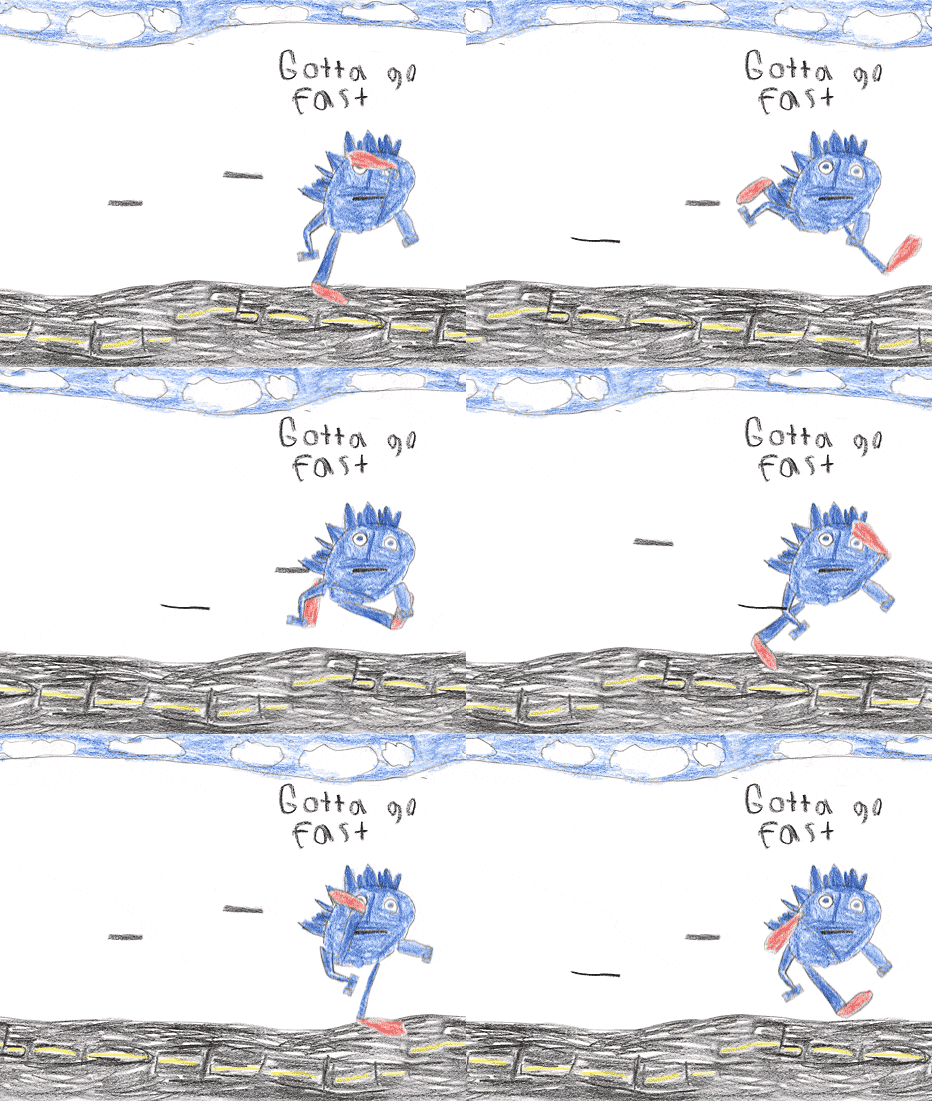
Sonic is too fast. There, I said it.

"Behold my legacy!"

But let’s back up a bit. Let’s go back to what I said a moment ago. I mentioned that I liked Sonic the Hedgehog 4. I liked it because it was like the old games. It featured very similar sorts of levels and bad guys to beat up. It managed to touch on nostalgia without becoming dependent on it. And, most importantly, Sonic’s speed didn’t actually hinder the game play. Just like in the old games.

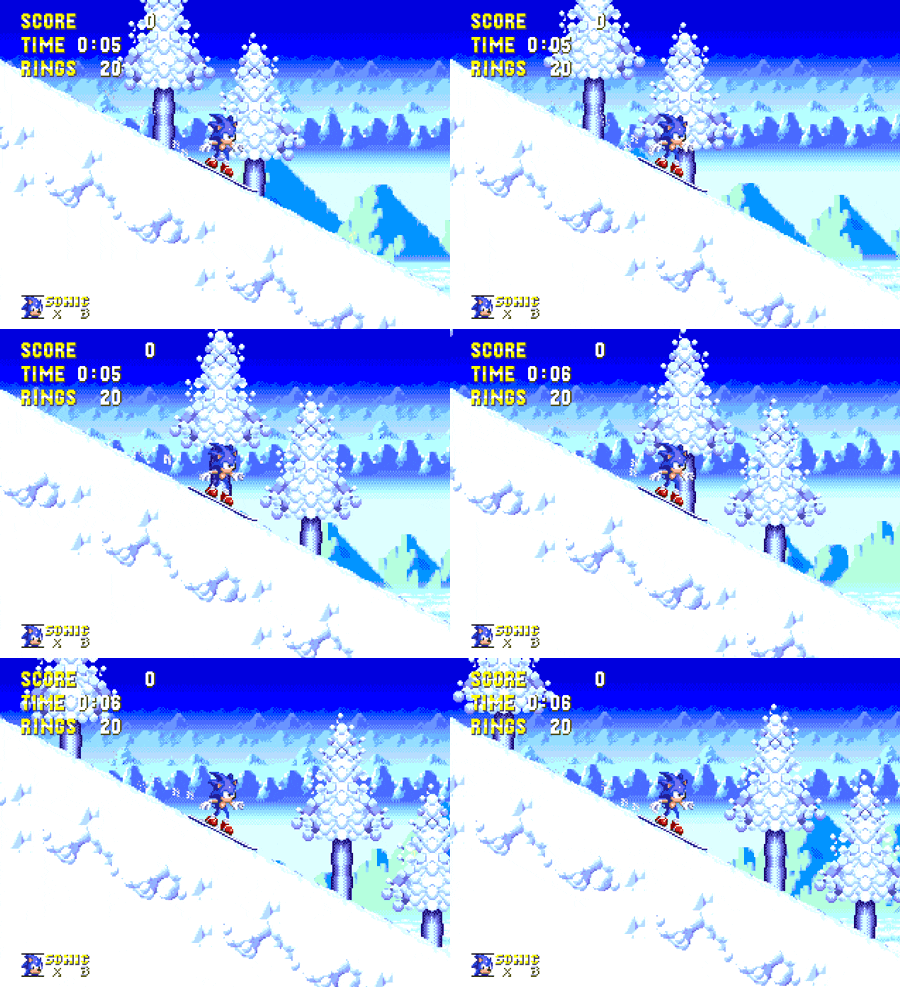
Back in the days when playing a game meant overcoming a challenge instead of just being immersed in a world (see my post on Dark Souls and Zelda for more), Sonic gamers knew that it took a few playthroughs to memorize a level and then blast through it once it was fully memorized. I myself can remember getting through several levels on Sonic the Hedgehog 2 without taking a single hit. Because this was naturally a function of the game, speed was allowed. Or, to be more precise, controlling Sonic’s speed was allowed. Higher scores were granted to the faster players, but knowing when to jump, when to duck, and where to go were more important bits of info to the players than just running to the right real fast. The point of the game became controlling Sonic’s speed so that the fastest playthrough could be found. Add to this different paths through which one could reach the end of a level (as well as hidden traps and goodies along the way) and the fun of Sonic becomes apparent: getting to the end in the fastest, funnest way possible without losing rings or dying.

You poor children will never know the joy!

Fast forward to the newer, 3-D games. We’ll take Sonic Adventure for instance. While a large portion of the game involves playing levels that have nothing to do with speed (such as the Casino stage or any stage played with Big the Cat), those stages that use getting to the end as fast as possible as the mechanical basis for the level design leave something to be desired. The reason is that Sonic’s playstyle is at odds with how humans function. Before, during the 2-D era, Sonic was not too fast to be playable. He operated at a good speed and when he did go fast, that speed didn’t interfere with a player’s attempts to go through the level. The level could still be enjoyed. The mysterious backgrounds and hidden items and special stages (a glorious invention in gaming) could all be appreciated as they were meant to be.

But now? Now the focus is on making Sonic so fast that the games nowadays actually have to help you play them in order to maintain Sonic’s speed. From utterly boring single-lane movement to auto-controlled camera sequences, the 3-D games began letting the tail wag the dog. Cool level design and player experience was all hindered (or worse, sacrificed) to keep up the appearance that Sonic and his games are about speed.

The sad thing is that the cool parts of the old games were never about the speed. What drew me to the Sonic games were the music, the level designs, and the wonder of knowing that a whole world was out there for Sonic to save without being told much about it, which creates a sense of wonder and awe. We get none of that now. We get awkward controls that are either too sensitive to be used well or are so sensitive that the game has to take control away from the player to maintain the illusion that Sonic’s speed is the real name of the game.

I get it, though: speed is Sonic’s schtick, and in the comics and TV series, that schtick works, but it doesn’t work in the games.

So what would work? Athleticism.

Sonic games need to emphasize more of Sonic’s athleticism. The level designs could be revamped so that the platforming action happens via jumps, flips, slides, somersaults, wall-jumping, and all those sorts of things. Things that made Maria Robotnik and the God of War games fun. Speed needs to be taken out. We don’t need to prove that Sonic is faster than Mario (especially since he actually isn’t). We need to show the Sonic world again. We need compelling level designs with intriguing, minimalist storytelling and special stages. And so we need to stop pretending that speed is what the game is about. Having fun exploring the world is what the game is about and has always been about.

Well, maybe he can be a liiiiittle faster.

So….

We can do one of two things. We can keep Sonic sequestered in the realm of 2-D side scrolling. Or we can take Sonic in a whole new direction, one that doesn’t involve streamlining the level designs so that it's easier for players to match their reaction time to Sonic’s. While I certainly want to see more 2-D games for Sonic to dash through, we can do better in the 3-D platform. We can let Sonic be his Sonicky self through the more standard platforming mechanics that have made several series the hallmarks that they are today.

Let’s agree to slow Sonic down before he crashes into yet another gaming blunder and give the blue blur a better way to be a snarky, rebellious freedom fighter.

Let me ask, intrepid, young speedsters,

What critical flaw have you found in the design of a great game or game series?

and

How else have you seen a 2-D game fall short when transitioning to a 3-D platform?

Saturday, June 10, 2017

Dark Souls, Zelda, and the Virtue of Patience


On September 22, 2011, the gaming community got to experience something that it hadn’t felt for a long time: difficulty. I’m not simply talking about a game that could be played on a higher difficulty than usual; I’m talking hard gameplay. Real hard. Not impossible, but still...

Really damn hard.

Pictured: death #487 of your first play through. (source)

The RPG titles that came out in the years leading up to the release of Dark Souls wanted to push the boundaries of what gaming could do. To most developers, this meant overhauling the ability of games to immerse players in a different world. The Elder Scrolls V: Skyrim is the front runner for those games that sought not only to create worlds but to make them believable. The game’s graphics style is impressive to say the least, and the ways in which the game mimics reality are charming. Players are capable of forging their own armor and weapons, cooking their own food, and even marrying an NPC should they have the appropriate necklace to do so. And sure, previous entries allow for just as much detailed gameplay (if not more; the second game in the series, Daggerfall, set records with its level of detail and the sheer degree to which the player’s experience could be customized), but Skyrim takes things to the next level. You sorta feel like you are there, that the world looks organic and behaves organically as well. It still remains a favorite among the gaming community.

It remains a favorite of the modding community as well. (source)

However, Skyrim also took out some features that other games in the series had: customizable spell creation, more specific skill tree leveling for different weapons, and more detailed item enchanting, to name a few. The aforementioned Daggerfall even has skill trees devoted to learning the languages of each of several different creature species within the game. And the map in which the game takes place held the record for years for the largest in-game world based on surface area. (The record was finally broken by Minecraft.) Because of its sheer complexity, Daggerfall is a much harder game to play. So huge is the world and so numerous are the options that the game has to track the player down by making the main-quest-initiating event find the main character, instead of requiring the main character to journey to the right place.

Skyrim doesn’t have that level of intensity in its design, and because of that it is objectively easier. However, while some shake their heads at the comparison, bemoaning the series’ decline in quality due to the loss of complexity, many people think of this as a good change. Consider the paralysis of choice that writer Alina Tugend of the New York Times discusses in her article. When too many choices are presented to a potential buyer of goods, the potential consumer is actually made anxious by the number of possibilities. With a greater selection of goods, the likelihood of choosing the less-than-perfect option is greater as well. For most individuals, this conundrum occurs when trying to choose which deodorant to buy or which meal to order for lunch. But in the gaming community, this sort of complexity can become stifling and simply a chore, and the last thing a game wants to be is a chore.

Usually.

There are other games, ones that remove the complexity of choice and instead introduce the difficulty of exploration, and it’s these games that actually bring people back for more. Consider The Legend of Zelda. The game doesn’t offer much in the way of complexity. While there are a number of ways to attack enemies, the sword you are given at the beginning of the game or one of its upgrades is your bread and butter. Other items, though there are many, are usually only used for specific instances, removing the anxiety of choice. Players don’t really get hung up on how to kill an enemy or how to access certain areas: you either have the best item for the job and use it, or you don’t have it and stick with the options left to you.

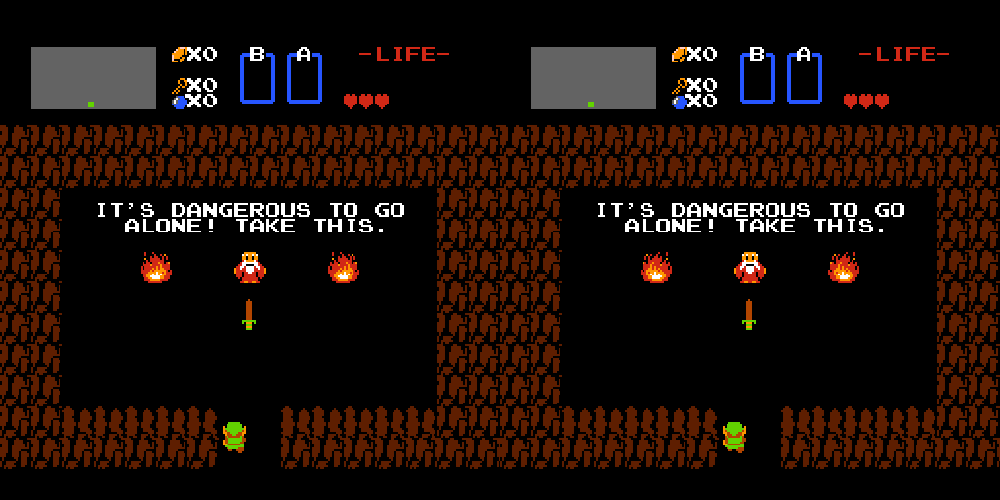
There do exist choices to be made in The Legend of Zelda, however. Those choices primarily revolve around where you want to go. For those of you deprived enough to have never played it (shame upon shame!), the game starts you off on a small rectangular segment of the larger world and tells you nothing. You see a cave at the upper left part of the screen and in this cave you receive the famous instruction, “It’s dangerous to go alone! Take this,” after which you are given your first sword. Now armed, you are free to explore the world.

This beats a taser any day. (source)

And therein lies the adventure. You aren’t told where to go. You aren’t told what items to use. Of the number of dungeons in the game, you aren’t told which one to go to first. You just… go. You encounter enemies as they come. You find what secrets you can. You travel the world as you’re able (‘able’ meaning you have the items necessary to access various places).

The anxiety of choices is replaced by the tedious nature of slow exploration. Each rectangular segment of the world has its own secrets and challenges with few exceptions. You, the player, are almost constantly fighting off some creature or another, and when you die, you appear back at the beginning, tasked with trying to return to where you were before you died (assuming you don’t decide to try your hand at another route). Because of the nature of the exploration and secret-finding the game requires of you (and it is required if you want to get to the end), the bulk of the gameplay revolves around trial and error. Where many games hinge upon being able to beat up enemies effectively and rewarding you with better ways to kill things as you go on, Zelda hinges upon exploring the world to solve the puzzles that hinder your progress. Combat is secondary. Combat is for stopping things from killing you and sending you back to square one. And if you do end up back at square one, you can put another mark down under tries attempted and errors made.

To be sure, the Elder Scrolls series has its share of puzzles and complicated chains of find-this-to-unlock-that-to-go-there sort of challenges. But those quests nowadays are almost handed to the player compared to the sort of work some of the older games of the world required of players. Such was the challenge of The Legend of Zelda, for instance, that I had to look up a guide to figure things out. I just wasn’t patient enough to beat the game on its own terms. (That, and my copy of the game was a borrowed one.)

But despite the challenge inherent in the tedious nature of the game, Zelda remains a platinum-grade classic. No one doubts the influence and pure fun that the game gave to hundreds of thousands of players. As games progressed, the need to continuously try, try, try again remained. Games even began to incorporate the life count to emphasize this. In Sonic games, for instance, players have a limited number of times to try beating a level. If they die or run out of time, they lose a life. Lives can be gained via the collection of enough rings or the finding of a 1-up, but the principle of having a limited number of tries is ever present. Mario did the same thing beforehand, as did Donkey Kong, Metroid, Streets of Rage, and a great deal of other side-scrolling and/or platforming titles.

As time went on, however, and as gameplay mechanics became more complicated and advanced, the point behind games became less about challenge and more about utilizing whatever game mechanics and unique gimmicks game designers could think of. Slowly but surely, customizable gameplay overtook trial-and-error gameplay. Granted, RPGs have been around for as long as any other genre of game (minus classic arcade titles like Tron and Pac-Man), but even then gameplay was about puzzle-solving and strategizing, not straining to figure out which of twenty different skill trees one ought to build up.

I’m not saying that that sort of thing can’t be fun; people get a kick out of it, but for a long time, the kind of difficulty in gaming that only came from trial-and-error progression was missing.

Until Dark Souls.

There’s a reason people have been comparing the Souls series to Zelda (and they have). Both include grueling stretches of trying not to die, both utilize item discovery to proceed to certain areas, both tell you little of the world and its lore, both spawn you back to a designated spot when you do die (Dark Souls is a little merciful in letting that location change with each bonfire you rest at in the game), both feature respawning enemies that behave in semi-predictable patterns.

And both require the patience to keep fighting, keep discovering, keep pushing forward.

Until you discover you're actually playing a JRPG. (source)

This brings me to my ultimate point. The game rewards patience. Patience is an idea that has been largely lost on the audience of most games these days. Quick-saving and/or dying with minimal consequence in the more recent world-exploring games allows for players to play almost seamlessly through a game’s campaign without much hindrance. But for Dark Souls players, getting through various dungeons or boss battles often requires multiple attempts. I still remember the agony of trying to defeat Dark Souls’ bell gargoyles boss battle. It took me nearly thirty damn times to do it. Nowadays I can usually do it in one pass, but I needed a lot of trials to remove the many errors in my play style first. I nearly abandoned the game because of that, though. I nearly put it away for another year, when I would have some gameplay guide or another to help me.

But the one guide I did look up, a video on YouTube, told me not to look up guides to beating the game. Why? Because I would ruin the experience for myself. To look up how to beat a boss or how to get a weapon or what have you—that sort of thing ruins the point of the game. The point is to be frustrated a little. The point is to suffer through multiple deaths and to curse at your TV as you lose an hour’s worth of progress (of which I am very guilty).

The point is to have patience. Though the game features a leveling mechanic, you can’t simply level-up to the point of being overpowered to beat the game. And though the game lets you find weapons and tools that make portions of the game easier, you can’t simply forge or find the best armor or weapon or what have you. You need to work at it. You need to use your brain in ways that most games today do not require of you. You need to study bosses’ moves and take advantage of the memorized pattern. You need to memorize where enemies are and what works and doesn’t work when fighting them. You need to explore and risk losing all the souls and humanities (crucial collectible items in the game) in order to get from one bonfire (the game's form of checkpoints) to another.

See, unlike many action-RPGs today, Dark Souls, like The Legend of Zelda and other such games before it, requires not that you beat the game but that you beat yourself. That’s the game: fighting your complacency and laziness and actually doing work (in a video game of all places) in order to reap the rewards.

If you can do that—if you can beat yourself, if you can tell yourself to get back on the horse—then you’ll have a good time playing the game. It might not always be a pleasant time, but it’ll be engaging and fun. In many ways, playing Dark Souls is like owning a dog: it’s not nearly as easy as owning a pet rock, but it’s much, much more rewarding. And fun.

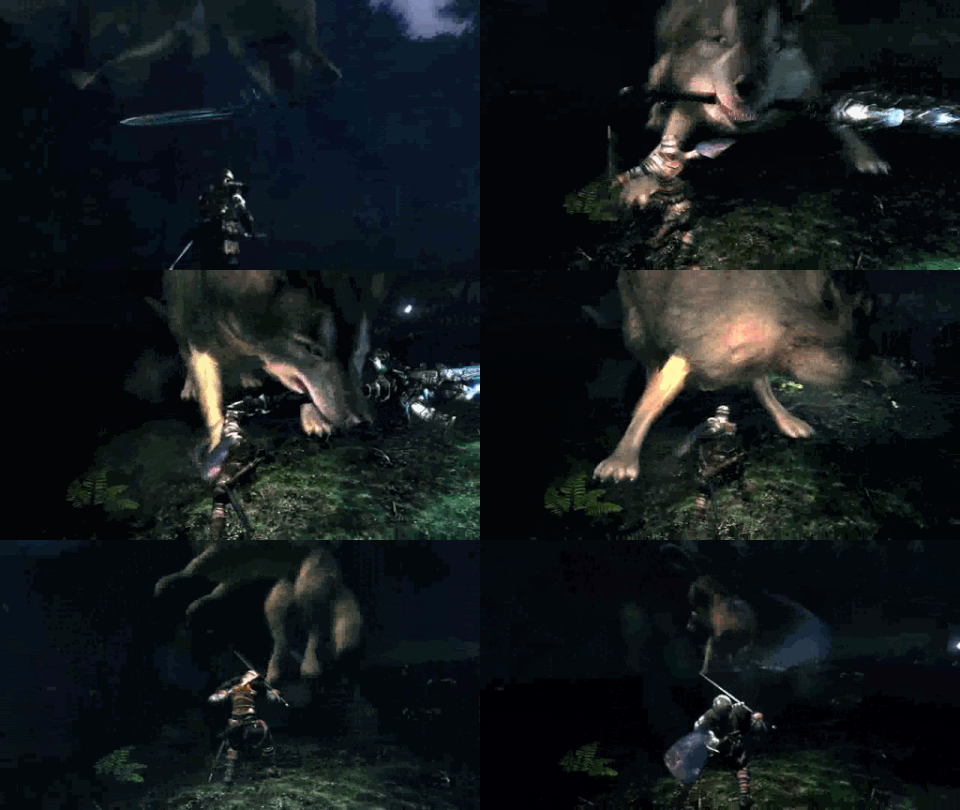
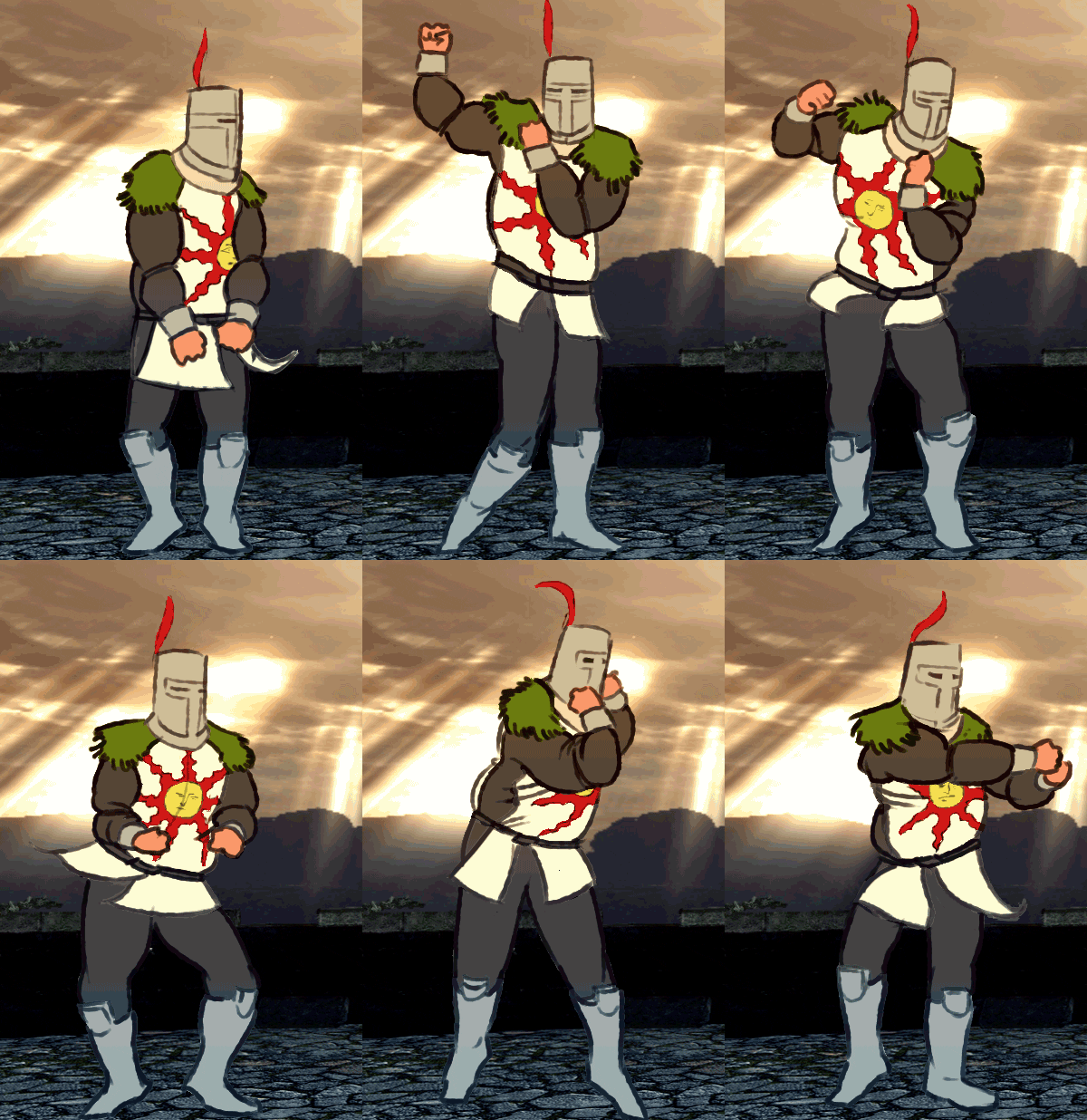
"Praise the sun!" -Literally everyone that has played this game. (source)

Before you go, intrepid young sport, let me ask you:

What games have tested your skills and patience in satisfying ways?

And...

What boss has given you the most trouble of any game you've played?

Thursday, May 25, 2017

May the Fortieth Be With You: Celebrating 40 Years of a Galaxy Far, Far Away


On May 25, 1977, Star Wars released in theaters, effectively changing the sci-fi genre and Hollywood forever. Forty years later, Star Wars is beloved around the world for its adventure story, outer space action, and most importantly the plethora of characters that expand the story beyond the silver screen. In celebration of the 40th anniversary of this phenomenal franchise, we're sharing our favorite characters that inhabit the "galaxy far, far away."

H.A. Titus
When I sat down to write this, I knew I probably wouldn't win any points for originality or geeky cred for picking out an obscure character. But what can I say... ever since I first watched Star Wars when I was a kid, I've loved Han Solo.


True, there are times he's incredibly annoying. Every time I watch the "I love you," "I know" scene, I just want to smack him.

And let's not even start on my dislike of his and Leia's relationship in The Force Awakens. (We'll stick with saying it was pretty much the only disappointment in the entire movie.)

But even when he's around a bunch of Force users who clearly outgun him, he keeps a cocky grin on his face and is always ready for a smart-mouthy quip. His knowledge of the seedier side of the galaxy has saved his friends multiple times. And even though he talks tough, he's there when people need him, ready to do what he has to in order to make sure his friends survive.


It's no wonder that my favorite Star Wars EU novel is Scoundrels (and if you haven't read it, you need to! It's a fabulous science fiction heist starring Han, Chewie, and a whole host of their sticky-fingered friends. Plus the twist at the end is phenomenal), and that my most eagerly anticipated 2018 movie release is the Star Wars Story starring our favorite scruffy-looking nerfherder.

Andrea Weisner
I’ve been a fan of Star Wars as long as I can remember, and as I sit down to write this, I think back over all of the wonderful characters I’ve been introduced to. Many of them have taken turns as my favorite, and any of them would have been a good choice for this collaboration post.

But then I also think of the ones not everyone knows about from the Expanded Universe… many of which no longer are considered canon. And to be honest, even after a few years, it still breaks my heart to see them pushed aside after being fan favorites for over a decade. None moreso than the Solo children: the twins, Jaina and Jacen, and little Anakin. As much as I adore the boys and would love to write about them (someday!), I always find my heart going back to their big sister: the one affectionately known as “Jaya."


In the stories in which they were small, she was the leader and took such good care of them, despite her young age. You could always tell her number one priority was her family. Her brothers’ safety came above all else. But her heart wasn’t all that she inherited from her parents, though. She was an amazingly talented pilot, and the future of the Jedi Order lives on through her.

Being who she was, life was never easy for Jaina, but that never stopped her for long. And watching her grow up and face all that she had to… her story will always stick with me. The story of her and her brothers is one of those heartwarming, heart-wrenching, and so well-written ones, that it makes me want to improve my own writing. I’d say more, but dare not, for fear of ruining the books. You don’t have to read them, but I do ask you to at least consider giving them a chance. As interesting as I find Kylo Ren, these three, especially Jaina, are so much better.

Kristen C.
In any fandom, if there's a sentient robot, there's a really good chance it's going to be one of my favorite characters: Data from Star Trek, Marvin from The Hitchhiker's Guide to the Galaxy, C-3PO and R2-D2 from Star Wars. They're always the funniest, the smartest, the most socially clueless, and, to me, often the most relatable. It's almost as if writers don't believe that combination of sass, logic, and helpfulness can be present in a human being. It can, I promise.


No matter how often my favorite Star Wars character changes (sometimes it's Han Solo, sometimes Boba Fett, sometimes Poe Dameron… you get the idea), I'll always love C-3PO and R2-D2. Their camaraderie and surprisingly entertaining banter through all that they go through is evidence of one of my favorite friendships in the franchise, and the fact that they fight and always make up warms my little robotic heart.

R2 manages to be one of the sassiest and most loyal and dedicated characters in the films, even though he doesn't ever speak. (Well, he makes a lot of beeps and boops, which you could argue is a language, but he speaks no words that we understand.) C-3PO, too, is sassy and loyal, and his constant pessimistically optimistic worldview speaks to me on a deep level. He's always stating facts and missing societal cues and trying to make the best of any given situation, and it's always made me happy to know that someone can be that logical, that oblivious, and still be funny and polite and, more importantly, can have friends. Even if he is a robot.


Travis Craig
My first thought upon seeing FN-2199, whom you might know as TR-8R, was that he stood out. Most stormtroopers aren't worth the dirt they stand on. Their armor is useless and their aim is deplorable. The internet is rife with jokes about it.

But FN-2199....

He did something that most characters don't do.


Most characters in the Star Wars franchise are important because they are made so by their place in the plot. Obi-Wan is important because he is Luke's mentor. The Emperor is important because he’s threatening the galaxy. Several characters are noteworthy for one reason: we’re told they are.

But let me ask: what did Luke do to become so important? Nothing, really. He happened to have some interesting connections, but beyond that he was unremarkable. He’s important because we’re told he’s important. If it weren't for his incidental connections, what would have made him worth paying attention to?

Or, getting back to Episode 7, what made Rey a memorable character? She was in the right place at the right time. She found the one droid in the galaxy intimately connected to the plot. Beyond that, what makes her special?

But look at Han Solo. You know what made Han Solo cool? Everything. He comes into town with a badass attitude and an itchy trigger finger, itchy enough to shoot Greedo. Even if he weren't involved in the story at all, he would have stood out. He made himself important.


TR-8R stands out for the same reason. With a badass-dom rivaling Han’s, he stands up to Finn, unleashes his baton, and beats the daylights out of him. When he was finally struck down, I was heartbroken. Why kill off the coolest character in the movie? And he IS the coolest. He freaking earned it. He didn't need to have special connections or be in the right place at the right time. He isn’t interesting because we’re told he is; he’s interesting because he shows us he is. TR-8R did something. Something captivating. Despite having barely a minute of screen time--if that--he earned what most characters need to be given: intrigue.

I really hope he lives. I really hope he comes back for revenge. I really hope he still has that baton. And I really, really, hope that he gets the story he deserves. Because he earned it.

Tabitha Wells
I was six years old the first time I saw Star Wars. They had just released the limited edition VHS set containing hours upon hours of interviews, and my dad thought it would be the perfect movie to test our new surround sound system on. From the moment the opening credits rolled across the screen, I was hooked. I wanted to live and breathe Star Wars.

A few years later, my parents gave me my first Star Wars EU book—Young Jedi Knights: Lightsaber.


I must have read the book at least fifteen times during the first month; everything about the story and characters captivated me.

There was one character in particular who laid claim to my heart and my imagination—Jaina Solo. Although her twin brother, Jacen, was easily my second favourite, there was something about Jaina that drew me to her.  The most obvious reason was her resemblance in personality and characteristics to her mother, Princess Leia. Leia was the first to become a hero in my mind, so it was only natural the same things leading her to that position for me would also draw me to her daughter.

Jaina was everything I ever wanted to be, combining charm, good looks, wit, cunning, and intelligence into a powerful adversary and Jedi. Loyal, protective, and determined, she laid out the kind of woman I wanted to model my own life after.

Perhaps one of the most powerful connections to this character has been that I essentially grew up with her. Though I was a few years younger than Jaina, she grew as I grew—the books released as she battled her teens and entered into young adulthood coincided with my own timeline.

There was a depth to Jaina I didn’t see in many of the other characters in the EU. While each character certainly was deep and well-rounded, few faced the kinds of struggles and battles Jaina did. Her turmoil and suffering only ever fueled her to become stronger, wiser, and more capable.

More than anything, my obsession, passion, and love for Jaina are what triggered my goal to one day join the ranks of authors responsible for the EU. And, if there is anything she has taught me, it’s that with the right amount of determination, you create your own destiny.

So on this Star Wars anniversary, I raise a glass to the character who lit the literary fire in my heart.

Jaime Heller
When it comes to Star Wars, I have a lot of favorite characters. Just when I think I've narrowed down my list, I'm reminded of another character I adore. If I have to pick just one, I will always say Darth Vader. But since we discussed favorite villains last year for Revenge of the Sith, I'm going to discuss my second favorite character, who is my favorite character of the prequel trilogy: Obi-Wan Kenobi.


It's fitting that Obi-Wan and Darth Vader are my two favorite characters of the Star Wars Universe since their stories are heavily intertwined. That's part of what I love about both of them. Their stories connect and come full circle: Obi-Wan trained Anakin, was betrayed by Anakin, and trained Luke to restore their broken relationship. Obi-Wan puts up with a lot of garbage (no, not just the Millennium Falcon and its pilot) over the course of the Star Wars saga. He's betrayed and abandoned; he loses a lot and sacrifices a lot. But he sticks to his ideals, and he keeps going even after everything. He's dedicated to helping people because he believes in people. He trains Anakin, and then Luke, despite what other people tell him (I'm looking at you, Yoda) because he can see the best in people.

*ugly sobbing* (source)

Obi-Wan is also cool. His lightsaber skills are awesome, and he's actually one of the most powerful Jedi to grace the silver screen. He defeated a Sith while he was still in training, fought Count Dooku twice, destroyed General Grievous, fought his best friend, and more. Plus, there's the sass.

Get 'em, Obi! (source)

Obi-Wan is one of the sassiest characters in Star Wars, if not in pop culture. He likes to make jokes and add a dramatic flair to everything he does. (I mean, come on, who else dramatically dies in front of his ex-best friend in order to turn into a Force ghost to help out his ex-best friend's son become a Jedi?)

#dramaqueen (source)

Obi-Wan is a memorable character for both his wisdom and skills as a Jedi. He's chock-full of humor and has a huge ego. All these traits, and more, make him one of my favorite characters from the Star Wars saga and definitely the best character from the prequel films.

#sassmaster (source)

Sky Destrian
There are a lot of characters I adore in the Star Wars universe--Obi-Wan, Poe, Rey, Finn, and even Anakin--but the one I come back to time and time again is Leia Organa: general, politician, princess, sister, hero.


I often wish I had appreciated Leia more while I was growing up--it’s a longstanding fandom regret of mine. I was exposed first to the prequels, so I often latched onto Padme as my first choice for a female hero to emulate. For whatever reason, I preferred her over her daughter. (Apparently liking both never crossed my mind.)


However, looking back, I remember moments where I still saw Leia as a hero. I loved her in the Battle of Endor especially. I saw her as a strong, competent leader who was able to fight back. When she killed Jabba the Hutt, it taught me that women could have power over their abusers and that we didn’t need to let them hurt us--in a world where I was very afraid of people who might hurt me, that meant a great deal to me.

As I got older, I started seeing how impactful Leia was as a character, both to myself and others. By the time I got to see Leia, I was incredibly lucky to have seen a bunch of kick-ass female role models already. But when Star Wars first came out, that was absolutely not commonplace. Leia was the first of her time, and once I got old enough to realize that, I was absolutely in awe of this amazing space princess.


When Carrie Fisher passed away, it absolutely broke my heart. I still can’t think or talk about it without choking up. Not only was Leia incredible, but so was her actress. Carrie Fisher imbued everything she had into life. She was an advocate for mental illness and a strong, conquering force. She was hilarious, she was witty, she was lovely. She will be greatly missed.

Her legacy as Leia was incredibly powerful for young fans around the world, especially girls who needed a role model to look up to. It was incredibly powerful for me. I will never forget Carrie Fisher, and I will never forget Leia. I will always love that strong, sassy space princess who wasn’t taken in by the wiles of a scruffy Nerfherder (well, not at first) and who grew into a general who commanded an entire Resistance.


Which character from Star Wars means the most to you? Share with us in the comments! And May the Force Be With You!