Showing posts with label Legend of Zelda. Show all posts

Sunday, July 9, 2017

The 8 Greatest Video Game Sidekicks


As a gamer, especially as an RPG gamer, I've come across a few terrible NPCs (non-playable characters) to say the least. But, there have always been a good amount of excellent sidekicks in the video game realm. Here are some of the best. 

GLaDOS from Portal 


Sidekick support: No support, really. Just provides comedic relief in the most hateful way possible.

She’s actually the antagonist of the series. Still, her comedic timing and clever quips make up for her many attempts to kill you, especially since she’s the only one you stay in contact with throughout the entire game. In a way, it's sort of endearing, right? Eh. Maybe not. Though, the amusement factor does help her case tremendously.

Mickey from Kingdom Hearts 


Sidekick support: Second chance and a reliable healer.

Odd, because at least for the first Kingdom Hearts, the AI wasn’t all that advanced and you usually had your sidekicks (*ahem* Donald) rarely help in battle. They would heal you directly AFTER you healed yourself or die within the first two attacks. I'm not bitter. No, not bitter at all.


But the game developers put special care into Mickey (and Riku!). In Kingdom Hearts II, he was the one who would swoop in when Sora died and you had a brief period of time where you controlled him. With all those flips and all that agility, it felt like controlling Yoda. He was even better in Kingdom Hearts 0.2 Birth by Sleep when he fought alongside Aqua. He did a great deal of damage (yeahhh, there was a time when I just sat back and watched him hack away at that life bar) and saved me more times than I expected.

Navi from The Legend of Zelda: Ocarina of Time 


Sidekick support: Information.

Uh, did I say best? I meant worst for this one. No, no. She was fine. Anyone who has played Zelda knows that Link comes across a variety of companions. Navi, the fairy friend in Ocarina of Time is extremely informative, unless you’ve played the game for the 100th time, then she just becomes annoying. I’m tempted to add Midna instead of Navi, but part of me is pleased by the fact that I might trigger some people’s dumbfounded wondering over why I put Navi on my list.

Miles "Tails" Prower from Sonic the Hedgehog


Sidekick support: Two player ability and air support.

I kind of want to include Knuckles here, just because the later Sonic games had him as your sidekick and he was awesome, but the nostalgic side of me, the younger side, the one who had Sonic and Tails, definitely wants to say Tails is the best sidekick. I remember always wanting to try out Tails, at least once because, heck, he could fly!!

Personas From the Persona series


Sidekick support: A manifested personality that evolves from social choices and battle. Also, gives you the ability to fight unseen monsters.

Okay, okay. I have NOT yet played Persona 5 (I know! What a crime.), but I have played Persona 3 and greatly enjoyed it. Two particular characteristics carry over in all Persona games: that your manifested personality, your persona, is affected by social choices throughout the game, and that both shadows (enemies) and personas are broken into tarot card categories, each with their own strengths, depending on real world and shadow world interactions.

Summons from the Final Fantasy series

(source)

Sidekick support: Depending on the series, they could be a form of worship and/or resurrection (FFXV) or perhaps even a connection to the dead and ultimate weapon for the big bad (FFX), but really they’re just beasts/gods/critters you use to battle monsters. Chocobos are included! They have been used as summons before.


Summons and chocobos have appeared in the Final Fantasy series since Final Fantasy III and Final Fantasy II respectively. Summons are ALWAYS a powerful attack, no matter the game, and later, usually have stunning cinematics to accompany them. Besides, the summons tend to repeat throughout the series, yet differ ever so slightly from game to game. Hm, are all final fantasies parallel universes?

Elizabeth from BioShock Infinite


Sidekick support: Emotional investment, complements main character’s personality, and is actually useful.

Bioshock Infinite was brilliant in many ways, one of them being the AI companion that follows you throughout the series, Elizabeth. Finally, a sidekick that doesn't typically die within the first 3 minutes of battle.


Though I won’t delve into the spoiler territory, I will say that having Elizabeth by your side adds not only to the story as a whole but also the gameplay. There are certain instances in the game where Elizabeth will find coins on the ground and chuck them towards you. Thankfully, Booker is a pretty good catch. Again, not venturing into spoiler territory, but she's a key piece of the plot and quite the interesting character.

Pocket/Digital “Monsters” from Pokémon and Digimon


Sidekick support: Best friend! Has emotional/cuddle/battle support.

How could I NOT add Pokémon for best sidekicks? Who wouldn’t want a gaggle of monsters you could carry around in your “pocket” to battle friends or total strangers? I mean, you were able to choose a starter Pokémon, making it seem interesting to say the least. Who would ever trade their starter? There’s a sense of loyalty there.


I also want to add digimon to this list as well. I mean, to have a monster that's tailored to your specific personality and needs, that you could connect with whenever you’re on the internet. After all, we’re always connected to the internet anyway, so you could basically see them 24/7.

Having an NPC that is informative, provides battle support, and contributes to the story and heart of the game is always welcome. They simply make the experience much more enjoyable and feed my fangirl heart, at the very least.

What's your favorite video game sidekick?

Saturday, June 10, 2017

Dark Souls, Zelda, and the Virtue of Patience


On September 22, 2011, the gaming community got to experience something that it hadn’t felt for a long time: difficulty. I’m not simply talking about a game that could be played on a higher difficulty than usual; I’m talking hard gameplay. Real hard. Not impossible, but still...

Really damn hard.

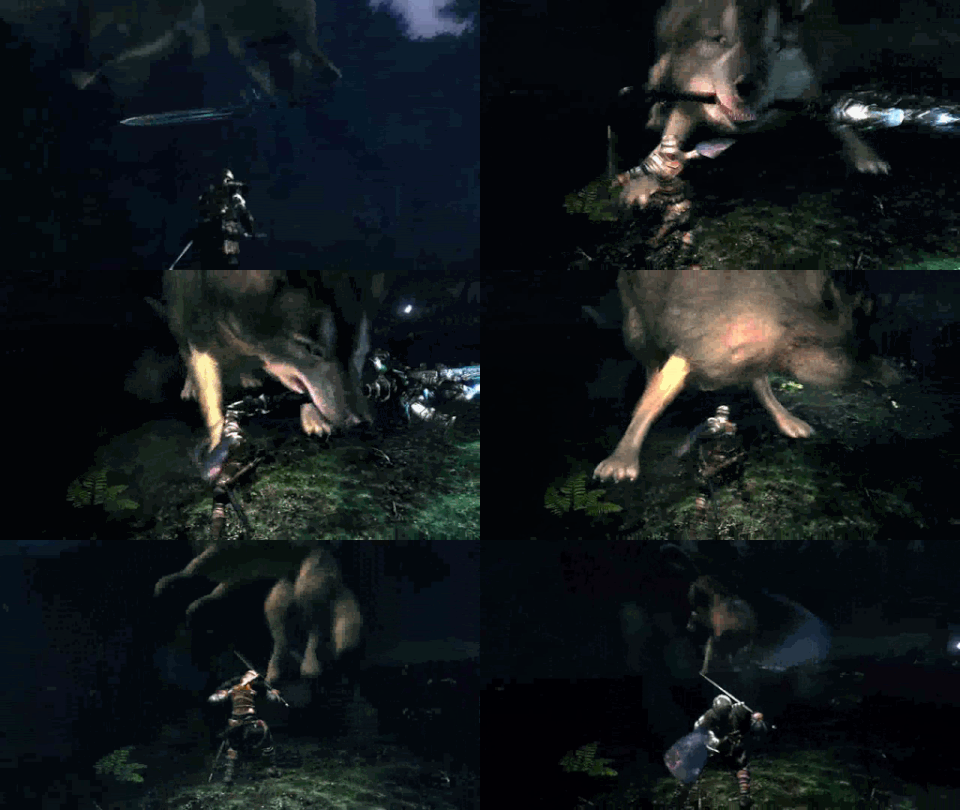
Pictured: death #487 of your first play through. (source)

The RPG titles that came out in the years leading up to the release of Dark Souls wanted to push the boundaries of what gaming could do. To most developers, this meant overhauling the ability of games to immerse players in a different world. The Elder Scrolls V: Skyrim is the front runner for those games that sought not only to create worlds but to make them believable. The game’s graphics style is impressive to say the least, and the ways in which the game mimics reality are charming. Players are capable of forging their own armor and weapons, cooking their own food, and even marrying an NPC should they have the appropriate necklace to do so. And sure, previous entries allow for just as much detailed gameplay (if not more; the second game in the series, Daggerfall, set records with its level of detail and the sheer degree to which the player’s experience could be customized), but Skyrim takes things to the next level. You sorta feel like you are there, that the world looks organic and behaves organically as well. It still remains a favorite among the gaming community.

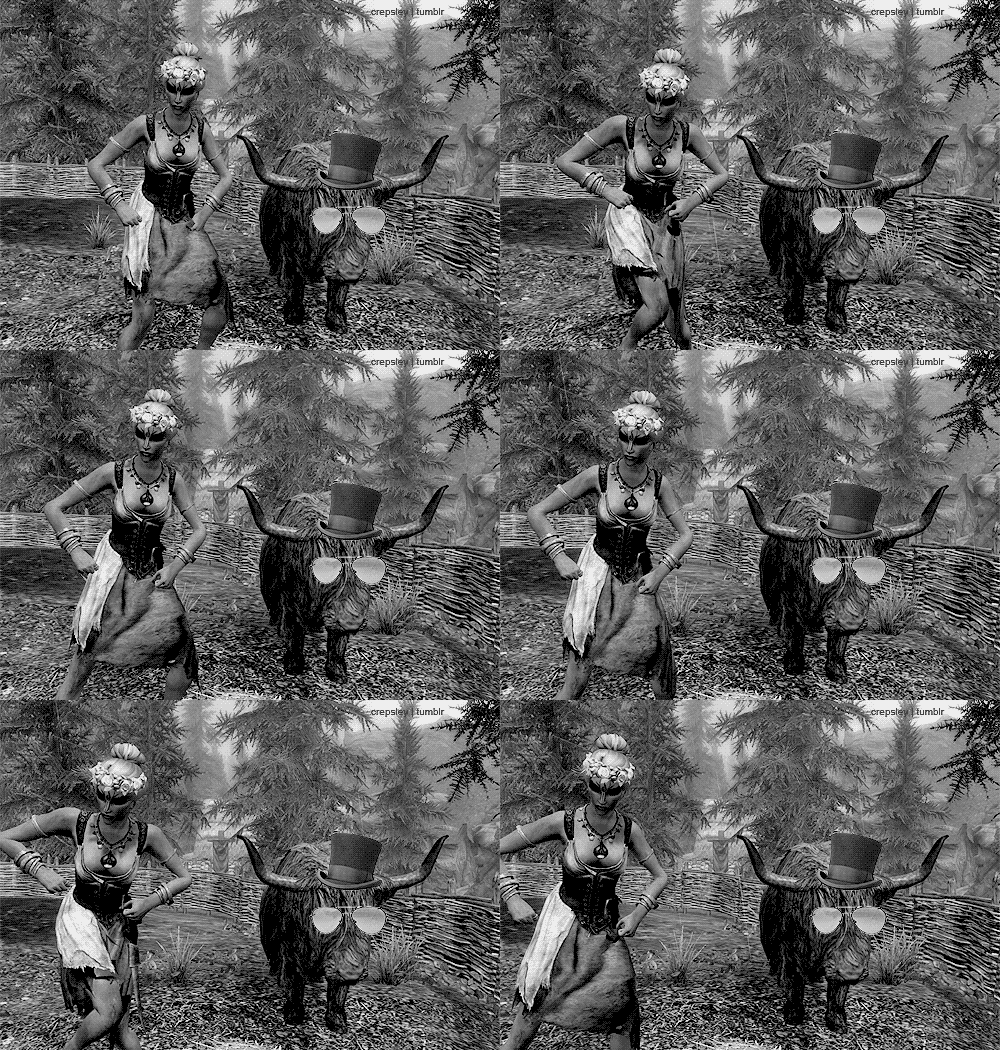
It remains a favorite of the modding community as well. (source)

However, Skyrim also took out some features that other games in the series had: customizable spell creation, more specific skill tree leveling for different weapons, and more detailed item enchanting, to name a few. The aforementioned Daggerfall even has skill trees devoted to learning the languages of each of several different creature species within the game. And the map in which the game takes place held the record for years for the largest in-game world based on surface area. (The record was finally broken by Minecraft.) Because of its sheer complexity, Daggerfall is a much harder game to play. So huge is the world and so numerous are the options that the game has to track the player down by making the main-quest-initiating event find the main character, instead of requiring the main character to journey to the right place.

Skyrim doesn’t have that level of intensity in its design, and because of that it is objectively easier. However, while some shake their heads at the comparison, bemoaning the series’ decline in quality due to the loss of complexity, many people think of this as a good change. Consider the paralysis of choice that writer Alina Tugend of the New York Times discusses in her article. When too many choices are presented to a potential buyer of goods, the potential consumer is actually made anxious by the number of possibilities. With a greater selection of goods, the likelihood of choosing the less-than-perfect option is greater as well. For most individuals, this conundrum occurs when trying to choose which deodorant to buy or which meal to order for lunch. But in the gaming community, this sort of complexity can become stifling and simply a chore, and the last thing a game wants to be is a chore.

Usually.

There are other games, ones that remove the complexity of choice and instead introduce the difficulty of exploration, and it’s these games that actually bring people back for more. Consider The Legend of Zelda. The game doesn’t offer much in the way of complexity. While there are a number of ways to attack enemies, the sword you are given at the beginning of the game or one of its upgrades is your bread and butter. Other items, though there are many, are usually only used for specific instances, removing the anxiety of choice. Players don’t really get hung up on how to kill an enemy or how to access certain areas: you either have the best item for the job and use it, or you don’t have it and stick with the options left to you.

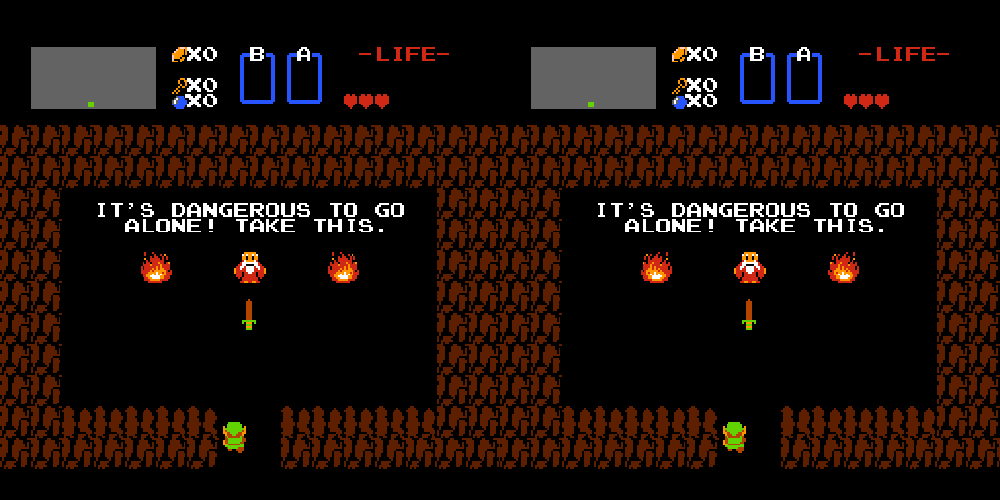
There do exist choices to be made in The Legend of Zelda, however. Those choices primarily revolve around where you want to go. For those of you deprived enough to have never played it (shame upon shame!), the game starts you off on a small rectangular segment of the larger world and tells you nothing. You see a cave at the upper left part of the screen and in this cave you receive the famous instruction, “It’s dangerous to go alone! Take this,” after which you are given your first sword. Now armed, you are free to explore the world.

This beats a taser any day. (source)

And therein lies the adventure. You aren’t told where to go. You aren’t told what items to use. Of the number of dungeons in the game, you aren’t told which one to go to first. You just… go. You encounter enemies as they come. You find what secrets you can. You travel the world as you’re able (‘able’ meaning you have the items necessary to access various places).

The anxiety of choices is replaced by the tedious nature of slow exploration. Each rectangular segment of the world has its own secrets and challenges with few exceptions. You, the player, are almost constantly fighting off some creature or another, and when you die, you appear back at the beginning, tasked with trying to return to where you were before you died (assuming you don’t decide to try your hand at another route). Because of the nature of the exploration and secret-finding the game requires of you (and it is required if you want to get to the end), the bulk of the gameplay revolves around trial and error. Where many games hinge upon being able to beat up enemies effectively and rewarding you with better ways to kill things as you go on, Zelda hinges upon exploring the world to solve the puzzles that hinder your progress. Combat is secondary. Combat is for stopping things from killing you and sending you back to square one. And if you do end up back at square one, you can put another mark down under tries attempted and errors made.

To be sure, the Elder Scrolls series has its share of puzzles and complicated chains of find-this-to-unlock-that-to-go-there sort of challenges. But those quests nowadays are almost handed to the player compared to the sort of work some of the older games of the world required of players. Such was the challenge of The Legend of Zelda, for instance, that I had to look up a guide to figure things out. I just wasn’t patient enough to beat the game on its own terms. (That, and my copy of the game was a borrowed one.)

But despite the challenge inherent in the tedious nature of the game, Zelda remains a platinum-grade classic. No one doubts the influence and pure fun that the game gave to hundreds of thousands of players. As games progressed, the need to continuously try, try, try again remained. Games even began to incorporate the life count to emphasize this. In Sonic games, for instance, players have a limited number of times to try beating a level. If they die or run out of time, they lose a life. Lives can be gained via the collection of enough rings or the finding of a 1-up, but the principle of having a limited number of tries is ever present. Mario did the same thing beforehand, as did Donkey Kong, Metroid, Streets of Rage, and a great deal of other side-scrolling and/or platforming titles.

As time went on, however, and as gameplay mechanics became more complicated and advanced, the point behind games became less about challenge and more about utilizing whatever game mechanics and unique gimmicks game designers could think of. Slowly but surely, customizable gameplay overtook trial-and-error gameplay. Granted, RPGs have been around for as long as any other genre of game (minus classic arcade titles like Tron and Pac-Man), but even then gameplay was about puzzle-solving and strategizing, not straining to figure out which of twenty different skill trees one ought to build up.

I’m not saying that that sort of thing can’t be fun; people get a kick out of it, but for a long time, the kind of difficulty in gaming that only came from trial-and-error progression was missing.

Until Dark Souls.

There’s a reason people have been comparing the Souls series to Zelda (and they have). Both include grueling stretches of trying not to die, both utilize item discovery to proceed to certain areas, both tell you little of the world and its lore, both spawn you back to a designated spot when you do die (Dark Souls is a little merciful in letting that location change with each bonfire you rest at in the game), both feature respawning enemies that behave in semi-predictable patterns.

And both require the patience to keep fighting, keep discovering, keep pushing forward.

Until you discover you're actually playing a JRPG. (source)

This brings me to my ultimate point. The game rewards patience. Patience is an idea that has been largely lost on the audience of most games these days. Quick-saving and/or dying with minimal consequence in the more recent world-exploring games allows for players to play almost seamlessly through a game’s campaign without much hindrance. But for Dark Souls players, getting through various dungeons or boss battles often requires multiple attempts. I still remember the agony of trying to defeat Dark Souls’ bell gargoyles boss battle. It took me nearly thirty damn times to do it. Nowadays I can usually do it in one pass, but I needed a lot of trials to remove the many errors in my play style first. I nearly abandoned the game because of that, though. I nearly put it away for another year, when I would have some gameplay guide or another to help me.

But the one guide I did look up, a video on YouTube, told me not to look up guides to beating the game. Why? Because I would ruin the experience for myself. To look up how to beat a boss or how to get a weapon or what have you—that sort of thing ruins the point of the game. The point is to be frustrated a little. The point is to suffer through multiple deaths and to curse at your TV as you lose an hour’s worth of progress (of which I am very guilty).

The point is to have patience. Though the game features a leveling mechanic, you can’t simply level-up to the point of being overpowered to beat the game. And though the game lets you find weapons and tools that make portions of the game easier, you can’t simply forge or find the best armor or weapon or what have you. You need to work at it. You need to use your brain in ways that most games today do not require of you. You need to study bosses’ moves and take advantage of the memorized pattern. You need to memorize where enemies are and what works and doesn’t work when fighting them. You need to explore and risk losing all the souls and humanities (crucial collectible items in the game) in order to get from one bonfire (the game's form of checkpoints) to another.

See, unlike many action-RPGs today, Dark Souls, like The Legend of Zelda and other such games before it, requires not that you beat the game but that you beat yourself. That’s the game: fighting your complacency and laziness and actually doing work (in a video game of all places) in order to reap the rewards.

If you can do that—if you can beat yourself, if you can tell yourself to get back on the horse—then you’ll have a good time playing the game. It might not always be a pleasant time, but it’ll be engaging and fun. In many ways, playing Dark Souls is like owning a dog: it’s not nearly as easy as owning a pet rock, but it’s much, much more rewarding. And fun.

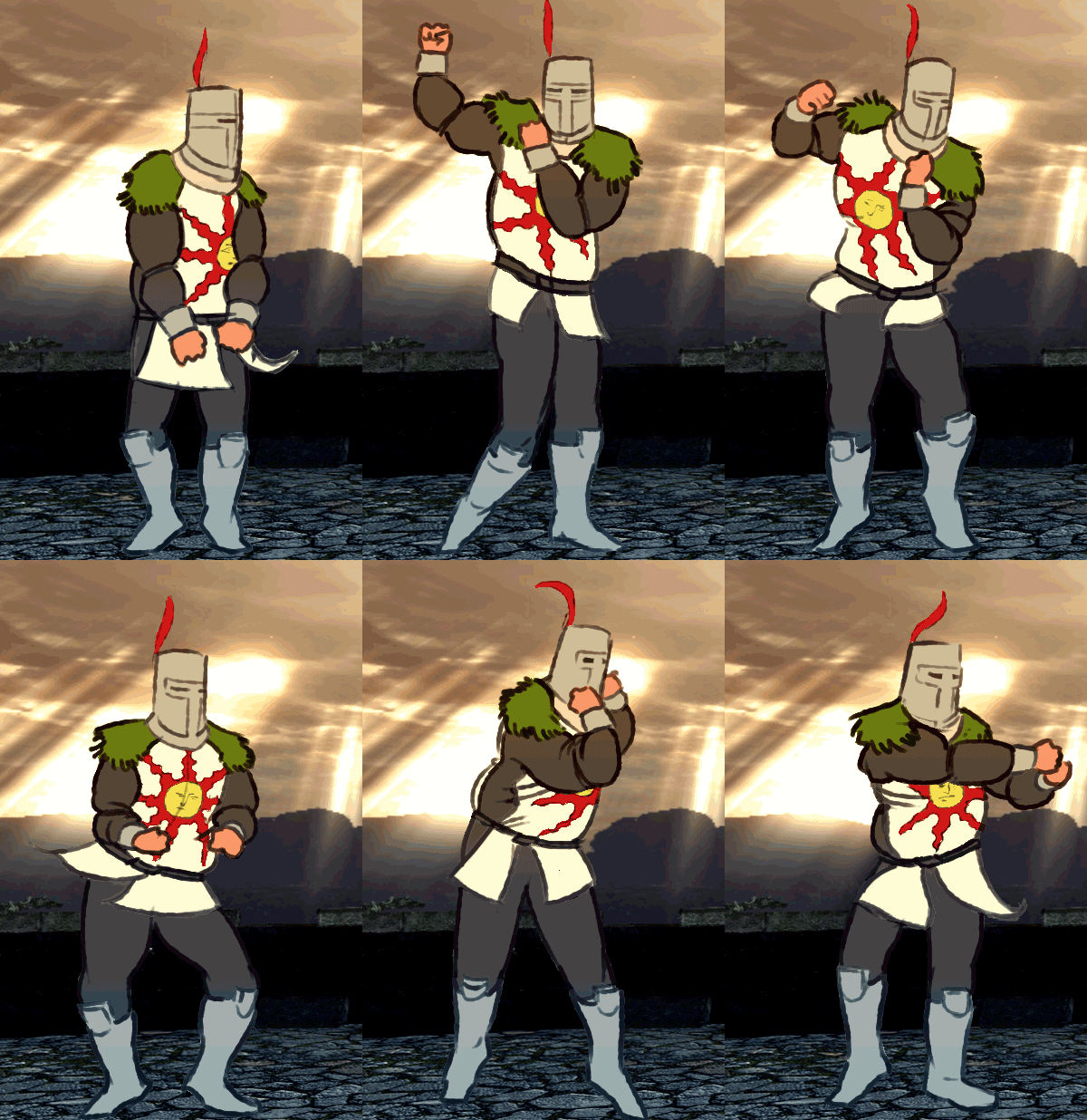
"Praise the sun!" -Literally everyone that has played this game. (source)

Before you go, intrepid young sport, let me ask you:

What games have tested your skills and patience in satisfying ways?

And...

What boss has given you the most trouble of any game you've played?

Thursday, June 8, 2017

A Non-Gamer, Non-Zelda Fan’s First Steps into Hyrule

Before we begin, a caveat: I’m not a Legend of Zelda fan. Or rather, I wasn’t, until I started playing Breath of the Wild last Monday and finished it after four-and-a-half fourteen-hour days of gallivanting about in Hyrule, but this is to say that I am a novice in Hyrule, and have only a little knowledge of continuity or the overarching lore of the series.

But that barely hampered my joy as I plugged my roommate’s (Stephan) Switch into the TV, ready to enjoy my first game in ages. It had been a grueling semester, I had a week off in between the end of classes and going to work full-time for the summer, and I was ready to plunge myself into the world as quickly and as deeply as possible. In addition to not being a Zelda fan, it’s also hard for me to call myself a gamer, since I really don’t play games much because of time constraints, but the heft of a controller still felt familiar in my hands though it’d been years since I’d played a proper narrative game that wasn’t just reflexes or strategy. And so I settled myself on the couch, awoke from a magical sleep, and proceeded to roll, jump, and whistle about this mysterious dark chamber that I (Link?) found myself in.


It didn’t take long to get into the action. There was the tutorial, of course, darting about from shrine to shrine to acquire the tools needed to solve future puzzles while following the instructions of a mysterious old man who yelled at me for stealing his apples but then chuckled and said I could have them, walking through the Temple of Time (still in my underwear—it took me a few hours of gameplay to figure out how to wear clothes) and feeling a strange sense of awe in the crumbled moss, trading clumsy blows with bokoblins while I figured out combat mechanics, but soon I found myself on the roof of the temple with the old man.

Then, with a touch that really made it that sort of electric, galvanizing fantasy, the old man threw off his beggar’s robes and revealed himself as the King. And of course, you knew he was gonna do that from the beginning. Any student of Lord of the Rings knows that any wise old man with a beard is a wizard or king, and if they’re in rags, that just means they’re in disguise—but isn’t there always still that little bit of you that always gets excited when it happens, no matter how obvious it’s foreshadowed? It made me scream quietly to myself at midnight as he sternly asked me—a king does not beg—to undo the evil Ganon had wrought upon Hyrule. And if I only know a little now, I knew nothing then, not who Ganon or Zelda was, not what Hyrule was like, not what Kakariko Village was, but I was still overjoyed to sail out over this bright new world and do my best to right what wrongs I could.

But Breath of the Wild, unlike most Zelda games (or so I’m told), is very open-world compared to the others, and I’m very bad at directions, so I quickly got lost, which wasn’t honestly too bad. After getting a little more introductory stuff out of the way, I headed west to Hateno Village to repair the magical tablet that is your key to the world, but instead of the southern road that would’ve taken me past inns, stables, and to Hateno Village, I took a northern road through a beautiful abandoned city (Lanaryu—it drips so pleasantly off the tongue) and left me on the wrong side of a mountain range. I tried to just say “Heck it, I’m here already” and climb the somehow-important Mt. Lanaryu before backtracking, but it was too cold for Link to climb in just his boxers. Frustrated by that and not wanting to go back and waste an hour in backtracking, I ate sixteen spicy peppers (a trend I believe Skyrim started, heroes gorging themselves in times of need) and clambered half-naked over a mountain and to Hateno Village, a sleepy little town by the sea with the world’s foremost expert in ancient magical tablets.

After short little scene with the expert, a little centenarian who reverse-aged herself to look like a toddler, I was off and set with the simple task of destroying Ganon, who for right now appeared as a plum-colored miasma around Hyrule Castle. And there are people that speedrun the game, flying straight from the tutorial to the final boss and beating the whole thing in about 40 or 50 minutes, which is about the time that it would take me to defeat a single dungeon, But while I knew I needed to beat it quickly, I also wanted to explore it as fully as possible, leaving with as much of a complete image of this world as I could. 

But then there was the thing: I was out of the tutorial and off the rails, and I wasn’t sure what to do, which I think is where the game really began to open up for me. Link as a character is traditionally silent, at least according to my sources, and so, unlike the Final Fantasy series where the main characters have dialogue, Link is a blank slate for you to project yourself onto. In this game, too, he’s not only mute but amnesiac, making his own personality even less of a factor in determining what to do.

My roommate, when he hit this point, started delving into side quests immediately, flitting about from town to town bearing loads of apples or goat butter to make the little people happy. A coworker I know actually did just rush Ganon, which took him about five hours of struggling and sneaking about before his wife told him there was more to the game (he’s a very straight-forward type of guy) and he made a new file to really explore. Myself, I really love exploring, so I hoofed my way across the realm to the top of each tower, which works like how they did in Assassin’s Creed—by climbing to the top, you reveal a part of the map.


That may sound anti-climactic, honestly, if you think of it as a just a stunted form of cartography. But in actual terms, what that translated to was traveling into unknown, fantastical territory, having to sneak past hordes of moblins and wizzrobes tucked behind amateur fortifications or find a way through toxic, boiling mud and bottomless pits to reach the tower, which was always worth it. The view was nice, sometimes the red clay mountains of the Gerudo, sometimes the mosaic of forests and ponds of Hyrule proper, and occasionally there was a person at the top (oftentimes stuck there), but to me, it’s hard to do anything without knowing where you are and what’s around you.

From up there, you could see everything, literally everything—labyrinths, dungeons, secrets of all sorts, and from my seat on the couch I could look out of my fourth-floor window and look out at my sleepy little town, the bar across the street mainly empty, the glow of a Wal-Mart in the distance, and I wonder: what secrets or hidden places lie in my own town that I’ve yet to explore? What side quests or new responsibilities, like new friends or jobs or projects, await me, that I might be able to see from here?

But for now, I put them all away and retreat from the world. I have a kingdom to save and four souls to set free. 

Have your journeys into Hyrule been the same?

Saturday, April 22, 2017

April Showers: Best Fictional Weather Wielders


April is the time of year when rain and thunder mount attacks on all your planned outdoor expeditions. Though at first it can be kind of annoying, I've come to appreciate April's bright white lightning and listening to the accompanying boom of thunder. Lately, I've seen quite a few impressive rainstorms, so it would be most appropriate to speak about my favorite fictional characters who control the weather. Whether these fictional characters control the might of worldwide super-storms or simply the power of floods, each one should be acknowledged. Thus, I present to you the best weather wielders: 

Divine Beast Vah Ruta
The Legend of Zelda: Breath of the Wild


Throughout Breath of the Wild, Link must travel the world and free all the divine beasts from Calamity Ganon’s clutches by solving insanely fun puzzles and fighting angry, chaotic spirits. When Link enters the land of the Zora (a race of fish people), he is told that Vah Ruta (one of the divine beasts) is spouting an endless supply of water that could potentially flood all of Hyrule if it isn't stopped.


Of course, Link saves the day by going inside Vah Ruta (he's mechanical, don't worry) and stopping the beast's magical flow of water. Once saved, Vah Ruta and the other legendary warrior beasts are tasked with the mission to help Champion Link defeat Calamity Ganon once and for all. Since Vah Ruta is one of the few who can truly make a dent in Ganon's might, weakening him just enough so Link has a fighting chance, I had to add him.

Storm
X-Men


X-Men are mutants with amazing abilities, which include the powers to phase through walls and move objects with their minds. Professor Xavier gathers these mutants and trains them to one day become superheroes tasked with making the world a better place. Most of the X-Men, when pushed to their limits, can do insanely powerful things, and with enough control, their powers make it possible for the mutants to save the world.


Having harnessed her power, Storm can let loose flashes of lighting, unleash a torrent of rain, and bring forth loud claps of thunder. If she wanted to, she could even hinder the weather from storming at all, giving her the power to not only control thunder and lightning, but also sunny skies. It's probably the reason why she’s worshiped as a rain god in Africa (so of course she makes this list)!

Thor
Thor and The Avengers


Marvel has a whole slew of people with unbelievable abilities, including a billionaire genius and a used-to-be cryogenically frozen war hero. But Thor isn't exactly a human being... he's a god! One of the first Avengers, Thor hails from another world known as Asgard, and after stumbling onto the planet Earth, he agrees to help the Avengers save the planet (all while wielding his mighty hammer). 


Only worthy heroes are able to wield the Hammer of Odin, a weapon with the ability to summon extraordinary blasts of electric energy, so it comes as no surprise that Thor is included on my weather wielder list. He's able to summon the power of a mighty storm and can even produce anti-force energy blasts that can annihilate an entire world. Besides, in the Avenger movies, he's pretty nice to look at and has some amazing one-liners (YAY Chris Hemsworth).

Vortex
Danny Phantom


Anyone remember Danny Phantom? If not, it's a Nickelodeon show about a boy who accidentally is transformed into a human-ghost hybrid and uses his powers to save the world from spirits escaping from the Ghost Zone. This show was a good part of my childhood, and there were many amazing villains throughout the series.


One such villain was a ghost named Vortex, who not only has normal ghost powers but also has the ability to control the weather, including droughts, hurricanes, whirlpools, etc. He sees his control of weather as a form of art, and is very much full of himself. Because of this, he is completely offended when Vlad and Danny try to stop him from creating "beautiful" rainstorms. Beyond this, he has the ability to control storms on an earth-wide scale, like creating blizzards in the dessert or a mass lightning storm that results in the Eiffel Tower collapsing.

Thunderella Happily Ever After


Ever wondered what happened to Snow White after she received her happy ending? That question is answered in the movie Happily Ever After. Snow White's ending starts off happy enough, that is until the Evil Queen’s brother, Lord Maliss, finds out what Snow White has done to his sister. He hatches a plan for revenge and captures Snow White's prince, so she must flee in order to survive. She eventually finds the Dwarves' cousins, the Dwarfelles, who are appointed to protect her.


Each Dwarfelle has a power that was given to them by Mother Nature. One Dwarfelle named Thunderella has the ability to (you guessed it) control storms. At first, she has a problem with using her ability, but when she’s needed most, she doesn't let Snow White down and creates a mighty thundercloud that rivals Lord Maliss's magic, ultimately saving Snow White from Maliss's evil intentions. Thunderella's courage and stormy abilities make her a perfect addiction to this list.


If you have to be cooped up inside, make sure to check out these fandoms. They may help cure some of your rainy day blues as you await those promised May flowers.

Do you have a favorite weather wielder I didn't mention?