Ghosts might roam through Allerdale Hall, the creepy mansion to end all creepy mansions featured in Crimson Peak, but let’s be honest—the true stars of the show are the costumes. How can spirits compete with ham-sized puffed sleeves and bodices designed to resemble spinal cords? And these costumes aren’t just eye candy; they’re meant to highlight elements of the characters’ personalities, some of which they’d rather keep hidden.
Here’s how the story starts. Edith Cushing, an American heiress, falls in love with Thomas Sharpe, a British inventor. They marry and move back to his ancestral home in the middle of nowhere, England. Lucille, the sister whom he shares the house with, isn’t exactly the welcome-your-new-sister-in-law-with-open-arms type. From the moment Edith and Lucille meet, the film focuses on the conflicts between them and the two worlds they inhabit: the wealth and warmth of Buffalo, New York vs the chilly emptiness of Allerdale Hall.
If that sounds boring, don’t worry. Kate Hawley, the costume designer, says it better.
“Allerdale is bleak, stark, winter, snow, blues and cyans, a world barren, a world of starvation, of nothing. The world of Buffalo is the opposite… and Edith personifies that, she is abundance, the cornucopia, wealth, golds, yellows, rich tones. Edith is the Sun and Lucille is the Moon. Edith is the butterfly… Lucille is the moth.” (source)
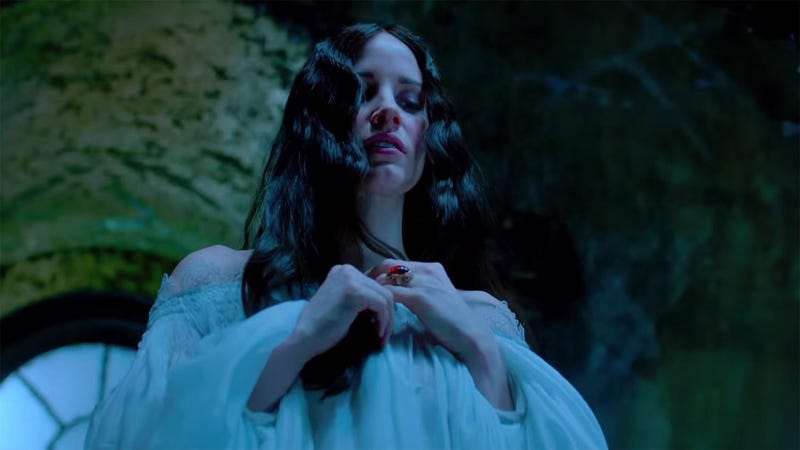
The moth comparison sort of implies that Lucille spends most of her time swooping around in dark, drab gowns. When she first meets Edith, though, she’s dressed like this.
The color is a reference to the secrets buried beneath Allerdale Hall (the locals call it Crimson Peak) and features a spine-like decoration on the back which pops up in every costume Lucille wears. In comparison, Edith wears a cream-colored ball gown. It’s gorgeous and much more modern, but nowhere near as eye-catching. Lucille is an ambassador of an older, apparently more romantic world.
Edith’s dress shares the spotlight in their second scene together. It’s light, billowy, and covered with flowers. There are darker elements to it, including a mourning belt braided with her dead mother’s hair. Mourning belts were a type of Victorian accessory made to commemorate the dead. Edith’s implies that though she looks innocent next to Lucille, she’s no stranger to death.
After Edith marries Thomas and moves to England, places are switched. She’s as out of place in the crumbling and distinctly unromantic hall as Lucille was in Buffalo. At first, she keeps wearing bright colors and attempts to befriend Lucille. It doesn’t go well, and as their relationship escalates from hostile to dangerous, the colors fade.
Vines are always featured somewhere in Lucille’s costumes, symbolically binding her to the vine-covered house. She doesn’t care that Edith genuinely wants to be friends and compares her to a butterfly—in the sense that she’s pretty but weak, and easily killed. Kate Hawley sees it differently. “…she never loses her inner strength—so her wings, the sleeves of her clothes, are bold, expressive.” It doesn’t matter how drab her costumes are—Edith always gets to keep the puffed sleeves.
One of Lucille's dresses. Unlike Edith, she doesn't have very many
(source)
Without giving away too much, Edith and Lucille are only dressed similarly during their final confrontation. And even though you could see this as a leveling of the playing field—that they’re finally equally matched—only Edith escapes Allerdale Hall. Lucille stays bound and trapped in her dark, cold world. It’s probably no coincidence that Edith is compared to a butterfly. In Victorian times, butterflies symbolized the soul, and her courage and strength are the soul of the movie. Outwardly she might seem more fragile, but unlike Lucille, she’s free.
My love of Guillermo del Toro
started with Pacific Rim. The movie
exceeded my expectations in every way. I went into the movie expecting something like Transformers Meets Godzilla and emerged astonished. Sure, there were
robots and monsters galore, but they weren't just robots and monsters. They were Jaegers and Kaiju. Teamwork versus
other-dimensional aliens.
The movie broadened my view of
storytelling and became one of my favorite films of all-time. Let me
tell you why.
• Gullermo del Toro always finds
room for well-rounded characters and character development, even in the midst
of an epic battle between monsters and machines. Colorful, three-dimensional
characters abound. Becket is a disillusioned young man whose life as a Jaeger
pilot was destroyed when his brother was killed alongside him. Mako is a
quiet, eager young woman who desperately wishes she could help fight
but accepts her adopted father's wishes that she stay off the field. Stacker is
a noble leader trying to keep the world from destruction. Doctors Newt and
Herman have a sarcastic camaraderie you'd be hard-pressed to find even in a
typical 'brothers in arms' movie. Even the other Jaeger pilots are creative,
colorful, and frequently deeper than you'd expect.
• There's actual story to this
story. It isn't just machines and monsters beating one another into a pulp -
the movie has heart. It's about
sacrifice and friendship and loyalty and doing the right thing, no matter how
hard - or fatal - it may be. It's about learning lessons and being the best
person you can be.
• The humor is a beautiful thing
in del Toro movies, and Pacific Rim is
no exception. Whether it's Becket's adorable puppy-eyed expressions, Herman and
Newt's back-and-forth snippy friendship, or the small touches like the
post-credits scene, the movie holds a strong sense of humor all the way.
• The design and special effects
are incredible, in no small part to del Toro himself. He insists on having
things be as real as possible, which means most of the sets and Jaegers are in
fact actual props and not just really
good CGI. Plus, he's an extremely involved director and cares about even the smallest
thing, which is why the amount of detail in his movies astounds me.
• The sheer coolness of this movie is hard to resist. Unique, enormous robots
fighting giant, florescent underwater alien-monsters? With swords? And ships?
How can you say no?
• The soundtrack is incredible.
Ramin Djawadi created themes that make you want to go out and take down some
monsters yourself. I'm listening to the score as I type this, and I'm
definitely ready to go kill some Kaiju.
How about it? Are you interested
in Pacific Rim now? Have you already seen it, and if so, what do you think? Are
you as upset as I am that the sequel was shelved? (INJUSTICE!!) Let me know!
Everyone loves a good anti-hero. There’s just something intrinsically-appealing about a monster with a heart of gold: a grizzly bear with a teddy's soul. All sorts of fictional series capitalize on this idea, from John Wayne’s signature role as the gruff wanderer Ethan in The Searchers, to the unstable Illya in the recent Warner Bros. reboot of The Man from U.N.C.L.E. that was just released into theatres.
However, of all the antiheroes that I have ever encountered, there is one character that is about as literal as they come. Allow me to explain (in my usual spoiler-free manner) why you should be looking into the movies based on lesser-known comic book character and literal hero-from-Hell… er, Hellboy.
HogwartsHellboy, A History
Whereas comic-book paragons like Superman or the Incredible Hulk have been around since the 1930s and 60s respectively, Hellboy is a fairly recent newcomer on the graphic novel scene. Created by comic book artist Mike Mignola (who has worked with characters like Daredevil and Rocket Raccoon), Hellboy was published with Dark Horse Comics* in 1993. Since then, it's inspired a handful of video games, animated direct-to-DVD videos, and two live-action films… as well as some impressive intercompany crossovers with the likes of Batman (1999) and supposedly even the Ninja Turtles (1996)!
* Dark Horse comics have included popular sagas like Conan the Barbarian, Joss Whedon’s Buffy and Firefly, and even the adventures of samurai rabbit Usagi Yokimbo. They’re best known for their work with Star Wars… or at least they were until recently, when Disney bought the rights and partnered with Marvel for any and all future comics.
The live-action movies, Hellboy and Hellboy II: The Golden Army, starred Ron Perlman as Hellboy and impressive contortionist/actor Doug Jones (a la Silver Surfer) as his counterpart, Abe Sapien. (There have been scattered rumours of a Hellboy III, but nothing substantial yet.) Both films were considered to be only loosely-based on the comics, since the plots deviated and went in their own independent direction, but fans couldn’t deny that the stories had style — especially with noted director Guillermo del Toro (of Pan’s Labyrinth) at the helm.
Yeah. Some of his stuff gets a little weird.
The Plot
Contrary to what my grandmother originally thought when she heard the title, Hellboy is actually not about a young man who bullies the other kids at school. (I still crack up every time I remember that conversation…)
In the films, the tale actually begins in the middle of WWII, when branches of the Nazi party start dabbling in the occult in order to gain victory over their enemies.
When their collaboration with Russian mystic Grigori Rasputin causes a portal to the netherworld to open, an infant demon is accidentally summoned to earth before Allied troops can close the gateway. In the wake of the battle, the child (nicknamed “Hellboy” by the soldiers) is adopted by Professor Bruttenholm (played by John Hurt, you Doctor Who fans) of the United States Bureau for Paranormal Research and Defense, and raised as a normal child despite his very un-normal appearance.
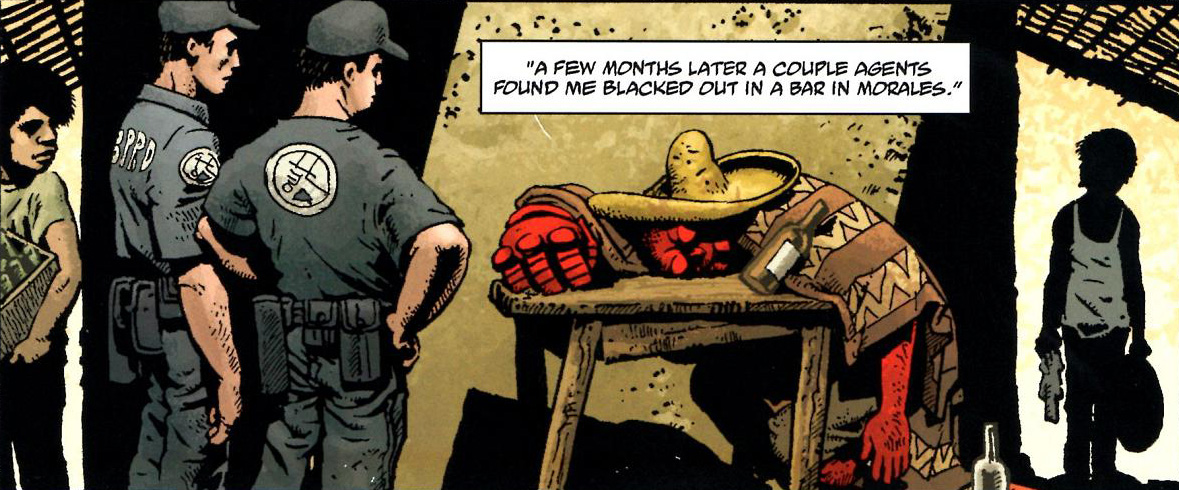
This humanoid demon has bright-red skin, cloven hooves, a tail, a stone "Right Hand of Doom," and two horns on his head, which he keeps filed down as nubs. (Most people think he does it to fit in… in reality, he does it mostly just to fit into doorways.)
Many decades later, the quasi-immortal Hellboy acts as the right arm (get it?) of the BRPD whenever they investigate reports of monsters, ghosts, or anything otherworldly. At his side is the methodical man-fish known as Abraham Sapien…
…and the pyrokinetic human woman, Liz Sherman.
Together, the three of them battle all sorts of creepy-crawlies and keep mankind safely ignorant… all the while trying to run from the fact that Hellboy’s real name is Anung Un Rama, and his birthright is to be the fallen angel supposedly destined to bring about Ragnarok (the destruction of the world).
The Appeal
Much in the same way as the Ninja Turtles, the Hellboy series doesn’t strive too much towards believability, because the creators know that their real power lies in simply entertaining usby mixing ancient mythology with a family of ridiculous misfits.
And thanks to Del Toro, the films are both colorful and clever. Despite some initial pressures about budgeting, the prosthetics and makeup provide a fantastic element of tangible realism to the adventures (which makes the now-aged CGI a bit easier to swallow when it is used). Furthermore, Del Toro crammed the scripts chock-full with snark and wit — which is especially impressive when you realize that English is actually his second language, and not his first!
And on top of that, Hellboy appeals to viewers because of how relatable he is. For one thing, his bloodline doesn’t make him invincible. He may be able to brawl like a literal monster, but he still doesn’t like getting stitched up afterwards. He may carry a big gun, but he’s a very lousy shot (and he knows it).
He may eat over a hundred pounds of food in one sitting, but that food might be nothing but piles of “pam-cakes”. He may argue with his friends for 90% of the time that they’re together, but he’d also lay down his life for them without question.
Hellboy is just as lovable as he is gruff, and that soft side is what draws audiences to him over and over. Because despite his appearance or even his heritage, Hellboy never stops making the effort to be a better person, and he won’t take words from anyone who attempts to look down on him just because of what he was born to be.
The Rating
Hellboy is roughly PG-13, just for one or two adult words and some nasty monster encounters… I’d say it’s roughly in the same boat* as Pirates of the Caribbean.
* Pun not intended, but still very applicable.
Violence: Hellboy does battle with a lot of scaly or slimy bad ’uns that bleed green goo, but every now and then he does encounter an unsettling foe that kills without mercy, and those battles can get intense.
Along with a few creepy undead creatures or cringe-worthy deaths that could feature in Indiana Jones movies, there are also some characters that quote religious texts and use talismans to perform ritual rites. So there’s a slightly-spiritual element to these stories, but for the most part it’s pretty vague and often gets mixed in with sciency-magic and magicky-science.
Sex: There’s not much shown to audiences beyond a few intense kisses, but there are a few creepy stalker characters encountered here and there. It’s probably also noteworthy that some of the major romance storylines occur between characters of different species… so goodness knows what the children could look like.
No, this isn't from Hellboy, but you have to admit,
it's a very applicable Treasure Planet reference...
Language: True to his name, Hellboy has a bit of a foul mouth (as well as a strong taste for beer and cigars)…
…but hopefully [sane] audiences won’t see this red-skinned demon as anything like a role model. And honestly, the closest anyone comes to uttering R-rated words in the series is when a foreign newcomer in Hellboy II has an accent that causes a bit of unintended hilarity.
The Genre
Scooby-Doo meets The Lord of the Rings in this ridiculous monster action-comedy a-la-Men-In-Black, where tooth fairies and giant squids collide with bullets and holy water. Hellboy and his friends may have occasional brushes with death (sometimes almost literally)…
…but the saga mixes religious philosophies into such a blur that viewers can’t mistake the whole combination for anything but fiction. No spiritual agenda here: just an attempt at good fun storytelling. Even the film commentary is entertaining!
So is it worth it?
The Decision
That depends on you. I can understand if the “demon” storyline or oozing monsters aren’t your cup of tea, but they’re not hard to swallow if you’re already a fan of stories like Harry Potter, The Lord of the Rings, or even Thor. There’s no point in worrying about getting caught up, since there are only two films in the series, best seen back-to-back (whereas if you want to start with the comics, then good luck to ya).
Trailers
And if you’re still on the fence, just give it time. There are plenty of trailers on Youtube that might interest you if you’re more of a visual person (like myself). Since there were only two movies made, there aren’t any ultimate trailers, really — but original previews like this one are still worth watching!
Conclusion
In the end, I’d recommend that you check with any of your friends to see if they’ve encountered this series before, and whether they think you’d enjoy it yourself. Personally, unless you’ve got a grandmother who doesn’t want you watching any movies about bullies, I’d say the first film at least is worth a gander.
In fact, I suggest that you make room between Nightmare Before Christmas and It’s the Great Pumpkin, Charlie Brown! during your Halloween movie-marathons this October; this series is a great popcorn-stuffer of a monster movie, and at the center of it all is an antihero with a heart of gold. Hellboy is about a demon fighting to overcome the evil that he was born with… and I daresay we all can relate to that struggle every now and then.