Showing posts with label Character Spotlight. Show all posts

Saturday, June 25, 2016

King T'Challa: The Newest Cinnamon Roll of the MCU


If you're like me, Captain America: Civil War contained a lot of things you didn't expect. A recreation of young RDJ, Vision cooking, and hints of a Pepperony break up... but also, the completely badass introduction of Black Panther, aka T'Challa. I mean, I knew Black Panther would be awesome, but I didn't expect him to be that awesome or for him to completely steal my heart away. 


With his menacing-looking supersuit and his sharpened metal claws, the thing I expected least was for T'Challa to be so pure. I mean, seriously. If you need a good definition of "Cinnamon Roll," just look at T'Challa.


T'Challa went through so much in this film. Not only did his dad die in his arms, but he also became a king. It would be far too easy for him to run away or to be grumpy about it, but instead, he takes on the role with grace. He aims to be noble. He always tries to do the right thing.

Yes, yes, I know. Most of T'Challa's role in Civil War consisted of him chasing after Bucky. However, we see in the end that T'Challa repents of his search for vengeance and chooses not to let Zemo die. (I know that Zemo will come back later to bite him, but whatever. Still noble.) He also chooses to put himself at risk by putting Bucky in cryo, and though I'm sad that it's necessary, I'm so happy that we have another person willing to protect Bucky at all costs. (Also, they've been given the ship name "T'Chucky" on Tumblr, which never fails to make me laugh.)


I totally sense the beginning of a beautiful friendship. (source)

In the end, T'Challa is a cinnamon roll not because he was perfect but because he was good. Though T'Challa made plenty of mistakes, ultimately he regretted them, apologized for them, and did the best he could to make amends. Instead of continuing down his path of revenge, T'Challa acknowledged he was wrong and then promised to do better.

"Vengeance has consumed you. It's consuming them. I'm done letting it consume me."

One of my favorite things about T'Challa is that his very nature seems to be a contradiction--not only is he totally terrifying, but he's totally good too. His dedication to nobility, virtue, and pursuing the right path never once compromises his badassness. As both a lover and a fighter, T'Challa is the male character I've been looking for.


In summary, T'Challa is an honest-to-goodness hero. I'm looking forward to seeing him continue to be pure(ly badass) in his titular movie, Black Panther, releasing in just a little over two years. (No! I don't want to wait that long.) Until then, I'll continue to stand on my belief that T'Challa is one of the best Marvel characters. Not only that, but I'll shout it from the rooftops. Where did I put my megaphone?

T'CHALLA IS A HERO. WHAT A CINNAMON ROLL. TOO PURE.
(Also, he likes cats. Pass it on.)

SAYS THE FALCON.

Why do you like T'Challa?

Monday, December 14, 2015

Six Reasons Why I Love Luke Skywalker

Star Wars: The Force Awakens is coming to theaters in just a few days. And what’s especially exciting about the return of the franchise this time around is that we’ll also get to see the return of the characters from the original trilogy. Of course, fans of the charming mercenary have been buzzing about Han Solo coming back to the big screen, and fans of strong, developed female characters have been eagerly anticipating Leia Organa’s return. But, although there has been some excitement and controversy surrounding what role Luke will play in the film, I haven’t seen too many Luke fans come out the woodwork to say how excited they are to see Luke again just for his own sake. I’m here to remedy that. While I know tons of Han and Leia fans, I don’t get to meet too many people like me who name Luke as their favorite Star Wars character. So I’m here to represent the hero of the original trilogy and give you six reasons why Luke Skywalker is an amazing character.


1. His Personality

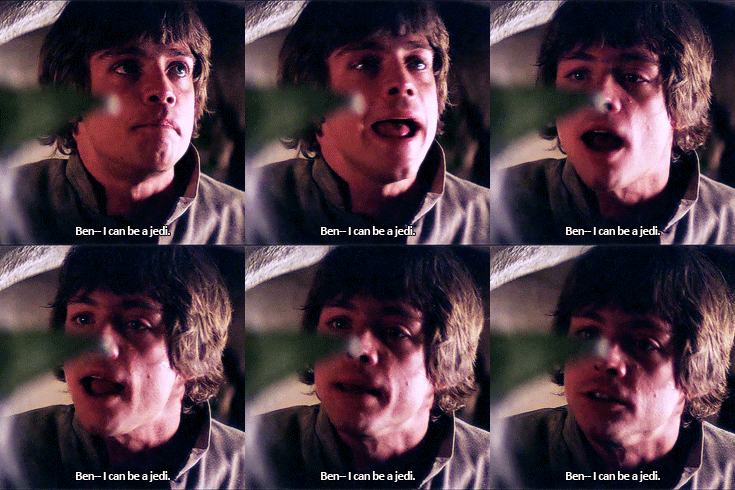
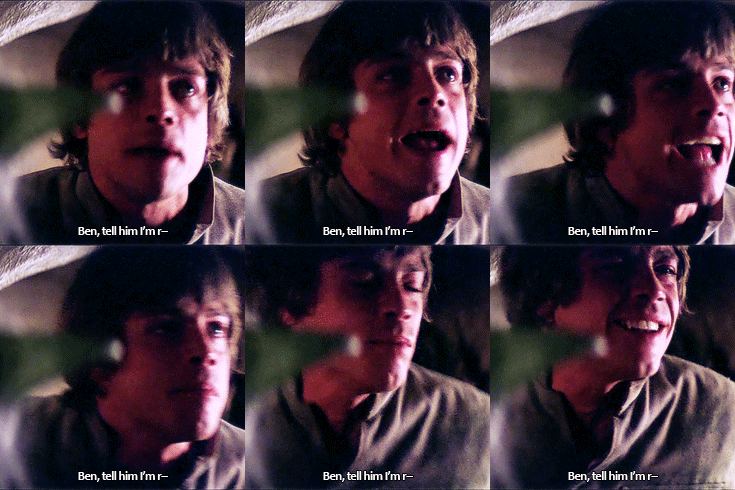
I’ll admit it. I’m a sucker for the sweet, innocent and naïve cinnamon roll characters. And that’s exactly what Luke is. In fact, Luke is the perfect example of a personality type often compared to cinnamon rolls too good for this world – ENFJs. I’ve always been particularly fond of ENFJs. They’re independent, adventurous, ambitious, often bossy, but ultimately driven by an overload of Fe – a cognitive function in MBTI personality types that gives people a constant need to be helpful or protect or save someone. Their Fe is like motivational insanity that can make them disregard all else. “Someone I love is in trouble? LET’S GO. What do you mean I’ll be in danger if I go? I don’t know what danger is. MUST RESCUE RESCUE RESCUE.” It’s very like them to jump blindly into crazy, dangerous situations to save someone else, with barely any thought about themselves or if this is even a good idea – and then win. And then, after they’ve won, to not even really notice that they’ve won, or realize the insane odds they just beat. “JUST AS LONG AS LOVED ONE IS SAFE.”

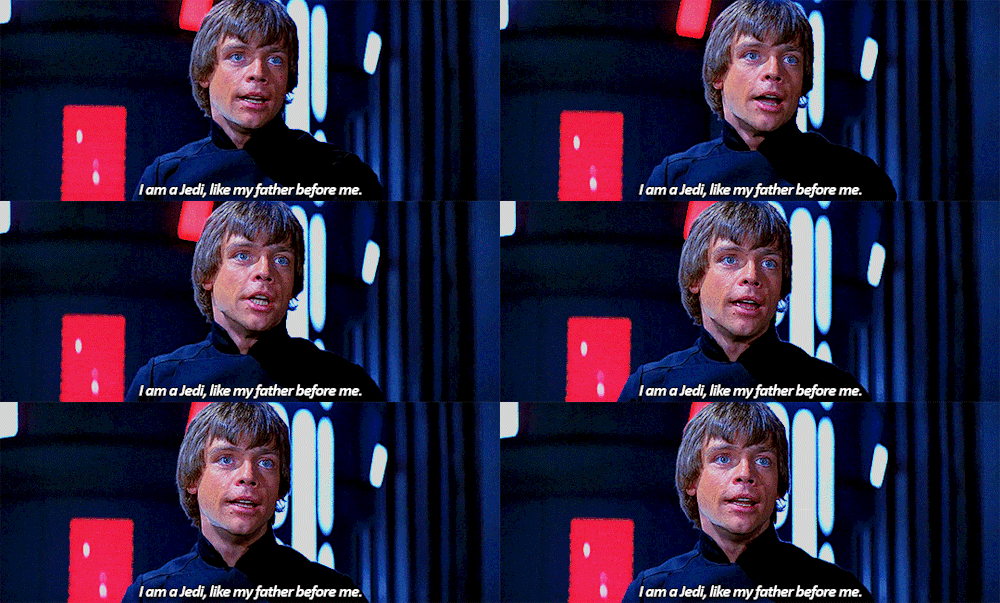
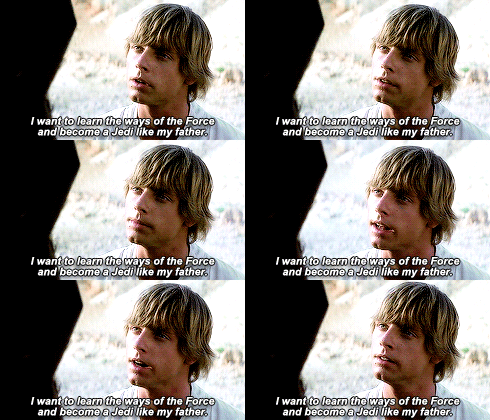
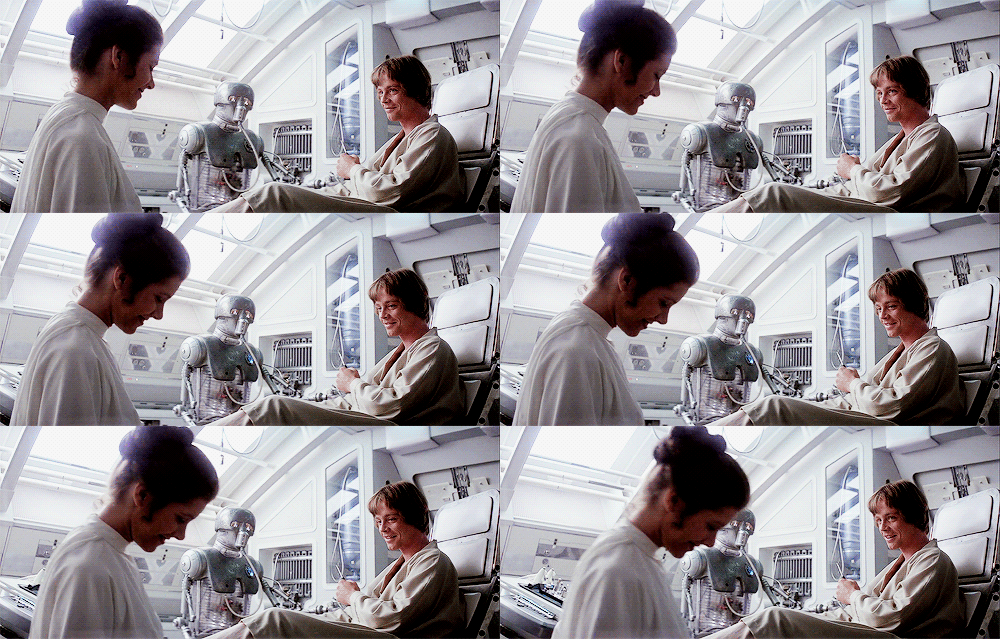
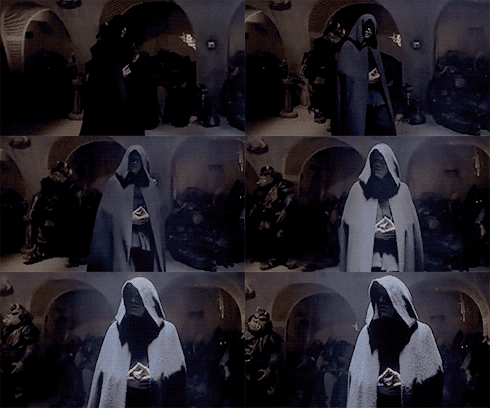
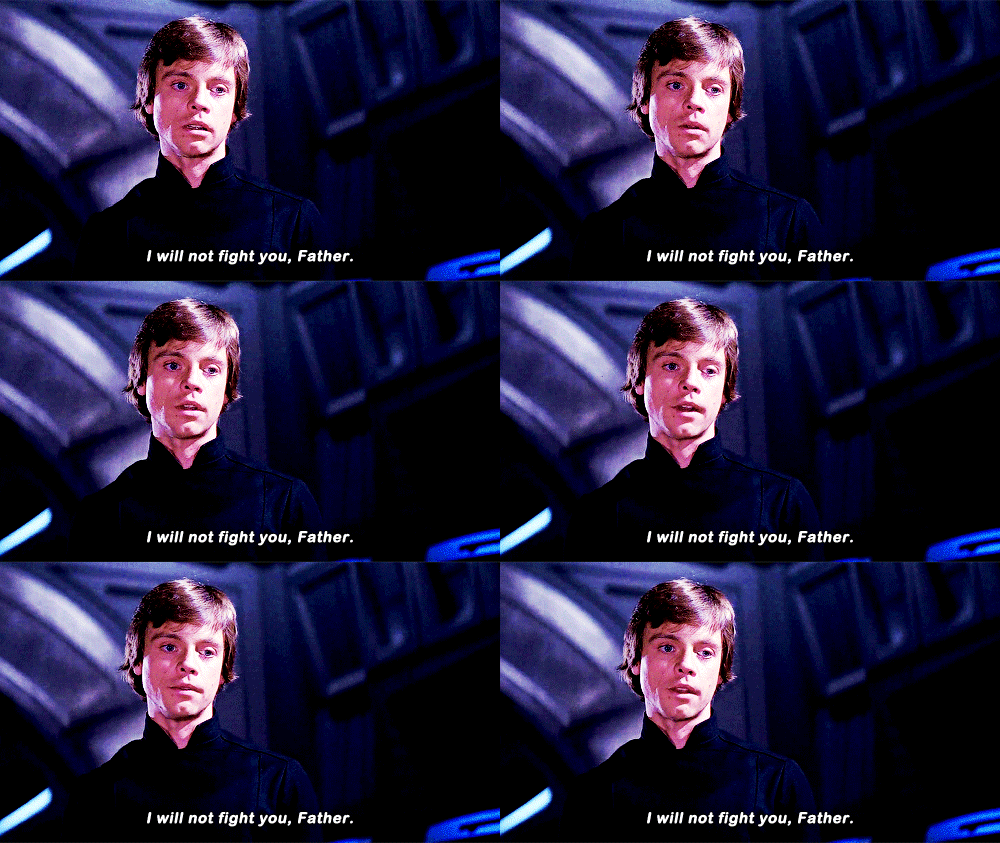
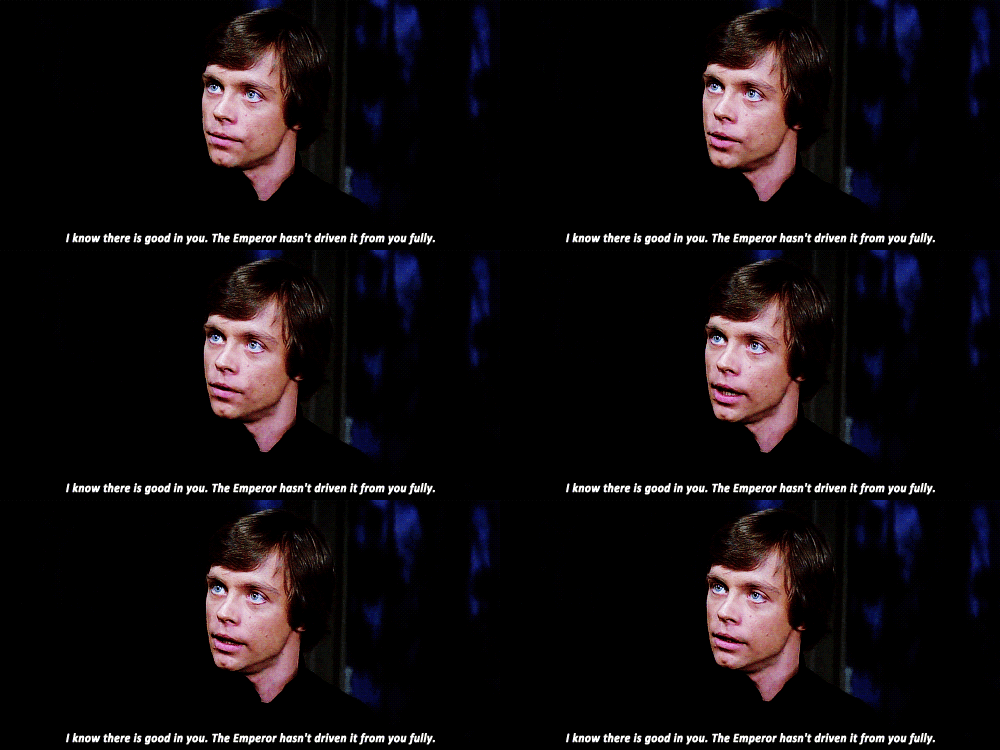
In fact, Luke is one of the most Fe-ish characters I’ve ever seen. He’s basically the ultimate burning emblem of Fe, unashamedly driven and consumed by it. I mean, there are characters out there who appear more Fe-ish. Characters who are more outwardly warm and parental and whatnot. But no one else is so ultimately defined by their Fe, with their identity and motivations so rooted in Fe, as Luke is. Whether he’s going off on a crazy mission to please his new mentor Obi-Wan and honor the memory of his father, disobeying Yoda’s instructions to go rescue his friends, temporarily risking going to the dark side out of a desire to protect his sister, or choosing not to fight in order to redeem his father, everything he does is ultimately motivated by his desire to please or protect someone else.

(Source: skywalkcrs.tumblr.com)

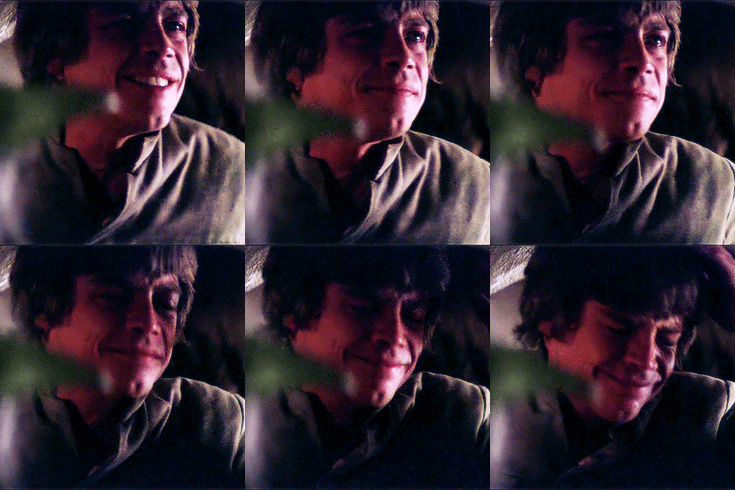
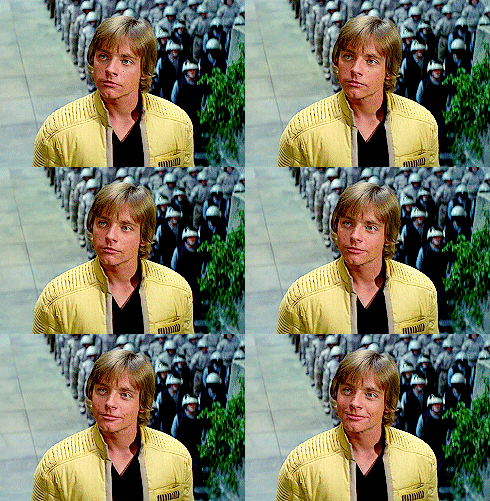
I’ve seen Luke accused of being all sorts of things from “whiny” to “clueless.” And while I think I know where such accusations are coming from, I’ve gotten a slightly different impression of such things. What’s more, they are very in line with what one would expect from someone of his age in his circumstances. Luke is very young, and he’s never known life outside the chores and everyday drudge of work on a farm. He’s an extrovert growing restless after being forced his whole life to cope with the very solitary life out in the desert.

(Source: luciusmafoy.tumblr.com)

The only social life he’s known are the few people he’s run into at Tosche Station, most of whom (as we’re shown in a deleted scene) aren’t very interested in talking to him. He doesn’t understand people yet. He’s spent his entire life extremely sheltered by his aunt and uncle. And his lack of experience causes him to be very naïve, often treading into “endearingly stupid” territory. Luke is still trying to fully understand the world he’s been placed in when tragedy suddenly throws him into a new one.

(Source: winchestheart.tumblr.com)
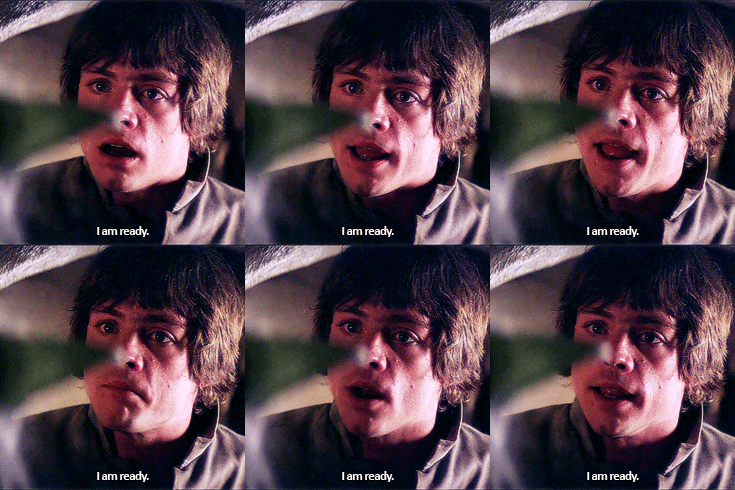
(Source: ianmckllen.tumblr.com)

He doesn’t face this new world with snark and narcissistic overconfidence as the case is with many protagonists these days (e.g. Iron Man, Captain Jack Sparrow, Star Lord, etc.), but he also doesn’t just wander around helplessly, wide-eyed and wonder struck. He shows initiative, though often in all the wrong ways. He has a very Gryffindor-like zeal, wanting to help, but instead being bossy; wanting to prove himself, but instead rushing head-first into situations he doesn’t understand yet. He grows and learns in a very hands-on way, making mistakes along the way.

(Source: Tumblr)

The amazing thing about Luke is, despite all his naïveté and inexperience, he still manages to win just with sheer determination. From Han and Luke winging their way through their rescue of Leia, to finding a tiny weakness that can blow up the entire death star, to ewoks destroying the empire’s AT-STs, a common theme in the Star Wars movies are big, powerful things being defeated in the humblest of ways. And Luke embodies that theme so much, which I love. As one of my favorite Tumblr quotes about Luke says, “God, he’s so young. Like this impossible creature of wisdom and naïvete. Luke is just so much: fierce and over-earnest and full of zeal. Drawling smirking mercenaries are easier to love; Luke is something else.”

(Source: godyoutalkpretty.tumblr.com)


2. His Unique Character Arc

All fictional characters fit into some kind of classic trope. Some character follow the pattern of that trope to the letter, while others find a way to break that pattern and add something unique to the mix. Either of these can be done well. For example, Han Solo fits the “charming rogue who secretly has a heart of gold” trope. It’s a very successful trope in fiction, and Han Solo becomes a good character by following its pattern pretty much to the letter. There’s not really anything unique about his arc, per se. It pretty much feels like the same thing as always. It’s “the same thing as always” done particularly well, but still the same thing as always. So, there’s definitely nothing wrong with following the pattern of a trope. Having said that, I find it much more interesting when a story finds a way to be surprising and throws in something unexpected.

Luke belongs to the “young everyman who gets caught up in a hero’s journey” trope. But his character arc goes against this trope’s pattern in many ways, becoming something very unique. Besides some unique elements about his character arc that I will discuss later in the article, examples include the following:

• While most adventurer MCs are reckless because they are always living in the present moment, never looking ahead or considering consequences, Yoda says Luke is reckless for the exact opposite reasons – because he is always looking ahead instead of paying attention to the moment at hand.

(Source: leialuke-archive.tumblr.com)

• Even though most main male characters “get the girl” at the end, the girl he loved ended up being his sister and fell in love with someone else while he remained single until the end of the films.

(Source: daisyrildey.tumblr.com)

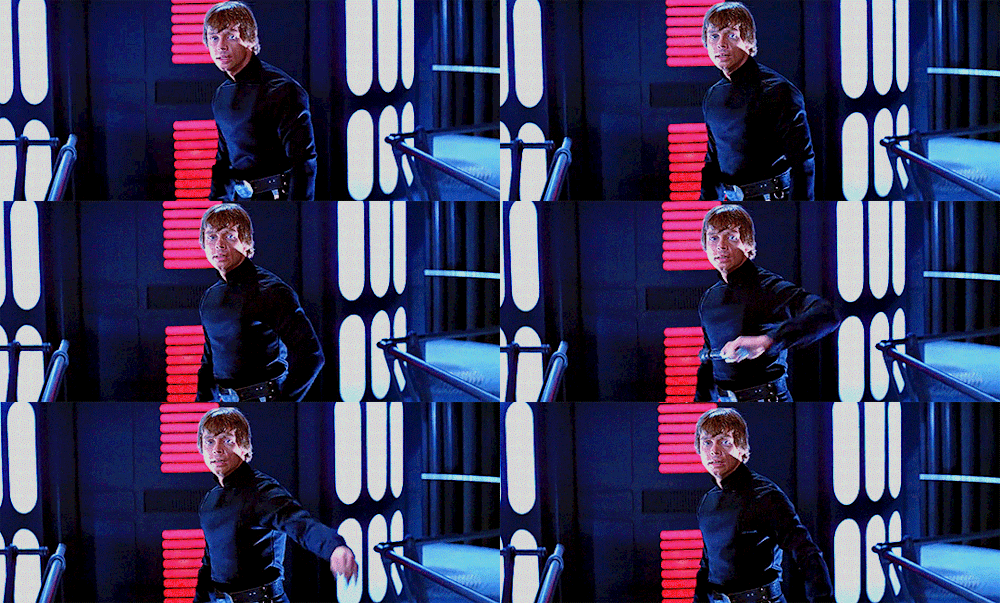
• Even though he’s an action hero, he wins by choosing not to fight, and instead chooses to save the villain so that the villain will send his own evil empire crumbling down.

(Source: skywalkcrs.tumblr.com)

Not only is his story done well, it goes in places you don’t expect.


3. His Complex Motivational Arc

Luke has one of the most tumultuous motivational arcs I’ve seen in an action/fantasy franchise. His Fe (and, along with it, his life purpose) is constantly being forcefully shifted without any way for him to stop or control it. Hardly any time passes before it ends up shifting yet AGAIN. For example:

• Life Purpose: Please his aunt and uncle.
• They die.

• Life Purpose: Please new mentor, Obi Wan.
• He dies.

• Life Purpose: Honor the great legacy of his father by becoming a Jedi.
• It turns out his father’s legacy was a lie. His father is actually evil and trying to kill his new friends.

• Life Purpose: Save new friends.
• It turns out trying to save new friends just makes things worse, and they are all about to die and there’s no way he can stop it.

• Life Purpose: Redeem father who has turned evil.
• Success? Yes!!! What to have as a Life Purpose now? …Ah! I know!

• Life Purpose: Protect newly redeemed father.
(Seriously, Luke will stay on board a ship he knows is about to be destroyed just to stay by his father’s side.)


…And he dies.


Characters are so often defined by their goals in stories, it’s interesting to see someone whose goals constantly change. Instead of knowing Luke by what he’s trying to do, we get to know him simply as a person and take the journey with him as he navigates his own ever-shifting agenda.


4. His Mystery and Morally Ambiguous Virtue

Previous readers of this blog might have guessed during my Star Wars Commentary that I’m not a huge fan of the Jedis or their philosophies. I’ve already talked a lot about how they deny vital parts of humanity and how they have displayed hypocrisy, impatience, and unfair judgment. But while I’m not personally fond of how this whole religion about the Force works, it does serve to make Luke’s story really unique. What it ends up doing is making Luke a morally ambiguous character, despite the fact that he doesn’t make morally ambiguous choices. Even though he’s good, he isn’t what the other good characters want him to be. And there’s such a question mark over whether he’ll ultimately be on the light or dark side. When I try to envision Luke’s morality or potential path before he’s tested by the Emperor, it’s like looking at Schrodinger’s Cat. But instead of shifting between good and evil, it feels more like it’s shifting between absolute good and good/evil. The possibility of evil in him is so small and yet so present. And the good in him is so solid, so indestructible, that if he did turn evil, I know it would be his desire for good that would lead him there and the purpose of his evil actions would be to bring about some good.

Most characters become morally ambiguous because of their questionable ethics – acting selfish, lacking empathy, employing trickery, or sacrificing other people for the “greater good”. But Luke isn’t any of those things. His main drive is selflessness and empathy, he’s honest and open, and his main “fault” in the second film was that he wouldn't sacrifice others for the greater good. And that’s what I find so interesting: Luke is morally ambiguous not because of how his own morality is set up but because of how the morality of this world is set up – their religion and the nature of the Force. And according to that religion, Luke’s ideals are gray in what is otherwise a very black and white world. And even though it’s a good gray, just the fact that it’s not what this world considers “white” puts him at risk for becoming what this world considers “black”.

(Source: twinklingbucky.tumblr.com)

Since this world’s version of morality is built on the idea that some virtues (calm temperament, clarity of mind, a strong connection the universe around us) are good while other virtues (passion, love, loyalty to friends, a sense of adventure) are bad and places ideals above people, the rightness of this world’s morality is at least subjective. We have to remember that just because a “wise” character on the movie says something is right or wrong, that doesn’t mean we, the viewer, have to take their word for it. Their right might actually be wrong, and Luke’s right could be correct instead. Or they might both be wrong. Or a mixture.

Because Luke has been made into a gray character who can easily tilt into white or black territory, this makes him something of a wildcard. You don’t know what side he’ll ultimately be on or even what side you really want him to be on. Personally, I want him to always just be on his own side. The dark side of the force is obviously evil. But the light side, I think, is pretty misguided. Whereas, I believe in Luke’s grayness.


5. His Neutral Good Alignment

One thing that makes Luke’s story so interesting is it’s one of the few I‘ve seen that actually explores the complex nature of the Neutral Good alignment. Neutral Good people have their own code of virtues (usually rooted in Fe – justice, mercy, and helping other people) and their own personal goals based on that code. Unlike, say, Chaotic Good people, they do their best to reach their goals while still working within the law or within the moral framework of the people and culture around them. But at the end of the day, if that law or that framework stops them from reaching their goals, they won’t hesitate to step completely outside those boundaries and do what they believe needs doing. While they greatly respect other people’s morality and will honor it if they can, their own code ultimately takes precedence over other people’s.

Neutral Good is very interesting because it’s very independent and somewhat rebellious but never too morally questionable. And that’s not an alignment I see portrayed well too often in media. Usually the characters I see in mainstream media are one of three extreme things. Either they’re a very righteous Lawful Good hero who stands up for always following the law to the letter and respecting/obeying people in charge of you and believing 100% in the ideals your betters teach you; or they’re a standard Evil villain who crushes all goodness while pursuing their own evil desires; or they’re some really extreme Chaotic Good/Chaotic Neutral character, dripping with rebellion and snark, breaking every rule they can while still being vaguely on the side of good (or at least having a lot of redeemable qualities). Neutral Good, on the other hand, is this calm, quietly rebellious alignment situated right between the Lawful Good and vaguely good Chaotic ones. It’s not, in any way, an extreme. And I think that’s why most filmmakers either don’t think about it or just aren’t interested in it. Since it’s not an extreme, they think people won’t take to it. But it is far more real and complex than the extreme alignments in my opinion, and way more interesting than people give it credit for.

Like most Neutral Good people, Luke isn’t really driven by loyalty to any side or by any ideology. He’s driven solely by his personal moral code, his desire to help/save people, his Fe. It drowns out all the issues for him that most other characters in this universe think about, such as politics and war and loyalty to certain philosophies. In fact, one really important thing about Luke that a lot of people don’t realize is just how apolitical he is. I’ve read/watched a lot of interviews about the creation of Luke’s character. And one thing that was apparently really important to the cast and crew to drive home is how little allegiance he has to any particular side. Unfortunately, a lot of the scenes they made to drive this home to viewers had to be cut due to time constraints. But one scene even showed Luke considering joining with the Empire because he had a friend who had done so. He didn’t care or stop to think about the philosophical implications of joining the Empire or helping them do what they do. All he knew was that he cared about his friend and wanted to join up with him.


And ultimately, it’s the same with his joining up with the rebellion and the Jedis too. He doesn’t have any particular passion for their cause or beliefs. In fact, all he knows of them is what Obi-Wan told him in one short conversation he was barely paying attention to. All he knows is he cares about Obi Wan and wants to follow him, and he cares about his father (or what he believed his father to be at the time) and wants to do something that would have made him proud. Luke isn’t about politics or ideologies or taking sides in anything. He’s willing to join up with a side, but deep down, his heart isn’t loyal to that side. And the only reason he joins up with a side in the first place is because someone he loves has done so and he wants to follow them so he can be around them or help/protect them.

I think the scene where the Emperor tries to turn Luke to the dark side but Luke resists the temptation and helps redeem his father instead is one you really have to watch in light of all that. A lot of people don’t, and I think that leads them to misunderstand the scene. A lot of people think, “Luke is a good guy but also kind of reckless and didn’t always listen to Yoda when he should. He makes mistakes, such as the time he was supposed to stay and train and instead went off to save his friends. But when tempted by the Emperor, Luke ultimately resists. Instead, he chooses to embrace the teachings Yoda taught him and accepts the way of the Jedis, helping redeem his father in the process.” While some of that’s true, it’s also much more complicated than that. While Luke does become a Jedi, I think he still has not fully embraced their philosophies the way Yoda would have wanted and instead still relies on his own moral code. In fact, in this regard, I don’t think Luke is particularly changed by the end of the movies. For example, if he was again presented with the choice to stay for more training as Yoda wishes or go save his friends, I believe he would once again choose to save his friends. He still has the same mindset and priorities he’s always had.

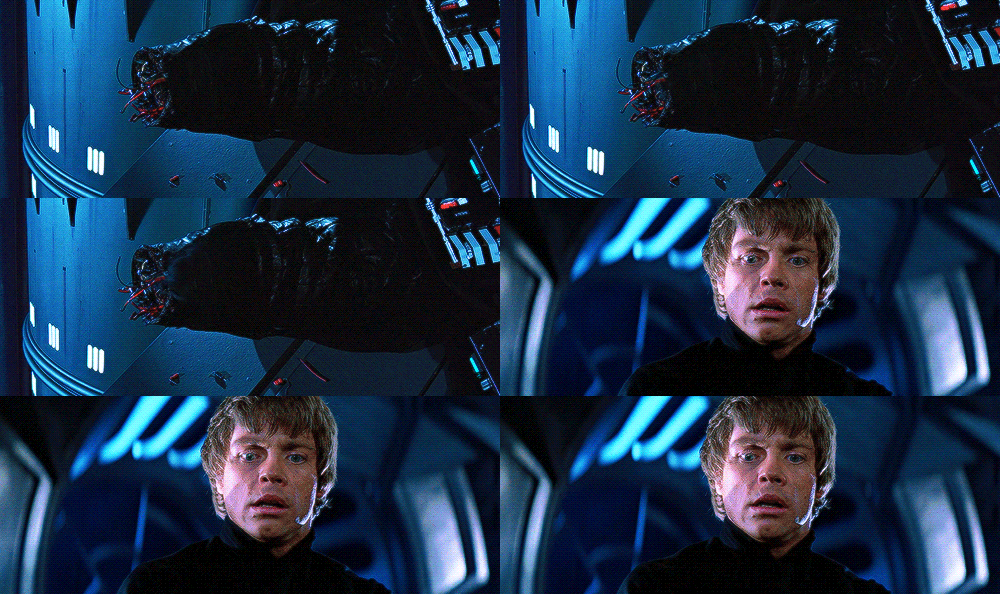
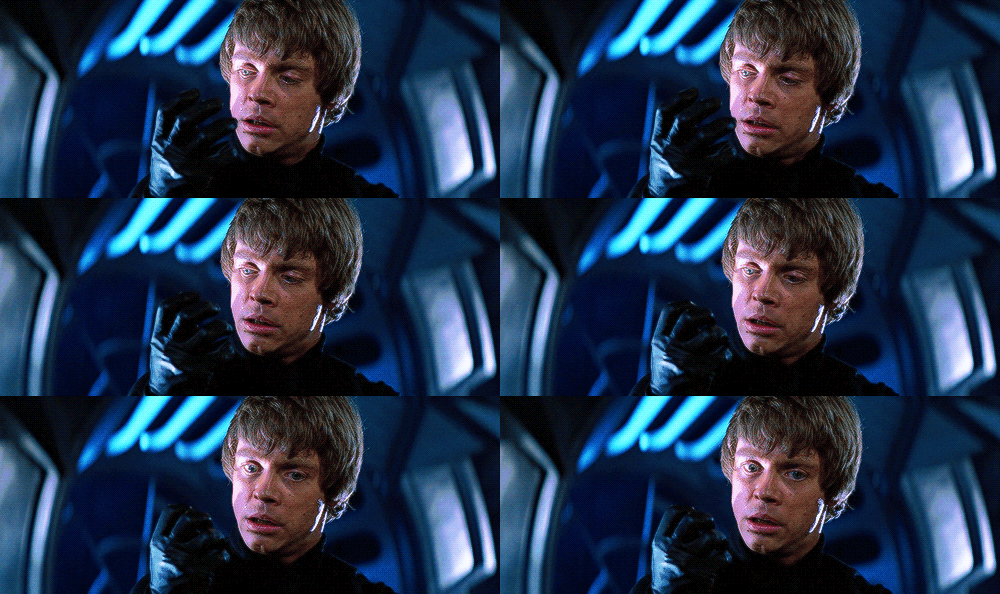
When given the choice between saving someone or doing “the right thing,” Luke will choose to save someone. Because, to him, saving someone is the right thing. Always. Even when others disagree and believe sacrificing others is necessary for the greater good. Because what’s the point of doing what others see as good if it means letting people die or failing people who count solely on you? What’s the point of living as a “good person” if you have to live without the people you love? Sure, the idea of going to the dark side scares him, makes him hesitate. Which is what we see him do when he sees his father’s hand and realizes he might be following Vader’s path.

(Source: padme4president.tumblr.com)

He definitely doesn’t want to be evil, and the possibility of turning evil is definitely making him cautious. But if the choice here was genuinely between going to the dark side while saving someone, or staying on the light side while letting people die, I think it would only be a matter of time before he went to the dark side (though I don’t think he would do so on the Emperor’s terms or view the Emperor as his master).

As I’ve said before, everything he does is completely dictated by his Fe. When the Emperor’s plan starts to work a little and they finally get Luke fighting Vader, it’s because Luke’s Fe kicks in and he’ll do anything to protect Leia. When Luke decides not to fight anymore, it isn’t because he’s conquered his Fe and realizes that “doing the right thing” is more important than saving Leia. Only by stepping back for a second and transferring his Fe to his desire to save his father does he stop himself from going to the dark side. But what would have happened if the person he was fighting wasn’t his father? What if it was someone he had no desire to save? I think there’s a very good chance he might have turned in such a case.

(Source: theforcesource.tumblr.com)

The reason he doesn’t go to the dark side is not because he’s ~so devoted~ to the light side of the force. I think, even to the end, he has that subconscious lack of allegiance to anything other than individuals he cares for. Rather, his resistance to being turned is because, in this particular case, going to the dark side would require him to give up trying to redeem his father, fight his father, and kill him. And he wants to save his father. That’s the point. It will never be about what side he’s on. It will always be about saving someone. Everything else – his morality and allegiances – will always be a question mark because it all depends on what he has to do in each situation to save whoever he wants to save.


6. His Determination To Love Others

In many ways, Luke remaining on the good side is due to luck and circumstances. But I also think it’s more than that. When something – even bad choices – is done out of love, it’s really hard to corrupt. Even Vader, who was turned to the dark side through his love for Padme, is not as firmly on the dark side as people think. He expressed a wish for the Emperor to be defeated in the second film, Luke senses strong goodness in him, and his love for his son (as well as his son’s love for him) ultimately turns him back to the good side again.

(Source: aaronpaauls.tumblr.com)

Love is such an inherently good thing that, even though it can be used to make people do bad things or even align with the bad side, sustaining that badness is very difficult because it was born out of a natural desire to do good. And I think that, while there is definitely a lot of risk involved with it, the way Luke’s morality is built is just so rooted in love that it gives him a sort of protection that others might not have. In fact, in many ways I think who he is – including the parts Yoda disapproved of – makes him more resistant to evil than what Yoda wanted him to become.

(Source: leialuke-archive.tumblr.com)

Lawful-aligned characters like Yoda definitely give an appearance of absolute righteousness and responsibility. But because his philosophies place ideals over caring for other people, that makes his focus ultimately inward on himself instead of outward. It’s all about his own growth, his own beliefs, his own feelings. When Yoda does something good he either does it out of duty, because he believes he’s “supposed” to, or he does it for himself because he wants to be a good person and wants to be on the good side of the force. Whereas, what’s very interesting about Luke is that the times he’s the most good is not when he’s trying to be good. It’s not when he’s mentally fighting the Emperor, trying to hold onto everything the Jedis have taught him. It’s not when he’s focused on himself, trying to control his emotions. The times he’s the most good is when he’s not trying at all, when he’s not even thinking about it, when his mind switches from himself and his morals to instead thinking about his father, wanting his father to be redeemed.

Luke’s goodness is built on taking his mind off himself and putting it on other people. And that’s why I prefer it. It’s about empathy and love. He’s not good because he wants to be; he doesn’t do good because he feels it’s his “duty.” It’s just natural. There’s such a genuine purity about it. And I think that’s why, no matter what sides (good or bad) he’d  join up with in his efforts to save people, he will always end up on the good side in the end. I think that’s why, more than just because of luck, he ended up on the good side in these films. His redeeming Fe doesn’t just save his father. It saves him too.

(Source: luciusmafoy.tumblr.com)

Sunday, September 20, 2015

5 Reasons Why Ahsoka Tano Will Live Forever

A long time ago in a galaxy far, far away…

There was a young Jedi Padawan named Ahsoka Tano, 
the apprentice of Jedi Knight Anakin Skywalker.


(Spoilers for Star Wars: The Clone Wars and Star Wars: Rebels)

In 2008, in the animated Star Wars: The Clone Wars movie and the ensuing TV series, Star Wars fans all over the world were introduced to a new character: Ahsoka Tano, a teenaged Togruta Padawan learner.  According to George Lucas, Ahsoka was developed for the series to demonstrate Anakin’s growth from the impetuous, headstrong Padawan in Star Wars II: Attack of the Clones to the more disciplined Knight of Star Wars III: Revenge of the Sith.  By giving Anakin a Padawan of his own, they were essentially putting him into a father role that would drive him to become more cautious and embrace his responsibilities.  And not only that, but by putting him through the experience of Master and Apprentice from the other side of the fence—as it were—they meant to strengthen and lend understanding to his relationship with Obi-Wan.  The decision to make Anakin’s Padawan a young woman was made when Lucas said he “knew something about the subject,” having raised two daughters of his own.  Although Star Wars: The Clone Wars has long since reached its untimely end, Ahsoka has endured and grown up independent of it, going on to join the new crew in the current series Star Wars: Rebels.  Since her inception, Ahsoka has gone on to garner thousands of fans—boys and girls alike, and here are five of the many reasons why.

1.  She’s brave and determined, and she never gives up.

Due to equal parts Jedi training, Anakin’s teachings, and her own innate unshakable spirit, Ahsoka is fearless both on and off the battlefield.  She’s always right behind her Master—and sometimes in front of him—as they lead their clone troops into battle.  And even without her Master, that fearlessness never wavers.  On one occasion, Ahsoka was kidnapped and dumped with other captured Jedi Padawans on an abandoned planet to be live game for barbarian Trandoshan hunters.  Not once did Ahsoka give up hope.  She led her fellow Padawans against their captors in escape attempt after escape attempt, relying on her Jedi teachings and her Master’s guidance: stealing weapons and airships and making allies out of their captors’ other prisoners.  Her leadership and courage not only freed her fellow captives but reunited her with her Master.


(Aww, look how concerned he was!)

2.  She and Anakin made a perfect—if unlikely—pair of Master and Apprentice.
They are a lot alike, Anakin and Ahsoka.  Both are brash, possessed of an almost ungodly amount of courage and a certain disregard for rules.  When they first meet, Anakin and Obi-Wan are in the middle of a war zone on the planet Christophsis, and it was Obi-Wan who had put in an offer to take on a new Padawan, not Anakin.  But Master Yoda felt that it was time Anakin honoured the age-old Jedi tradition of passing down knowledge to the next generation, and he was convinced that if Anakin had an apprentice of his own it would teach him patience and responsibility.  The majority of Ahsoka’s first mission in that war zone was spent trading jabs with her new Master; she dubbing him “Skyguy” and he calling her “Snips” for her “snippy” attitude.  Their equally headstrong natures were not long in getting them into trouble.  On the way to deactivate an enemy forcefield that was causing problems for their troops, they got themselves ambushed by enemy droids and Ahsoka very nearly squashed her new Master to death when she Force-pulled a wall down on top of the droids attacking him.  But despite such a rocky start, Anakin was impressed by her resourcefulness and her bravery, and made no effort to get her transferred to another Master.


3.  Her kind heart is equal to few others.
There are many times Ahsoka looked after the welfare of the clone troops under her command and that of her Master, and she not only cared about many of them but grieved deeply when they died in battle.  She also has a soft spot for children.  When rescuing Force-sensitive infants from infamous bounty hunter Cad Bane, Ahsoka tirelessly and without complaint helped care for them until Jedi reinforcements arrived.  In other instances, she undertook the task of teaching a class on political corruption to young cadets on the planet Mandalore and lent an understanding and helpful ear as they attempted to apply what they learned to their own lives.  She also escorted and protected Jedi younglings as they completed the ancient Jedi tradition of seeking and claiming a lightsaber crystal on the planet Ilum, and offered guidance as the younglings assembled their lightsabers.


4.  Like the most exemplary of her Order, she is selfless in her protection of others.
It is the duty of the Jedi to serve and protect, to be peacekeepers, and sometimes warriors when the need arises.  And sometimes it falls to the Jedi to make the most ultimate of sacrifices when protecting others.  In this, Ahsoka is as steadfast and sure of heart as any of the Knights and Masters to come before her.  During a mission when she and her Master were paired with another Master-Padawan duo of Jedi Knight Luminara Unduli and her apprentice Barriss Offee, Ahsoka and her fellow Padawan were assigned the task of planting and setting explosive charges to bring down an enemy droid facility.  Over the course of the mission, Ahsoka and Barriss were not only separated from their Masters, but they were faced with a terrible choice: saving potentially thousands of lives or their own.  In the end, both Padawans followed the teachings of the Jedi and their Masters and made the choice that would preserve thousands of innocents.

5.  In the end, Ahsoka is unafraid to walk her own path.

There came a time when Ahsoka was framed for a grave act of violence against the Jedi Temple, expelled from the Order and forced to go on the run.  She was eventually cleared and the perpetrator was caught, but the damage had been done.  She refused the offer to return her to the Order and chose to leave the Jedi behind to find her own way in the galaxy.  In doing this, she was leaving behind not only the Master she had come to view as a father but the only family she had ever had.  Ahsoka had been found as a very young child by Master Plo Koon of the Jedi Council, abandoned by her parents, and she was raised in the Temple until the age of fourteen, when she was chosen by Master Yoda to be the apprentice of Anakin Skywalker.  I don’t know about you, but it would take a great strength of will that I do not possess to walk away from and sever ties with the only family I’ve ever known.  For those of us who are steeped in Star Wars lore and know what was to come in Star Wars III: The Revenge of the Sith, we now know that Ahsoka’s courageous decision spared her from the genocide that wiped out the Jedi and destroyed the Republic, enabling her to return in the new series Star Wars: Rebels.


Like many other Star Wars fans out there, I love Ahsoka.  I grew to love her over the course of the series for her heart, her spirit, and the fact that she does not let anyone define who she is but her.  And like many of my fellow fans, I cried when she made the decision to leave the Jedi at the end of season five.  I still do, sometimes, when I watch that episode.  At that point in time, to us fans, her fate was uncertain.  We did not know if she died like all the other Jedi despite her leaving or if she survived Order 66.  But then in October 2014, a year after her departure, we fans were rewarded for our loyalty and our tears when Ahsoka made her triumphant return to the world of Star Wars as she joined the fight against the Empire in Star Wars: Rebels and found her destiny as one of the founding members of the infamous Rebel Alliance.  To quote Darth Vader…

The Apprentice Lives.

Are you an Ahsoka fan?  What do you love most about her?


Sunday, April 12, 2015

Character Spotlight: Oswald Cobblepot

Content warning for open discussion of sex and some violence. Trigger warning for blood, and discussion of bullying, rape and sexual abuse. 

Despite some characters being labeled heroes and others being labeled villains, there are very few truly good or bad characters in Gotham. All of them are some mixture of evil and neutral, with tiny specks of good thrown in here and there.

People often assume that if a person or character is on the side of the law, that makes them “the good side”. But this isn’t necessarily the case. Especially when the law itself has been corrupted. And in Gotham, there is very little to divide the law from the mob lords they supposedly “fight”. Everyone, excepting Jim Gordon, has been wrapped around Don Falcone’s calculating finger. Some may argue that this makes Jim a truly “good” character; but it has also been admitted on the show, by Jim himself and others who know him, that he fights criminals not so much to win real justice, but because he loves the thrill of the fight. And fighting for order and justice is simply a more traditional outlet for seeking out that thrill. Jim isn’t by any means a bad man, but he leans more toward neutral morality than truly good. Some may argue Alfred is a truly good character; but he too is more neutral than anything. All his actions are motivated solely by duty, and he will do anything (including encouraging bad behavior from Bruce) to protect the dignity of the family name and the child placed in his charge. The only truly good character I’ve seen on the show is Bruce Wayne himself, who at this point is only a child, and doesn’t yet have much part in the story’s main plot.

No, instead of fitting “good” or “evil” labels, each character has their own unique vision of good and evil. To me, this is no bad thing. It makes the show more interesting, the characters more intriguing. And out of all of them, Oswald is, to the majority of viewers (including myself), the one with the most complex and fascinating characterization.


For Gotham fans, you don’t pick the good or the evil side. Instead, you pick your poison; and Oswald Cobblepot seems to be the most well-loved poison on the show. That’s why, today, I’ll be delving into what makes him such a fascinating character.  In this article, we will discuss and speculate about many popular and controversial aspects, such as character background, motivation, sexuality, alignment and morality, MBTI Personality Typology, and HP House Sorting. Let’s delve in to find out what makes the Penguin tick!


Character Background and Motivations: 

Oswald was born into the Kapelput household, an old and once very wealthy family who resided in Eastern Europe until they fell on hard times and immigrated to the US. Oswald is the first in his family to go by the anglicized name, Cobblepot.

Oswald’s childhood is not described as a very happy time in his life. He had no friends and was bullied by other children severely — an experience that would stay with him and shape his motivations in adulthood.


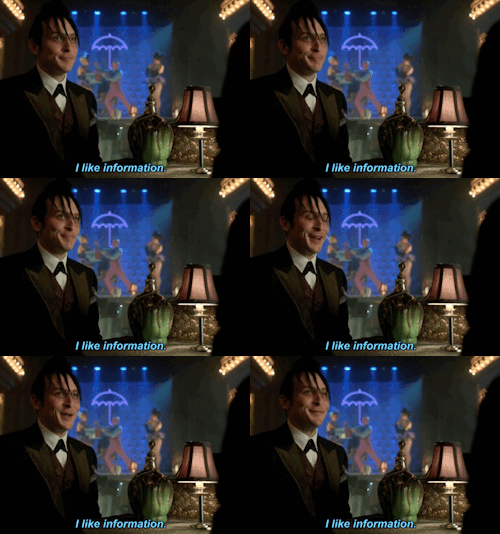
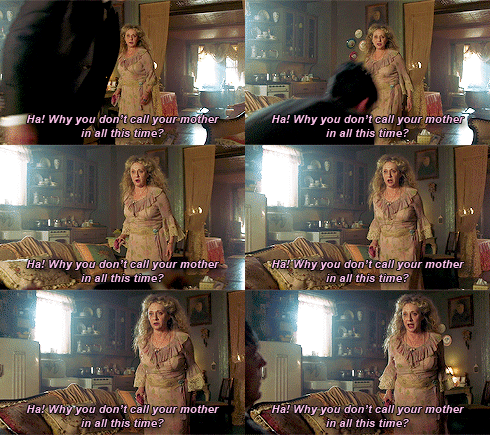
Though not much is known about the majority of his family members, we are shown that he was very close to his mother, Gertrud. An eccentric and conniving woman, she passed many of her negative qualities on to him. In particular, the habit of gathering information about others to use against them for personal gain.

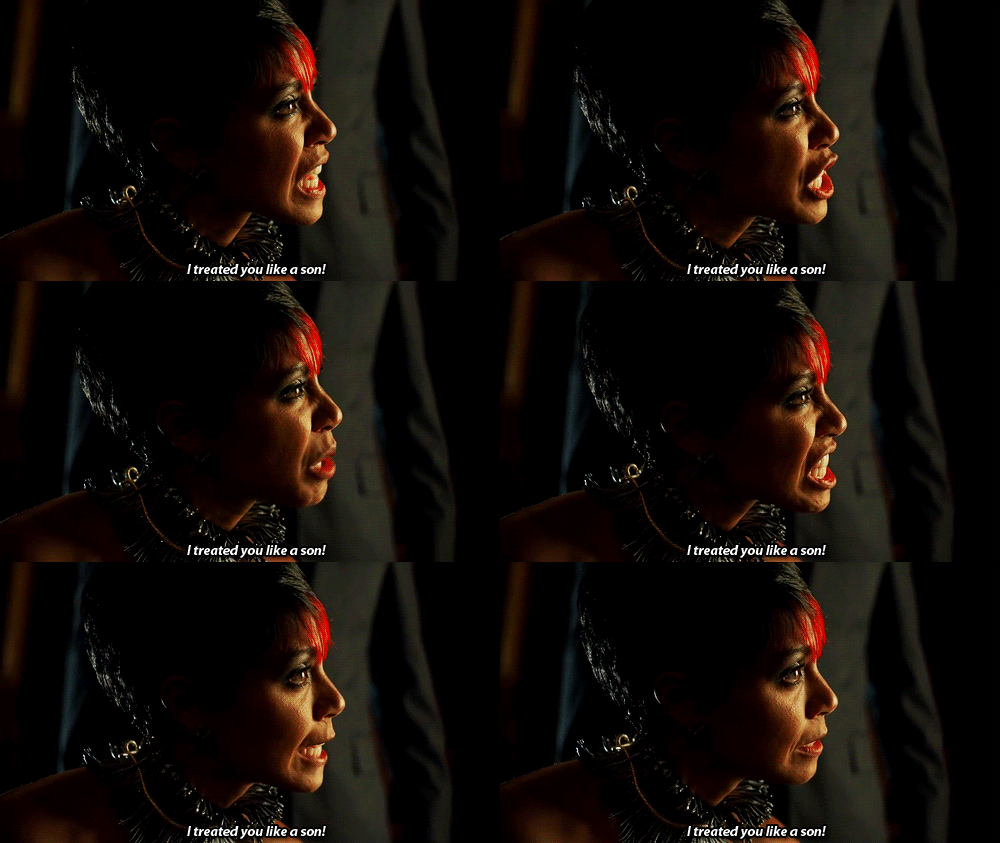
As an adult, Oswald’s experiences with bullying drove him to seek more power for himself.  His desire to learn the ways of the Gotham underworld led to him being taken under the wing of Fish Mooney, a sadistic and powerful mobster, who treated him as both a son and a slave. When Oswald eventually betrayed her, Fish beat him, permanently injuring his leg so that he now walks with a limp.

From there, Oswald pretended to work for Maroni in order to learn his secrets, all the while working in secret as an informant for Falcone. Maroni eventually learned of this treachery from Fish Mooney; and now Oswald works for Falcone publicly, running a nightclub previously owned by Fish.

(Source: baskervilleshund.tumblr.com)

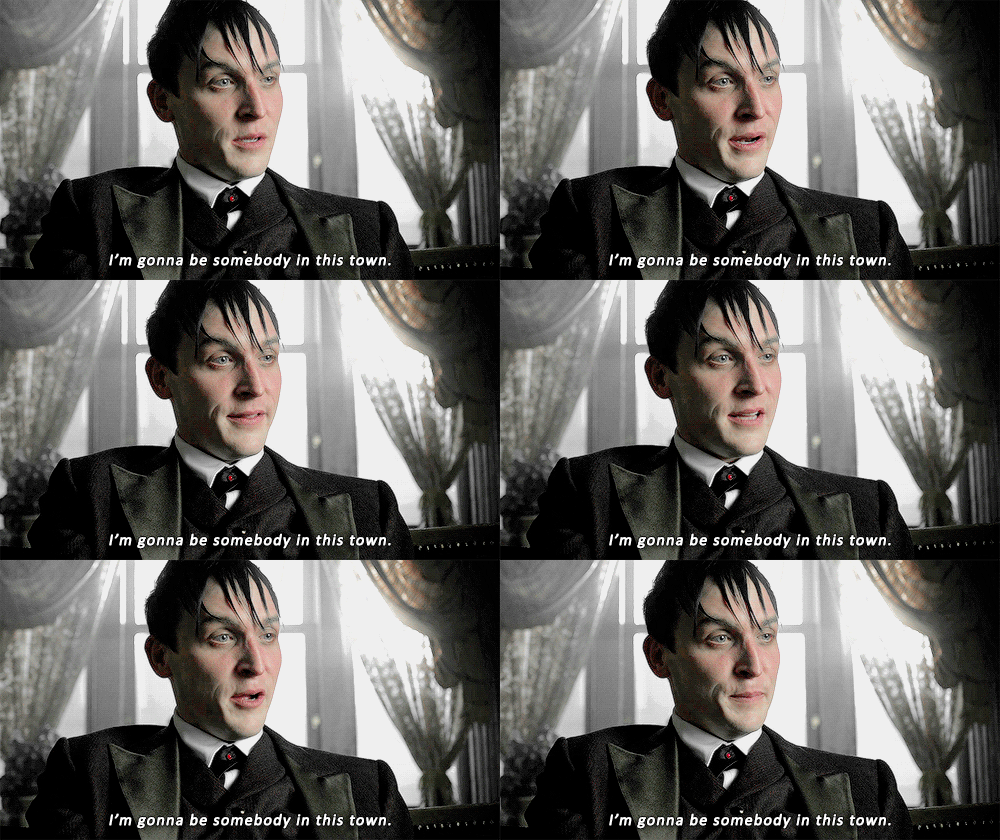
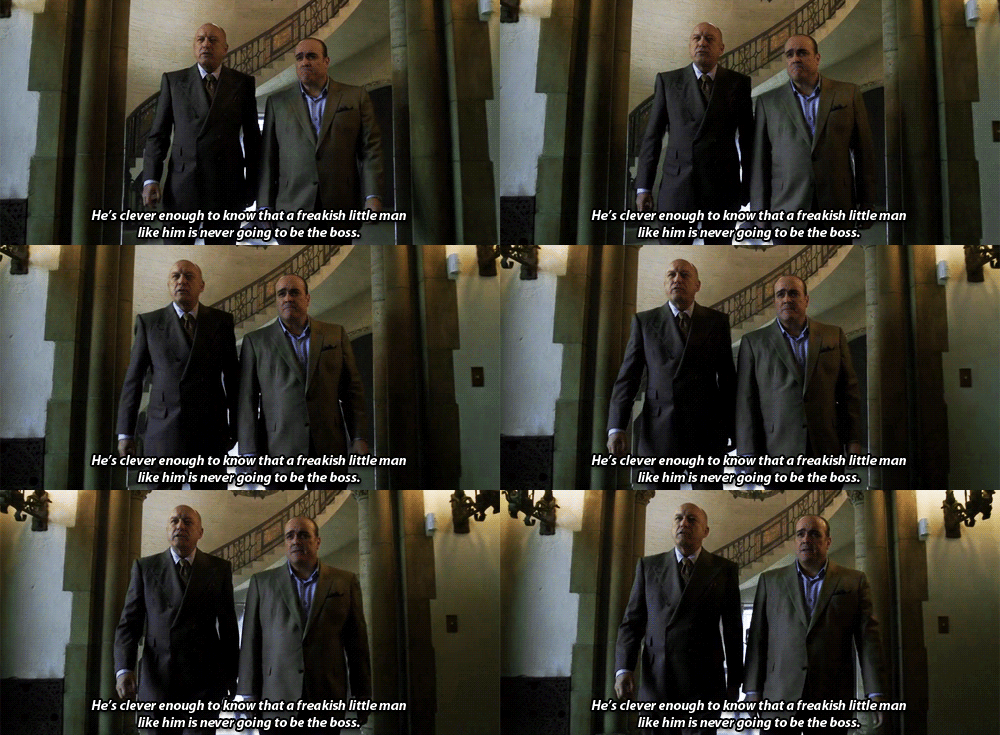
His thinking shaped by the relentless teasing he suffered years ago, Oswald now regards the powerful people around him as bullies. And it is his goal to show them up, and prove it takes brains instead of brawn to make it to the top. Despite his physical weaknesses, and the fact that he is underestimated by everyone around him, Oswald Cobblepot plans to eventually become the most powerful man in Gotham.


Sexuality: 

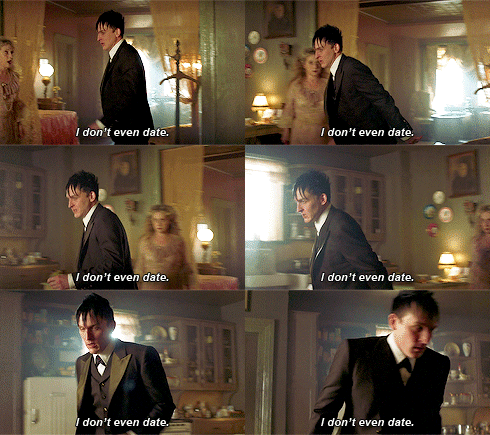
Oswald’s possible sexuality is a complex subject. Some say he’s asexual and/or aromantic, as he seems to show absolutely no interest in having any sexual/romantic relationships with anyone.

(Source: salmaroni.tumblr.com)

Others are convinced he must be gay, due to his fixation on Jim Gordon.

(Source: raymukada.tumblr.com)

From what I’ve watched on-screen, however, as well as what I’ve read in interviews with cast and crew members, I’ve seen nothing to suggest Oswald has any sexual attraction toward Jim. He definitely has a child-like obsession with him. But its innocence more resembles admiration; or, at most, the simple sort of “crushes” young children develop on one another, when they are still too young to even understand what sex is. And every interview that has discussed their relationship confirms it comes from Oswald’s childhood loneliness, his desire for friendship — a privilege he has yet to enjoy with anyone.

(Source: brotherlyfeels.tumblr.com)

Asexual/aromantic is closer to the mark for him, I think, but not quite there either. To truly understand his sexuality, we have to take a closer look at Oswald’s relationship with his mother, Gertrud.

It has been strongly insinuated on multiple occasions that the relationship between Gertrud and Oswald goes beyond that of a mother/son relationship. In fact, Gertrud gets extremely upset whenever she fears Oswald might have acquired a girlfriend  — not because she believes no one is good enough for her son, but because she’s jealous of any potential “other women” who might steal his affection away from her. It has also been stated in several interviews that their dynamic was inspired by the incestuous Bates’ relationship portrayed in Alfred Hitchcock’s infamous film “Psycho”.


You can’t approach the subject of incest between Oswald and Gertrud without also considering the almost inevitable possibility of sexual abuse. For a son to willingly enter into such a relationship with his own mother, without being conditioned to do so during childhood, is virtually impossible. And if a mother is willing to enter into such a relationship with her son, it’s highly unlikely she would be the sort of person to wait until her son came of age, or put much emphasis on consent. Healthy, platonic parent/child relationships do not produce incestuous relationships in adulthood. If the element of incest is there, then it was an element that was introduced early and, probably at first, unwillingly.

This idea is supported by the characters’ behavior toward each other on the show. Oswald’s attitude towards his mother has two elements that run together simultaneously — one of love, loyalty, and absolute devotion; the other of derision, anger, and bitterness. It is a classic symptom of abuse for the victim to show both these attitudes at once. This is because abuse victims are manipulated into believing their relationship with their abuser is normal, even good; while at the same time, their subconscious recognizes there is something wrong, making them feel trapped and bitter.

Another intriguing aspect of this is Oswald’s relationship with Fish Mooney. It is interesting to note that, out of all the powerful figures in Gotham, the one he chose to use to gain a foothold in the underworld  — the one he chose to show false loyalty toward, only to betray and conquer in the end  — was the only female mob boss in the city. A woman who, the show goes out of its way to point out, he developed a mother/son bond with.

(Source: fuckyeahgothamfox.co.vu)

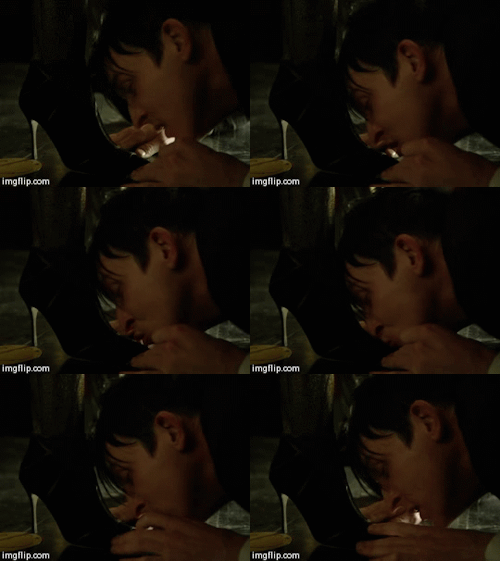
During his service to her, Fish Mooney alternated between coddling Oswald like a beloved child and dominating him like a master does her slave. And ever since his betrayal, he’s constantly fought with zealous rage to dominate her instead. After all, if you still feel loyalty toward your original abuser, why break ties with them if you can instead channel all that hurt and anger toward someone who reminds you of them?

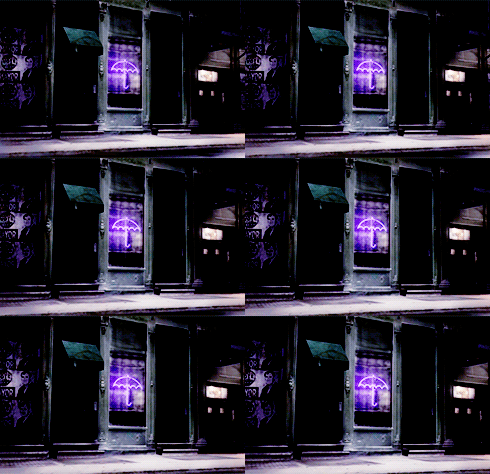
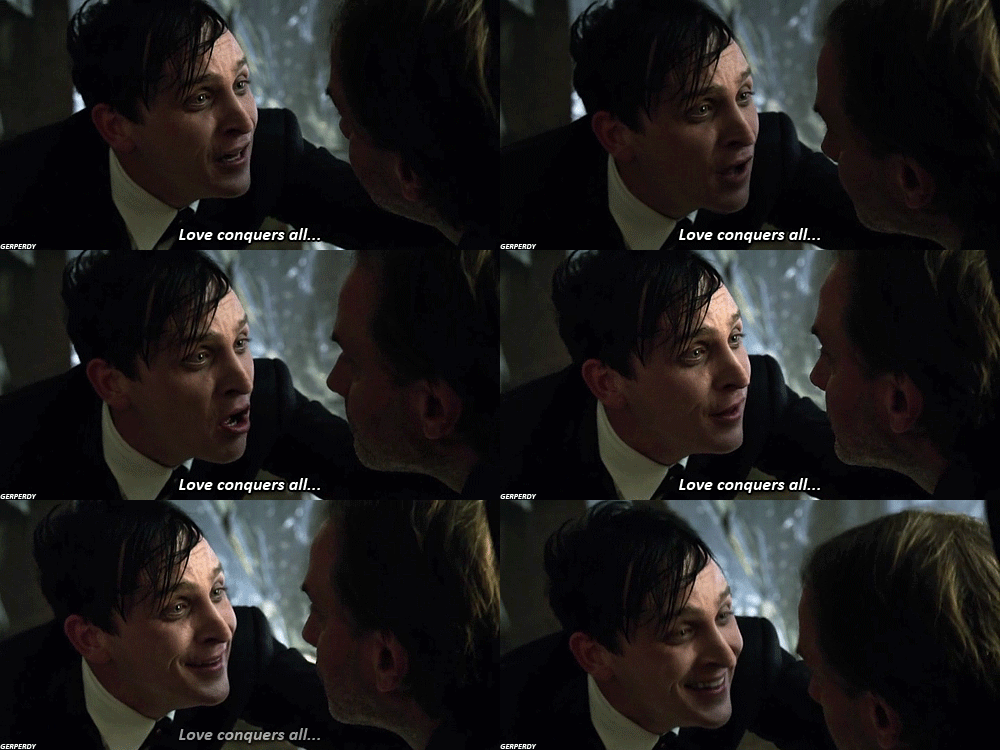
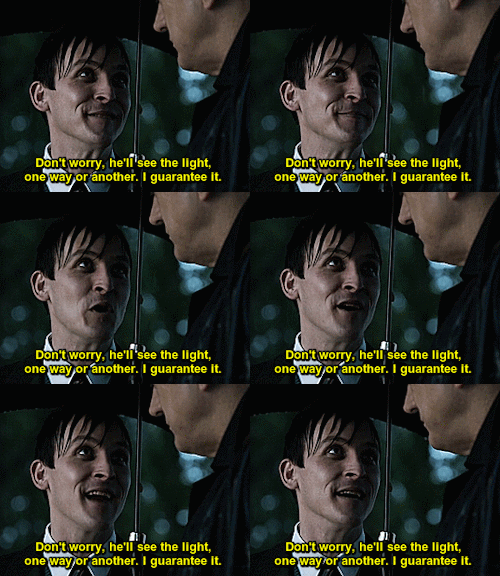
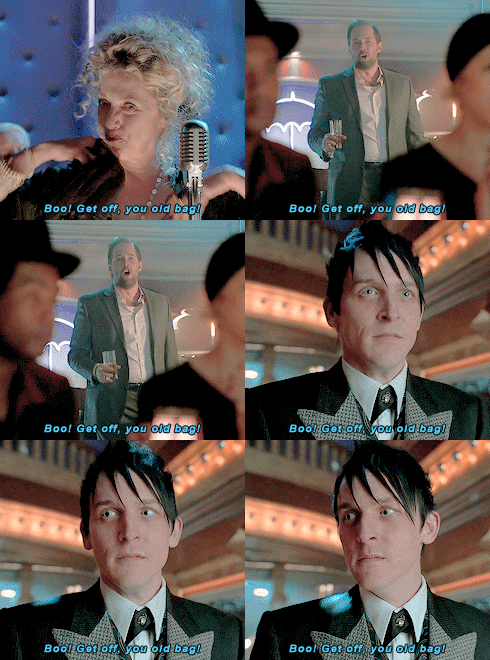
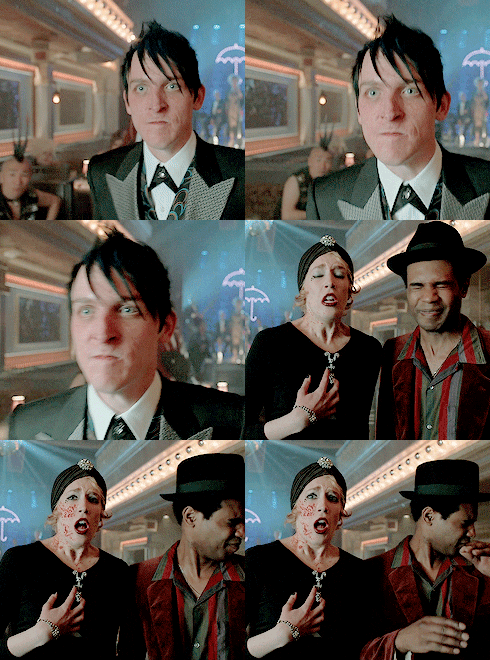
Even more interesting is Oswald’s behavior toward his victim, Carbone, in the episode “Penguin’s Umbrella”. After Carbone attempts to assert his power, Oswald “teaches him a lesson” by having him forcibly held down and stabbing him to death. As Carbone dies, Oswald seems to adopt his mother’s mannerisms, comforting him the way a mother would her child after a particularly unpleasant punishment or lesson.

(Source: gerperdy.tumblr.com)

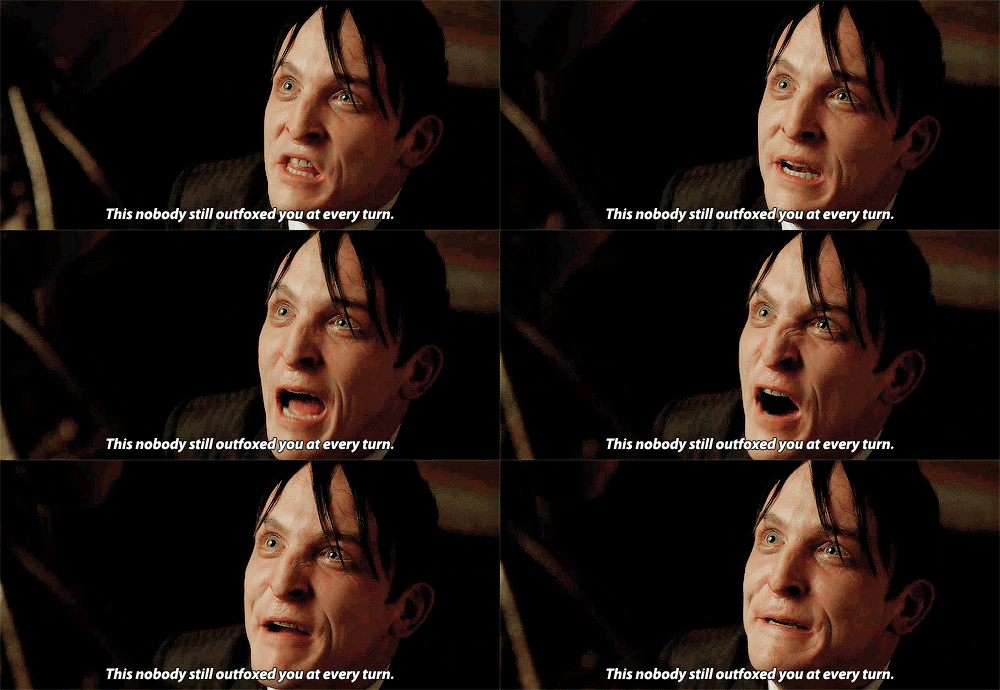
This behavior is very telling. It’s not uncommon for victims to suddenly adopt the mannerisms or phrases used by their abuser, if their actions somehow subconsciously remind them of how their abuser has treated them in the past. Since Oswald suddenly adopted his mother’s behavior, something about his actions toward Carbone in that scene must have reminded him of something Gertrud did to Oswald long ago. Of course, it’s obvious Oswald’s mother never forcibly held him down and repeatedly stabbed him.  But it doesn’t take much imagination to realize what the most likely alternative would be. What I find particularly chilling, though, is Oswald’s last words to Carbone. Especially when you consider he’s saying it as if he’s comforting and teaching a young child. “Love conquers all,” he says. Love leads to being dominated. Love is something that either conquers you, or becomes a tool you use to conquer other people. And from the way he says it, it sounds like it’s a lesson he has learned from experience. It wouldn’t surprise me if he was told those same words while being “taught” something unpleasant as a young child.

This association of love and conquering, as well as the fact he has been bullied, abused, and dominated by absolutely everyone in his life growing up, has not led him to possess a healthy view of relationships. He has been the victim for far too long. As a result, he is not necessarily attracted to a certain type of person so much as he is a certain type of situation. Namely, a situation where he finds any person of great power and discovers some way to conquer them. This type of situation allows him to be the one to dominate for once. For once in his life, he gets to be the victor.

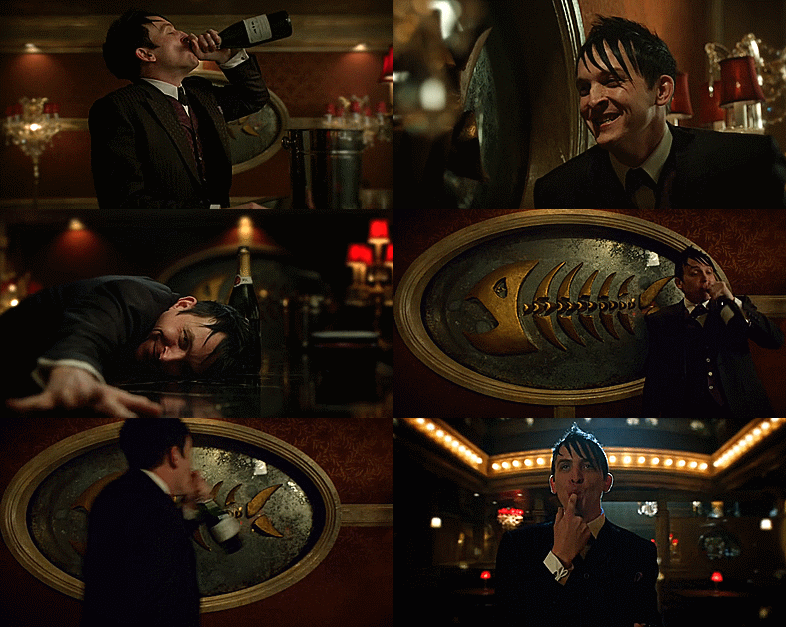
While most characters on television display a lustful gleam in their eye whenever a pretty face or tempting figure turns their head, Oswald only has that gleam when something arouses his sadism. When he’s forced to kill, when he’s given the opportunity to harm others, or when he believes he is finally about to win his cat-and-mouse game with Fish. Love, hate, sex, violence, and domination have been forcibly melded together in his mind too strongly to be separated. Any sexual identity he would have had instead gets channeled into his desperate desire for power. His sexuality is no longer about sex. Instead, his lust has become literal bloodlust.

(Source: gobblepotfans.tumblr.com)


Alignment and Morality: 

Despite the fact he seems to greatly enjoy hurting people — a trait commonly associated with Chaotic Evil  — Oswald does surprisingly well at keeping his bloodlust in check. Instead he prefers to take the tactical route, only killing if it will serve some greater purpose in his plan, or if the victim deeply insulted him or someone close to him. For this reason, I would classify Oswald as being Neutral Evil. Wikipedia describes Neutral Evil as follows:

“A Neutral Evil character is typically selfish and has no qualms about turning on its allies-of-the-moment, and usually makes allies primarily to further its own goals. A Neutral Evil has no compunctions about harming others to get what it wants, but neither will it go out of its way to cause carnage or mayhem when it sees no direct benefit for itself.” 

Although many viewers (including myself) have found his character to be extremely sympathetic, I believe Oswald is far too evil to count as either an anti-hero or an anti-villain. He is firmly in the villain category. That is not to say, however, that he doesn’t have a good side. In fact, he has much more good in him than even he realizes. And it manifests itself in his relationship with Jim Gordon.

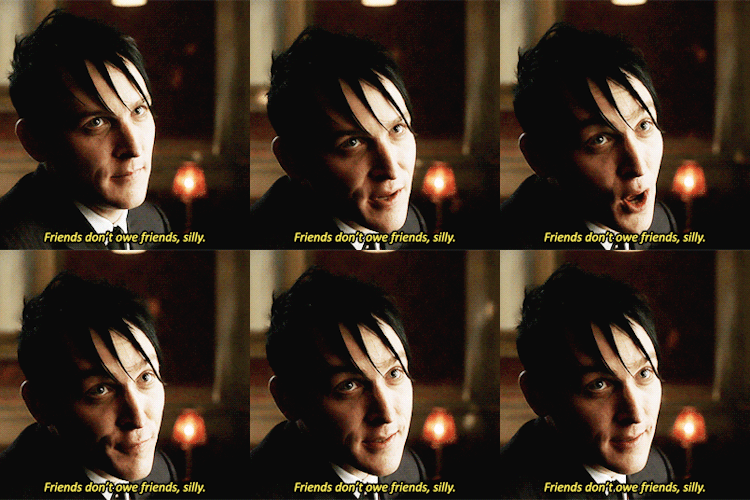
Oswald has convinced himself that the reason he constantly pursues Jim’s acquaintance is because he wants him as an ally. A partner in crime that will help him rise to power.

(Source: russianhookers-and-cheapgin.tumblr.com)

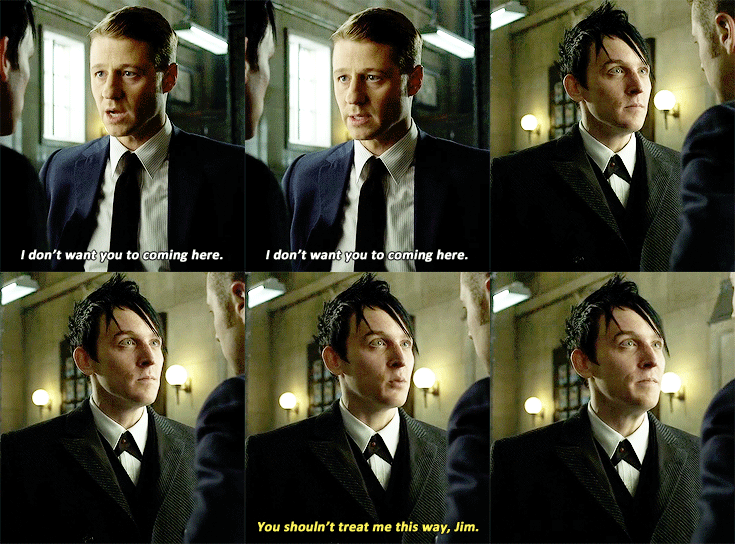
But in reality, it’s much more than that. Jim represents goodness and hope for Gotham which, on some level, still appeals to Oswald. Despite his greed and personal ambition, he can’t help coming back to Jim. He can’t stop hoping there are good men out there. Men who want more than power and domination over others. Someone who wants to stop the bullies in this world once and for all.

(Source: down-the-muddy-river.tumblr.com)

When Oswald reaches out to Jim, it is both a cry for friendship and a last leap of faith in law and order. It is the last faint traces of goodness in his character trying to hold on.

However, as a mostly villainous character, Oswald’s personality does not much appeal to Jim, who believes himself to be firmly on the side of good. This places what’s left of Oswald’s morality in a precarious position. And it won’t take much more rejection for those little bits of goodness to slip away forever.

(Source: down-the-muddy-river.tumblr.com)


MBTI: 

As more and more people have been learning about MBTI Personality Typology, debates on the psychological wiring of fictional characters increasingly dominate fandom discussions. Everybody wants to know what type their favorite characters are. So what character analysis would be complete without some MBTI speculation? Now, it’s well known people can be much harder to type when they are unhealthy or unstable individuals. So, of course, typing villains can be particularly challenging. Despite this, I am still confident in saying Oswald Cobblepot is an ISTJ.

ISTJs are defined by their four main cognitive functions, Si - Te - Fi - Ne.

Dominant Function: Si 
Because Oswald’s dominant function is Si, he belongs to the SJ Temperament, also known as the Guardians. Si looks to the past, as well as one’s peers, to figure out the “correct” way of doing things. There’s a good reason Oswald was nicknamed the “boy who loves his mother”, and not just because of their unusual relationship. It is the trademark of Si to feel great loyalty to one’s family and family background.

Even though he is normally a very tactical person, Oswald employs a very old fashioned, outdated way of speaking to others, despite the fact this isn’t the best method of communicating with those involved in his plan. Interviews with cast and crew have confirmed that the reason he does this is because his mother speaks this way and taught him to do the same. Oswald views this as the “correct” way to speak, and wishes to honor his mother in this matter. Like all ISTJs, Oswald highly values tradition, as well as good manners.

(Source: okimi79.tumblr.com)

Auxiliary Function: Te (with Inferior Ne)
Oswald’s second strongest function is Te, a highly motivating and organized function. Hard working and punctual, Te drives people to get things done. Though, as an introverted Te-user, ISTJs are much less likely to lead or conduct their plans center-stage. They instead prefer to work quietly, behind the scenes.


One of their biggest strengths is the large mental database of facts that only they seem to know. As sensors, ISTJs are very aware of their surroundings. They listen, they observe. And they make mental notes on all that they learn, so they can use these facts to their tactical advantage later.

(Source: gobblepotfans.tumblr.com)

Like most Js, ISTJs are naturally step-by-step planners. Their planning process is assisted by their inferior function, Ne, an analytical tool that evaluates situations and helps them see possibilities. It allows them to be very detail-oriented and meticulous in their mental process, as they formulate clever and intricate foolproof plans.

(Source: gobblepotfans.tumblr.com)

There, however, the benefit of their Ne ends. While individuals with high usage of Ne become very analytical, intellectual people, Ne is the ISTJs inferior, and therefore weakest, function. They are far more sensing — and therefore practical — than they are intuitive. An ISTJ will not see the value in philosophy, mind games, or thinking for its own sake. And in fact, are likely to become annoyed or suspicious when others attempt to force them into such activities.

(Source: felicity-smoakqueen.tumblr.com)


Tertiary Function: Fi
Unlike Fe, which expresses emotions outwardly and reaches out to others, Fi is directed inward. Because of this, most Fi users put great value on their emotions and inner harmony. For ISTJs, however, Fi is shown in a more unique way. For them, Fi does not refer to valuing inner emotion so much as it does their seeming inability to express emotion outwardly. And what emotion they do show can sometimes feel contrived or insincere. They are, on average, serious, calm, and private people. No one but the ISTJ really knows what he is thinking or feeling.

Not only are ISTJs often out of touch with their own emotions, they often have difficulty empathizing with others.  They generally are not very good at understanding people, making them feel comfortable, or keeping them entertained. A great example of the latter is the fact that Oswald, despite being very clever in his manipulations and schemes, continuously fails at pleasing guests at his newly acquired club.

(Source: baskervilleshund.tumblr.com)

Always thinking practical, ISTJs easily forget or ignore the feelings of others, in favor of carrying out their complex plans. Because of this, they do not have much time for socializing, and can often come across as cold and aloof. They may even neglect the  people they care most about.

(Source: salmaroni.tumblr.com)

Not only this, but ISTJs often neglect their own needs. Not wanting to be distracted, they are all work and no play. At least, until the job is done. Once an ISTJ has fully carried out his grand plan, he may then have a victory celebration. In his own introverted way, when no one is around to see.


(Source: sigurism.tumblr.com)
(Source: russianhookers-and-cheapgin.tumblr.com)


Hogwarts House: 

There’s no questioning that Oswald Cobblepot is in Slytherin House. And not just because he’s a villain (as a Slytherin myself, I have to point out that not all Slytherins are villains, and not all villains are Slytherins!). If you think of all the main traits for which Slytherins are famous, they describe Oswald with amazing accuracy. Crafty and cunning? Check. Desiring of power and status? Check. Will do anything to achieve his goals? Once again, check.

(Source: fuckyeahgothamfox.co.vu)

Another defining characteristic of Slytherin house is that, although they tend to mostly look out for number one, regard others with suspicion, and can be hesitant to trust, Slytherins are also known for their intense loyalty and sense of brotherhood. Because of this, each has a small group (or sometimes only one or two people) who they will always stick by and defend to the death. This describes Oswald very well. He is so out for himself that he practically lives in his own little bubble. No one fully knows what he’s thinking or planning except himself. He doesn’t have friends, and only socializes with others if he thinks it will gain him something. Yet, he would go to the ends of the earth to make Jim Gordon smile. And if you dare to insult his mother? Well…

(Source: milkovichgifs.tumblr.com)

Finally, the last thing to prove once and for all that Slytherin is his true home is the fact that he shares a seemingly contradictory characteristic with many others in Slytherin house. Namely, their habit of being obsessed with pride and self-respect, but also willing to subject themselves to humiliating begging and flattery.

The Slytherins we meet in the Harry Potter series put great emphasis on their power, their money, and especially their status as purebloods. Yet they are perfectly willing to become the groveling slaves of Lord Voldemort. And then there’s the moments of flattery and shameless cowardice the normally smug Malfoy displays throughout the series. People often read this as Slytherins accidentally showing their “true colors”, their curtains of pomp and pride drawing away to show the true weakness underneath. But what people fail to take into account when they assume this is that, with Slytherins, everything is tactical. Everything is part of a much larger plan. Slytherins know that playing the part of the flattering, groveling slave can be a very useful tool. And being first and foremost cunning, they are not going to let their pride get in the way of using it.

This willingness to voluntarily enter into humiliating circumstances is what separates Slytherins from the other houses with which they are often compared. Slytherin and Gryffindor, for example, are two houses famous for being very similar to each other, due to their fixation on reputation — Gryffindors on their reputation as being brave, and Slytherins on their reputation as being powerful. However, while a Gryffindor would rather die a hero than live with the reputation of being a coward, a Slytherin would gladly sacrifice their reputation to survive the battle and go on to win the war. After all, a reputation can easily be rebuilt once victory is at hand. Slytherins play the long game. Why lay down your life to avoid a moment’s shame, when that shame can earn you a lifetime of power later?

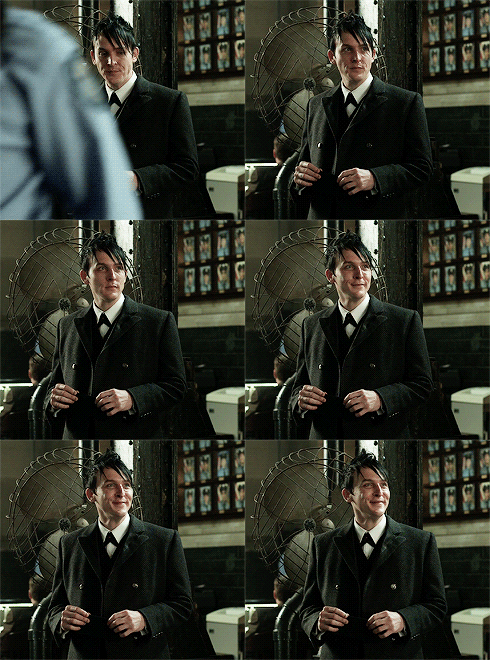
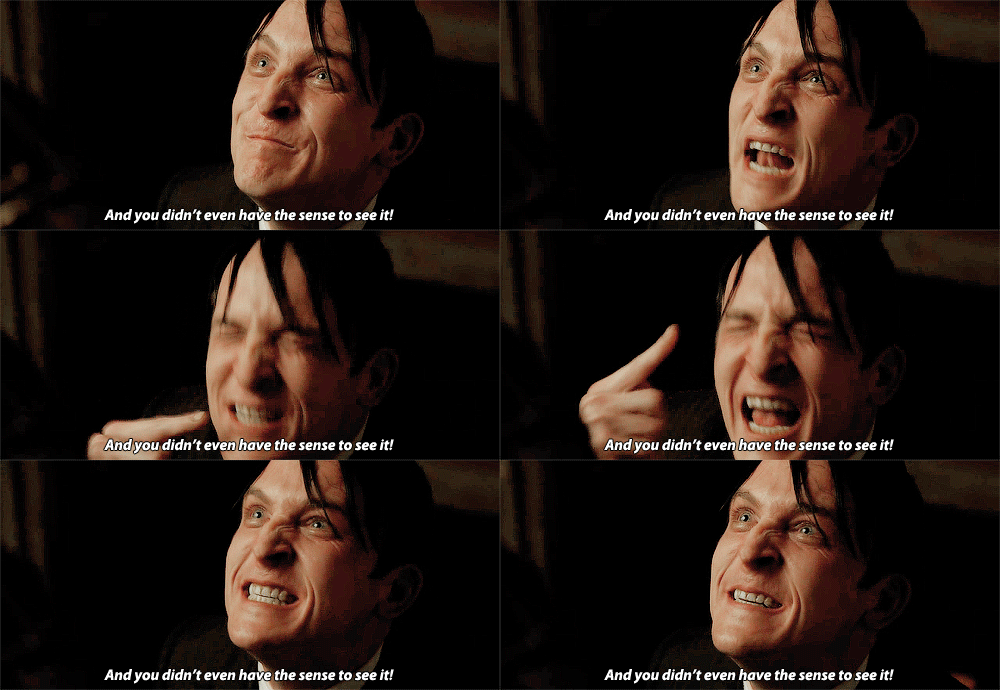
This characteristic is a very important aspect of Oswald’s characterization, and is also the aspect most frequently misunderstood by viewers. Just as they did with the Slytherins in the Harry Potter series, viewers mistake this tactical move as a sign of weakness. “He’s not powerful,” they say. “He’s a pathetic, groveling weakling, and everyone around him knows it. He’s not fooling anyone. You need only look at him to see he doesn’t actually mean a single polite word that comes out of his mouth. He’s only trying to suck up to powerful figures, in the hope they might share some of their power with him.”

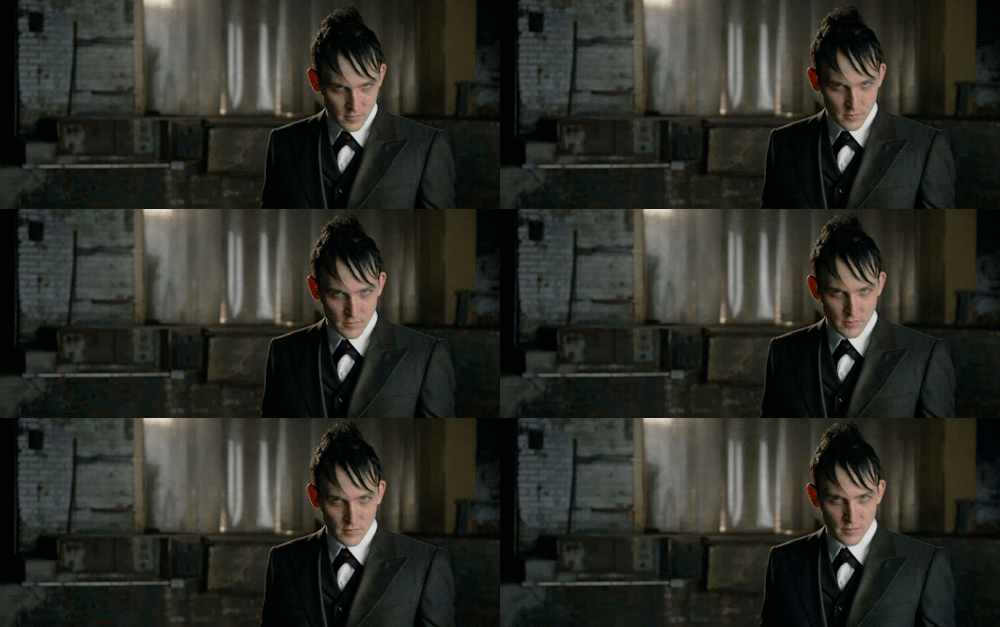
What they don’t see is that the whole thing is a double play, a trick based on what he knows about his own strengths and weaknesses. He knows very well that his biggest weakness is his inability to hide his ambition. Therefore, his smartest move is to purposely let it show clearly before all his enemies, but misdirect it. When people like Fish, Falcone, and Maroni see Oswald not-so-subtly sucking up to them, they assume they’ve figured out his secret plan. They assume Oswald is trying to get on their good side in the hopes they will promote him, make him their special right-hand man, and allow him to profit from the shadow of their glory. By doing this, Oswald is able to distract them from his true secret. Because in reality, he doesn’t want to get on their good side so they’ll share their status with him. He wants them to underestimate him — just enough to allow him to discover their secrets — and play them against each other. In the end, his weak groveling and bad flattery serves as the ultimate disguise.

(Source: fuckyeahgothamfox.co.vu)

It may be difficult for some to understand how Oswald could humiliate himself the way he does without actually being the pathetic weakling he pretends to be. After all, how could someone literally grovel at someone’s feet, unless they had an enormous lack of self-respect?

(Source: beg-for-mercy-twice.tumblr.com)

But actually, it is his self-respect that allows him to do it. Or, to be more accurate, what he does with his self-respect. It’s a well known fact that the more confident you are, the more free you will be to make a fool of yourself if the situation calls for it. Oswald derives his pride and self-respect from his cleverness. And this pride is protected by his confidence in it. No matter what humiliating act he has to subject himself to in order to make it to the top, he knows he’ll come out of it just as clever as he was before. His self-respect is locked up, secret, safe inside himself where no one can touch it or take it away. All he loses from his groveling and flattery is the good opinion of the mob bosses he manipulates. And that will be easily remedied once he becomes the most powerful man in Gotham. In the meantime, their good opinion is not worth having, as they are not nearly as great as they pretend to be. Just as Oswald’s willingness to subject himself to humiliation is a sign of inner confidence, the mob bosses’ need to constantly assert their status and dominance is a sign of lack of confidence. They’re the ones who, at all times, feel they need to prove something to everyone around them. Whereas, Oswald only has one thing to prove: that, for all their riches and power, it is instead the ever-underestimated Oswald Cobblepot who has the confidence and cleverness to beat them all in the end.

After his long experiences with being mocked and taunted, Oswald knows a cowardly bully when he sees one. It is no wonder, then, that Oswald would be unafraid to make a fool of himself in front of such people. He knows it’s just a game to turn the bullies’ pride against them, dethrone them, and take their power. He knows that, deep down, they’re hypocrites. All brawn and no brains, pompous, and gullible. Although people might say you make yourself into a fool when you grovel and flatter, Oswald knows that, in reality, it’s those who get taken in by groveling and flattery who are the actual fools. And being a weak, pathetic nobody in the eyes of hypocritical, cowardly fools doesn’t say much against you. Especially when you’re secretly the cleverest one in the room.

(Source: fuckyeahgothamfox.co.vu)


The media is filled with black and white characters. Characters who are either good or evil, hated or sympathetic. Characters who value life and are cautious in whose life they take; characters with bloodlust who want to kill everyone. Characters who are humble and satisfied, who don’t desire any power; and characters who wear their pride and greed on their sleeve, openly asserting their power on all those around them. But the best kind of characters are the in-between characters. The carefully constructed characters like Oswald Cobblepot who, like most complex humans, can be all of these things at once. He can be sympathetic, yet despicable. Love others, yet hate them; sometimes at the same time. He can be bloodthirsty, yet cautious. Desperate, yet controlled. He will do everything for the sake of proving himself powerful to others, yet humiliate himself in front of others to gain that power. He is weak and broken, yet unstoppable. And that is what makes him the most dangerous villain in all of Gotham. That is what makes him one of the greatest characters I‘ve ever had the pleasure to watch.

(Source: crawlingmist.tumblr.com)