Showing posts with label character analysis. Show all posts

Thursday, June 15, 2017

INTJ Diaries: Jane Austen Is My Homegirl


MY DEAR CASSANDRA,
To make long sentences upon unpleasant subjects is very odious, and I shall therefore get rid of the one now uppermost in my thoughts as soon as possible. (1801)

MY DEAR CASSANDRA,
Where shall I begin? Which of all my important nothings shall I tell you first? (1808)

MY DEAR CASSANDRA,
I have a magnificent project. (1811)

Sometimes you read an author's works and you just don't get it. You don't understand why they're famous, you can barely slog through their overworked prose, you don't connect with their words at all. And then sometimes... sometimes it just clicks. You read their thoughts, the words they put to feelings you experience daily, the thoughts that have been nagging at you for as long as you can remember, and you're certain that had the fabric of space and time been folded differently, the two of you would have been great friends.

For me, one of those authors is Jane Austen.

Previously, I showcased Mr. Darcy as the poster child for a healthy INTJ, claiming that the reason he's such a good example is because I believe Jane Austen herself was an INTJ. No one else could have so convincingly and subtly written one without making him the villain, and I don't think I've ever so strongly identified with a character as I have with Mr. Darcy, regardless of the fact that he is male and lived approximately two hundred years before me.

And, after doing some research into Jane Austen herself, there are very few authors I identified with so completely. Maybe C.S. Lewis or Lewis Carroll, who, wait for it, were also INTJs.

Jane Austen's novels were the novels of her day, albeit with a smarter and more timeless bent. They were romances, set in country estates, revolving around balls and letters and misunderstandings. But more than that, her novels were written in such a way to stand as stories while critiquing the more flighty and silly novels that were being published and lauded. Her characters were mockeries of both popular characters and people she knew, and her novels themselves mocked the conventions expected of women and society in general at the time.

"And what are you reading, Miss — ?”
"Oh! It is only a novel!” replies the young lady, while she lays down her book with affected indifference, or momentary shame. “It is only Cecilia, or Camilla, or Belinda”; or, in short, only some work in which the greatest powers of the mind are displayed, in which the most thorough knowledge of human nature, the happiest delineation of its varieties, the liveliest effusions of wit and humour, are conveyed to the world in the best–chosen language."
Northanger Abbey, from which this quote comes, is a parody of a Gothic novel, one of the popular genres of the day. The heroine fancies her life to be like a Gothic novel, and Austen spends the entire book mocking her, and thus the notion that girls shouldn't read novels, for it. She is repeatedly shown to be completely oblivious to life--in short, the type of girl society supposed would read novels.

Of course, for an author of novels, this was absurdity to the highest degree. "The person," she writes in this same novel, "be it gentleman or lady, who has not pleasure in a good novel, must be intolerably stupid." Preach it, Jane.

But of course, the bulk of her personality, her beliefs, and her wit is going to come through in her letters, particularly those to her sister Cassandra, which I referenced at the beginning of this article, as they constitute what would have conceivably been in Jane Austen's diary. It's speculated that Austen wrote near 3000 letters over the course of her life, but most were burned, cut, or destroyed, lest people, especially younger relatives, should be privy to her scathing remarks concerning people they knew. Only about 160 letters were preserved, and, given what's in those letters, I can hardly imagine what was destroyed.

At the bottom of Kingsdown Hill we met a gentleman in a buggy, who, on minute examination, turned out to be Dr. Hall -- and Dr. Hall in such very deep mourning that either his mother, his wife, or himself must be dead. (1799)
She has no tact and doesn't care one whit if other people know it. She grabs onto the absurd and presents it with such sincerity that if you weren't looking for it, you'd have hardly noticed it. If you know an INTJ, watch them. They'll do this a lot.

She writes a lot on the goings on about her: who's marrying whom, who's visiting from out of town, who's having children. On the birth of one such child, the most recent in what we can only assume is a great many, she comments:

I would recommend to her and Mr. D. the simple regimen of separate rooms. (1817)
No wonder at the birth of a child, no congratulations for the happy parents. Simply a commentary that maybe they should stop sharing a bedroom so they'll stop reproducing. And again, in one of her more tactless comments, she remarks on a miscarriage one of her neighbors had:

Mrs. Hall, of Sherborne, was brought to bed yesterday of a dead child, some weeks before she expected, owing to a fright. I suppose she happened unawares to look at her husband. (1978)
She must have looked at her husband. Ouch. But it's also funny, almost shockingly so. It's unexpected; it makes light of serious subjects. If you keep watching your INTJ, you'll notice that they do this a lot, too. We don't feel deeply about things that don't affect us; if we did, we'd lose all sense of perspective and probably spiral into a deep depression. So we make light of things that shouldn't be made light of, much to the shock (and sometimes awe) of those around us.

INTJs are also master people watchers. While many of the types--especially the types that choose writing as a profession--take up people watching, few, if any, can approach it with uncanny accuracy that an INTJ can. We treat people watching as we treat every other aspect of our lives: with scientific accuracy, holistic knowledge, and an all-consuming interest. We see patterns in people; we get good at predicting how someone will react to any given scenario, testing ourselves when out and about and refining our knowledge when we're wrong, until we're no longer wrong.
Image result for gif not wrong

It helps that we're immune to emotional manipulation. Where another type might feel empathy, sympathy, or some other feeling that would trump thought upon seeing a person crying, an INTJ without a conscious decision to act otherwise would feel mostly detached curiosity. This is how Jane Austen saw life, how she was able to wrap people into her novels, caring for them while also mercilessly mocking them, but never--never--turning them into caricatures. Her people were always believable people, regardless how many flaws she gave them.

But no matter how accurate to life her characters were, she could never treat them with anything more than she treated people in real life. She noticed everything about people: she noticed their sins, their quirks, their follies, their strengths. And rather than harshly judge them for it, she simply saw it all as amusing. People are people, and people will always continue to be people. What good is it to do anything but laugh?

I could no more write a [historical] romance than an epic poem. I could not sit seriously down to write a serious romance under any other motive than to save my life; and if it were indispensable for me to keep it up and never relax into laughing at myself or other people, I am sure I should be hung before I had finished the first chapter. (1816)
I feel this sentiment to my soul. The feedback in almost every writing class I took was to add more emotion to my stories, to treat things seriously, to make the reader feel everything. And no matter how much I tried, I couldn't make anything I wrote sound completely serious without also sounding completely hokey. I wish Jane Austen had been there to tell me that it was okay, that I could take my deeply unserious stories and turn them into something great, something filled with emotion that not only made readers today feel, but readers two hundred years later.

Austen's brother Henry tells us, "She became an authoress entirely from taste and inclination." She saw that the serious romances of the time weren't of interest to her, so she wrote her own. She wrote what entertained her, and it entertained everyone else as well. INTJs tend not to believe in the word "impossible." If we see something that we don't like, and we care enough to fix it, we will. It's as simple as that.

In the first chapter of Northanger Abbey, the narrator says, "Strange things may be generally accounted for if their cause be fairly searched out." This is an INTJ's mindset in a nutshell. It is an obvious truth to Austen, who tucks it neatly in the middle of a particularly satirical passage.

It is in this searching and accounting for things that Austen's writing really shines. Not only does she people watch like a pro, she learns their motivations and their place within society--not in the society that claimed women shouldn't write novels, but the society that existed in her mind, the practicalities of everyday life. And thus her characters practically jumped off the page.

INTJs aren't concerned with the particulars of life, the small details of society that have no bearing on them personally. Sherlock doesn't care that the earth revolves around the sun. Mr. Darcy doesn't like to dance. Jane Austen cared not at all that women in her society were supposed to be proper, were supposed to refrain from reading novels. There was a war going on as she wrote most of her novels, but the most mention she makes of this is when it affects one of her characters directly: when the militia is in town, for example, bringing lots of eligible young men. She wrote about human nature, the one thing that will endure as long as humanity is around, and moreover she understood human nature, and so her novels are timeless.

But, like most INTJs, the fact that she understood human nature simply meant that she liked it less.


She is cantankerous and constantly annoyed with humanity, the fate of many an INTJ, and she knows it. There is a weird paradox that exists between INTJs and people: we're angry, bitter, conceited, and a great many other negative adjectives, and yet, because we're aware of this fact and treat those emotions with the same indifference we show the rest of our lives, people like us for it. I still don't totally understand it, other than the "you're so funny!" comments I get on the regular.

"You deserve a longer letter than this; but it is my unhappy fate seldom to treat people so well as they deserve," (1798) she writes, and yet her brother said of her, "No one could be often in her company without feeling a strong desire of obtaining her friendship."

Maybe this disconnect comes from the loyalty INTJs display once they've deemed someone worth their time. Loyalty might even be the wrong word for it. It's a stubborn affection, a commitment to like a person and enjoy their company for conceivably ever, unless something happens to cause the INTJ to cut ties completely. Once an INTJ likes you, however, this is very very very unlikely.

There is nothing I would not do for those who are really my friends. I have no notion of loving people by halves, it is not my nature.
Austen writes this in Northanger Abbey, but it may as well have come from her letters. All her words are colored with the fact that she cares very little for the people of the neighborhood that she so scathingly writes about, but she would do anything for those she loves: her sister Cassandra, for example, or her niece Fanny.

I sometimes like to think of Jane Austen as the nice lady down the street who takes care of widows and orphans, is always nice to her neighbors, and yet, just to entertain you, tells hilarious stories about people, nailing their personalities, quirks, and flaws, and weaving a world in which humanity’s foolishness is no more harmful than a few hurt feelings and awkward situations. It’s not for no reason that Austen aficionados refer to her as "Aunt Jane."

She of course had all the typical INTJ quirks and faults, as well. She thinks herself brilliant and exceedingly witty: "Expect a most agreeable letter, for not being overburdened with subject (having nothing at all to say), I shall have no check to my genius from beginning to end." (1801) Though, to be fair, she was both of those things. She has incredibly high standards for not only the people she meets (few measure up, as you can tell by her writings), but for a romantic partner as well. She loved one man, did not marry him because it was impractical for both of them, and no one ever quite measured up to him again, and so she died unmarried.

While some of her novels may seem boring or clichéd to the uninformed reader--the reader, perhaps, who has not pleasure in a good novel--they show a complex and intelligent woman who understood life and let it amuse her. In an outline to one of her novels, she details her heroine, in all her moral and worldly glory, then she writes, "Heroine must meet with the Hero—all perfection of course." Accurate to every girl’s fantasy, the female protagonist is complex and wonderful, but the hero doesn’t have any recognizable features: he is simply perfection. Of course. She gives no cares whatsoever about what is proper, what is expected of her, what is societally correct. She is an INTJ to the core.

And, like any true INTJ, she pauses one of her letters to say this:

I have got so many things to say, so many things equally important, that I know not on which to decide at present, and shall therefore go and eat with the children. (1799)
I have much more I could say about Dear Aunt Jane, I could laud her merits and her wit for days. (Possibly quite literally, though I've never tried.) But, as I cannot decide what else is important enough to add as everything about her is so equally wonderful, I will go eat with an episode of Arrested Development.

What do you love most about Aunt Jane?

Thursday, November 17, 2016

INTJ Diaries: Aaron Burr, Sir


Dear Diary,
I'm done. Hamilton started the game, but I'm going to finish it.

A while back, I talked about the merits and strength of an INTJ/ENTP friendship. Now I'd like to explore the other side of that coin (er... ten-dollar bill?). While INTJs and ENTPs can complement each other nicely, they don't always. Check out the ENTP thread on the INTJ subreddit, and you'll find all sorts of mixed views. Sometimes iron sharpens iron for the better, and sometimes, well, one or the other is stretched a little too far. And then they snap. 


How does Hamilton--an arrogant immigrant orphan bastard whoreson--somehow endorse Thomas Jefferson--a man he's despised since the beginning--just to keep me from winning? ...you've kept me from the room where it happens for the last time.
Hamilton's Aaron Burr is the perfect example of an INTJ's descent into vengeance and madness. He starts the show amiable, helpful, quiet and reserved, but generally willing to lend a hand where needed. But little things add up, more and more things start to nag, start to burn, and eventually he's had enough. He makes a rash decision--something INTJs should never do--and, well, the rest is history. Literally. But let's start at the beginning.


So Hamilton, this wet-behind-the-ears, nineteen-year-old kid finds Burr in a bar and is like, "Hey! Hey! You don't know me but I heard your name at school and I want to be just like you!" And Burr is like, "Well, okay, sure. Who are you?" The conversation continues and eventually Burr says, "Dude. Calm down. Here's a tip: Talk less. Smile More. Don't let them know what you're against or what you're for." This is the INTJ motto. Keep your friends close, your enemies closer, and your thoughts and beliefs closest of all. It's not that we don't think we have good things to say. On the contrary--we hold ourselves in very high esteem. It's just that we know mystery is power. The less people know about us, the easier we can surprise them, the easier we can confound them. The easier we can win.

The rest of the show is essentially Hamilton not listening to that advice.

Image result for hamilton no hamilton yes

Burr, like all good INTJs, spends a while trying to keep Hamilton in check. He's the exasperated father of the revolutionaries. But then George Washington enters the mix. Burr sees this as a chance to put himself to good use, a chance to advance in the ranks, to make something of himself.

Your excellency, sir! Permission to state my case? I was a captain under General Montgomery until he caught a bullet in the neck in Quebec and well, in summary, I think that I could be of some assistance. I admire how you keep firing on the British from a distance. I have some questions, a couple of suggestions on how to fight instead of fleeing west...
This is the perfect INTJ introduction. He asks permission to speak and has it all planned out. He gives background, states his purpose, slips in a compliment, is polite and succinct, and has reasoning for everything he says. But then Hamilton enters the tent and it comes to light that Washington had asked to see Hamilton. Burr is dismissed without a second thought. That's a blow to the pride if there ever was one. We don't deal with that well.


So Burr disappears for a bit while Hamilton courts Eliza, and shows up again at the wedding where he's mocked by all his friends and it's revealed that he's dating a British officer's wife. During this conversation, he tells Hamilton to "be sensible" (the rallying cry of INTJs everywhere), and later, Hamilton says to Burr, "I will never understand you" (the rallying cry of everyone confronted with an INTJ). So Burr explains himself. If you read my last INTJ Diaries, you'll recall that INTJs love a chance to explain themselves. Burr is no exception. Enter "Wait For It"--the most important song for Burr's character.

Let's break it down step by step.

Love doesn't discriminate between the sinners and the saints--it takes and it takes and it takes. And we keep loving anyway. We laugh and we cry and we break and we make our mistakes, and if there's a reason I'm by her side when so many have tried, then I'm willing to wait for it. I'm willing to wait for it.
INTJs have both a very black and white and very grey view of the world. We see that everything is subjective--"love/death/life doesn't discriminate between the sinners and the saints"--which accounts for the grey. Nothing is set in stone because everything depends on people and people are notoriously unreliable. But we're also very set in our belief that everything is subjective. We know how the world works and we know what's going to happen--"we laugh and we cry and we break and we make our mistakes"--so we're able to make black and white judgments frequently and, if I may say so myself, well.

So Burr approaches his relationship, and later, the rest of his life, with this dichotomy of thought, and comes to the conclusion that he's where he is for a reason. He doesn't know that reason yet, but that's okay. Because he's going to wait for it. INTJs are all about the waiting game. In the story of the tortoise and the hare, INTJs are the tortoise. We're slow, we're steady, and we win the race. So Burr, in contrast to Hamilton's crazed mania, is going to wait.

I am the one thing in life I can control.
When I heard this line, I was blown away. So simple, and yet such a deep truth. INTJs know that the world is unreliable; we know that most of life is out of our control despite the fact that we've gotten fairly good at manipulating it. But we can control ourselves. We can talk less and smile more. We can keep our hearts not on our sleeves. We can be mysteries. We can be brilliant. We can be in control. So when Hamilton comes in and screws up all of Burr's pre-laid plans, well, Burr isn't happy. His gut starts to twist and knot. His mind rebels against any sane rationalization and Fi (introverted feeling) starts to take hold in all its underdeveloped glory. Suddenly emotions are dominant, anger is dominant, and he makes a snap decision. But more on that later.

I'm not falling behind or running late. I'm not standing still, I am lying in wait. 
Justification. A common trait of INTJs is being able to justify literally anything. It's a fun mental exercise to see just how far we can take a rational argument. (It pisses people off to no end.) Here, Burr is feeling inadequate. He sees how far and how fast Hamilton has risen. He hears the critiques of his peers, even if he doesn't acknowledge them, and it takes root somewhere deep. So he justifies his actions. He's not falling behind anyone. He's not losing the race of life. He's lying in wait for something greater. The tortoise will win--it'll just take time. He also manages to spin inaction into action. By not moving forward, he's not standing still, he's lying in wait. He's suddenly doing something rather than nothing. Isn't rationalization great?
Hamilton faces an endless uphill climb. He has something to prove. He has nothing to lose. Hamilton's pace is relentless: he wastes no time. What is it like in his shoes? Hamilton doesn’t hesitate. He exhibits no restraint; he takes and he takes and he takes. And he keeps winning anyway. He changes the game he plays and he raises the stakes, and if there’s a reason he seems to thrive when so few survive, then God damn it I'm willing to wait for it. I'm willing to wait for it.
Ah, jealousy. Admiration. Malice. Disgust. It's all in there. Hamilton is doing better--Burr knows this. Burr watches Hamilton and sees everything that Burr himself cannot do. INTJs are generally unable to act without hesitation. We're unable to act without restraint. And we usually view these as weaknesses. They don't lead anywhere good. They lead to unwise actions and early deaths. (Which, granted, is true, at least in this case.) But somehow this way of life is working for Hamilton. He keeps climbing and succeeding and winning. But how? Why?

And this is when Burr acknowledges that they're playing a game. INTJs have a tendency to view the world and all their actions within it as one large chess game. This move causes this move which results in this move: saying that will upset her which will upset him which will allow me to take his queen while he's upset. Every action has a reaction, every move a countermove. Everything follows the rules of the universe, which each INTJ has divined for himself through his interactions with other people. But Hamilton--Hamilton changes the rules and then raises the stakes. He's reckless and it's paying off. And whatever the reason for that is, it'll eventually come to light. And Burr will be there, ready to pounce. Ready to win.


So this mindset influences how he acts for the rest of the show. He's reached a turning point. At first, Hamilton was just this vaguely annoying kid with some good ideas and a lot of zeal. He was interesting, amusing. But then he started to get the upper hand. So, like any good INTJ, Burr stepped back to reassess the situation and came to the conclusion to wait. And so he waits.

"Dear Theodosia" is a chance to take a break from the deeply personal conflict and see that Hamilton and Burr aren't really that different after all. (Shadow functions, anyone?) They're both trying to do what they think is best. They both want the best for their children. They both want the world to end up more or less the same way, they just have very different ways of going about. There's a small hope that they can go back to getting along, but then Hamilton opens his mouth. 
Image result for hamilton character

"Why do you assume you're the smartest in the room?" Burr asks. He has had it about up to here with Hamilton. "Goodness gracious, child," he thinks. "You're not nearly as smart as you think you are. So calm down, and then do us all a favor and shut up."

Then Hamilton comes to Burr in the middle of the night which Burr, as any tired INTJ would, points out. "Is this a legal matter?" he asks. "Yes, and it's important to me," Hamilton replies. Though, really, everything is important to him. "Burr, you're a better lawyer than me. I know I talk too much, I'm abrasive. You're incredible in court! You're succinct, persuasive. My client needs a strong defense--you're the solution." Burr is going, "Yes, yes, tell me something I don't know." And then, of course, he asks, "Who's your client?" and Hamilton timidly responds, "The new U.S. Constitution?" I can almost feel Burr rolling his eyes and sighing.

Burr: No.
Hamilton: Hear me out!
Burr: [Let me rephrase that...] No way!
He's hedging his bets. As much as he secretly admires Hamilton's ability to rush headlong into something and come out the other end successful, he refuses to try it. "But what if you're backing the wrong horse?" he asks. INTJs have to come at everything from every perspective. We see every side of an argument, which is one of the reasons why arguing with us is so irritating. (It's also one of the main reasons INTJs and ENTPs get along. Both types love to argue just for fun.) So he refuses to take a stand and Hamilton goes on to succeed some more.

They meet up again in "The Room Where It Happens," and Burr hits his final straw for going easy on Hamilton:

Hamilton: I'm sorry, Burr, I've got to go.
Burr: But--Hamilton: Decisions are happening over dinner. [Without you.]
Don't get me wrong, he's still going to be civil. Nice, even. But he's done waiting. Burr decides to act. "I want to be in the room where it happens." And that decision is irreversible. It sets him on a course, one that no one could stop.


See, when INTJs get an idea in their head--one that stays for more than just a fleeting conversation or thought experiment--it's nigh impossible to shake. It becomes an all-consuming force that drives every action and decision until the idea has reached its completion. This is often (frequently) harmful in relationships because if it doesn't have to do with the other person, the other person is mostly ignored. If it does, well, I can't imagine many people are comfortable with that level of scrutiny and obsessiveness. Crushing doesn't usually work well for us.

So, with an end goal decided, Burr runs for senator and beats out Hamilton's father-in-law. Hamilton is, understandably, not happy.

Hamilton: I've always considered you a friend.
Burr: I don't see why that has to end.
Hamilton: You changed parties to run against my father-in-law.
Burr: I changed parties to seize the opportunity I saw. I swear your pride will be the death of us all. Beware: It goeth before the fall.
Burr, in INTJ fashion, doesn't understand why Hamilton is upset. "Of course we can be friends. Why wouldn't we? It's all business." Hamilton, of course, doesn't see it that way. In Hamilton's life, everything is connected. Burr is able to compartmentalize. Burr didn't care who he beat--Schuyler was just the best chance he had. He just wanted power. Hamilton thinks it's a personal slight. The INTJ/ENTP relationship starts to sour. Don't get me wrong, this one was never really good to begin with. But it was fairly neutral. Not anymore.


Then Burr runs for president. He goes door to door campaigning, which is quite the task for an INTJ. We don't like interacting with people, much less people we don't know. So it only makes sense that Burr says, "Honestly, it's kind of draining." But he has a goal. He has decided what he wants and he will stop at nothing--no matter how unpleasant--to reach that goal.
Hamilton is MIA, and people are begging him for an opinion. "Jefferson or Burr--we know it's lose lose. Jefferson or Burr--but if you had to choose?" I truly believe that Hamilton thought about his answer. Burr was his friend, after all. But then pride--both of theirs--got in the way. So Hamilton responds:

If you were to ask me who I'd promote-- Jefferson has my vote. I have never agreed with Jefferson once. We have fought on like seventy-five different fronts. But when all is said and all is done, Jefferson has beliefs. Burr has none.
And, as the chorus properly responds, "OOOHHHHHHHH." And see, this may seem to be the case: INTJs hedge their bets, we keep our beliefs close, we don't talk much. We rarely take stands, because usually it's not worth the effort and we can be much more effective working quietly behind the scenes. But it's untrue. Aaron Burr believed in his family. He believed in his friends. He believed in himself. He even once believed in Hamilton. He believed in America, but he knew we had to be careful. He believed in stability and constancy. But to Hamilton--loud, opinionated, do-first-ask-questions-later Hamilton--it would appear that Burr has no beliefs to stick to.

Related image

So Burr lost the election. But he loses with grace and dignity. He congratulates Jefferson and tells him, "I look forward to our partnership." To which Jefferson responds by mocking him and throwing back in his face that Hamilton chose to endorse Jefferson, even though the two hated each other. And Burr goes, "You know what? You're right."

Dear Alexander:
I am slow to anger, but I toe the line, as I reckon with the effects of your life on mine. I look back on where I failed, and in every place I checked, the only common thread has been your disrespect. Now you call me “amoral,” a “dangerous disgrace"--if you’ve got something to say, name a time and place, face to face.
I have the honor to be your obedient servant,A. Burr
It's calm, it's collected, it's pure ice. See, that's another thing about INTJs. When we get angry, we get quiet(er). It's not so much "I'm angry with you" as "You're dead to me." But Burr gives Hamilton a chance here. He goes, "You've effectively ruined my life, but let's fight it out. What's your reasoning?" Hamilton proceeds to be Hamilton, and Burr responds: "Careful how you proceed, good man. Intemperate, indeed, good man." Hamilton is quickly losing any and all chances to defend his actions. And then he loses them all. "Then stand, Alexander. Weehawken. Dawn. Guns drawn."

Burr has been pushed too far. He has reached the limits of quiet forbearance, and he makes a rash decision. Hamilton dies.


And Burr is struck with instant regret. Then that regret grows.

Now I'm the villain in your history. I was too young and blind to see. I should have known that the world was wide enough for both Hamilton and me.
That's generally what happens when INTJs make snap decisions. Even if those decisions turn out for the best (not that this one necessarily did), we regret them. We regret not taking the time to think it through. We regret not having the satisfaction that comes with a job well done. We don't particularly like the feeling of a lucky break, because it's not the feeling of personal satisfaction. A snap decision doesn't come from us, it's not something we can really take credit for, good or bad. But we will feel guilt. And we will feel regret. And, depending on the action, our new purpose in life could be to atone for whatever it was we did. "I should have known" becomes our rallying cry.

Alexander Hamilton, the ENTP, was best equipped to drive Aaron Burr to madness. He knew what buttons to push, and, even more than that, he knew how to be better. He knew how to win the game. He succeeded where Aaron Burr failed. Pride went against pride, and no one won.


So, all this to say, if you start to engage an INTJ in the chess game of life, talk it out before it comes to a life-or-death situation. If Alexander Hamilton and Aaron Burr had set their egos aside for a few hours and talked out their issues with each other, I don't think things would have escalated quite as quickly or as badly. INTJs have the rules of the universe in their heads, and everything is organized and planned. ENTPs are all about breaking the rules, barging forward without a plan. Together, the two can spur each other to greatness. But pitted against each other, well, one of them ends up dead. And it's not the INTJ.

Thursday, September 29, 2016

INTJ Diaries: I Love You. Most Ardently.


Dear Diary,
I attended a ball the night before last and have managed to alienate myself from every moderately beautiful woman in the room and, in doing so, most of the pleasanter gentlemen as well. It's a miracle Bingley still spends time with me. I wish I was as charming as I am rich. Can you buy conversing lessons? Flirting lessons? Sigh.

INTJ flirting. Like sighting a unicorn on a cold winter's morn, this almost unheard of phenomenon does actually happen from time to time. If you want to witness it, you must watch very closely--blink and you might miss it.

(source)
For me, there are only two fictional characters whose MBTI type discussions bring to mind the words fight me: Sherlock Holmes and Mr. Fitzwilliam Darcy. Mr. Darcy is the poster child for a “normal” INTJ. He's not classified as a genius, he’s not a morally-lacking sociopath, and he's not unnecessarily rude to everyone. At least not purposely. Everything he does stems from his undying devotion to those he cares about and his lack of social graces due to his misunderstanding social cues and his bluntness.

(source)
He thinks he's smarter and better than everyone in the room--and, to be fair, he is the richest, which amounts to the best in that society--but when he meets his match in Elizabeth Bennet, well, he's intrigued. To put it lightly. In all reality, meeting Lizzy Bennet sends him in an obsessive downward spiral full of confusion and self-loathing until he realizes he needs to stop being so… rational.

Their relationship, like any good INTJ relationship, starts out with teasing and irritation on her side and confusion and cluelessness on his. He refuses to dance with her at the ball and calls her “barely tolerable,” but we’ll get back to that in a moment.
The most important scene in the Darcy/Lizzy relationship, in my opinion, is the scene in Netherfield’s sitting room after Jane has fallen ill. Lizzy, Caroline, Mr. Bingley, and Mr. Darcy are discussing character.

BURN. (source)
Caroline, intent on impressing Mr. Darcy, suggests that she and Elizabeth walk about the room and asks Mr. Darcy to join them. Mr. Darcy responds that whether they have secrets to discuss or simply think their figures look better in motion, he would only be in the way, and he stays sitting. Caroline pretends to be taken aback, and Lizzy suggests that they find something about him to laugh at. You can almost see his ears perk up at this. Caroline is actually taken aback by this one and says that Mr. Darcy is not to be laughed at. (A common trait among INTJs--many people seem to be weirdly intimidated by us.)
(source)
So Lizzy, of course, tries to find a fault of his that she can tease him about. He’s more than willing to oblige: “I have faults enough,” he says, “but they are not, I hope, of understanding. My temper I dare not vouch for. It is, I believe, too little yielding; certainly too little for the convenience of the world. I cannot forget the follies and vices of other so soon as I ought, nor their offenses against myself. My feelings are not puffed about with every attempt to move them. My temper would perhaps be called resentful. My good opinion once lost is lost for ever” (57-58). If you’ve never met an INTJ in real life, well, this is what we look like. On the upside, though, while our good opinion can be lost forever, once it’s well-formed, it’s incredibly hard to shake. Hence the reason Mr. Darcy falls crazy in love with Elizabeth and can’t talk himself out of it, despite how much he tries.

The sweet, sweet, irrational sexual tension. (source)
Lizzy goes on to say that she can’t very well laugh at that, and he responds that every disposition has a tendency toward an irremediable defect.

“And your defect,” Lizzy says, “is a propensity to hate every body.”
“And yours,” he replies with a smile, “is willfully to misunderstand them” (58).

Thinkers and Feelers, y’all. INTJs will never understand how someone could purposefully see something in someone that isn’t there, whether it’s choosing to believe that everything they do is magic or choosing to see only their worst traits. Feelers (specifically that group that includes INFJ, INFP, ENFJ, ENFP) have no problem with this dichotomy of thought.

Hence most of the difficulties Lizzy and Mr. Darcy run into while falling in love.

But back to the ball.


When she’s brought to his attention, he’s not impressed. Bingley sees her for what she is: an attractive girl. But Darcy doesn’t know her, isn’t intrigued by her--his interest has yet to be piqued. So it doesn’t really matter if she’s a pretty face or not; he doesn’t really see that. But then she talks to him, teases him and…

(source)
...she has suddenly become much more attractive to him, even though her face and body have not changed in the slightest. In order to be loved by an INTJ, you not only have to attract their body, you have to first and foremost attract their mind.

So then Lizzy shows up at his home in order to see her sister and, well, worse things could happen. They continue to bicker--I’m pretty sure this is his first attempt at flirting--and he starts to say things with smiles rather than the typical INTJ angry resting face. You see this most clearly in the 2005 movie:

Dork. (source)

He stands quickly and awkwardly when she gets into the room and then, when she asks a question, he makes sure that he’s the one to respond. So he says the first helpful thing he can think of and then probably mentally facepalms for the next half hour.

Then, of course, comes the pivotal sitting room scene in which they begin to understand one another.

They continue, for the rest of the story, to get into fights based on misunderstandings (one of the only reasons an INTJ will get into a true fight), and to learn more and more about one another: her by asking questions, him by trying to explain himself. An arduous task, to be sure.

When they’re discussing the ball, he tells her the true reason that he danced with no one: “I am ill qualified to recommend myself to strangers. [...] I certainly have not the talent which some people possess of conversing easily with those I have never seen before. I cannot catch their tone of conversation or appear interested in their concerns, as I often see done” (174). He’s not being a snob, he’s being an INTJ. Totally in over his head in social situations.

(source)
Not fifteen pages later, he proposes. Because that’s a natural progression. He comes to the house she’s staying in, asks her about her health, sits down awkwardly, then just straight-out goes for it: “In vain I have struggled. It will not do.” The ultimate INTJ weakness, struggling without succeeding. Telling her this is his idea of being humble, though for obvious reasons, she doesn’t see it. “My feelings will not be repressed.” I can almost see him shudder at this. Unchecked feelings are the Achilles’ heel to any INTJ. They’re irritating and irrational and they shouldn’t exist. “You must allow me to tell you how ardently I admire and love you” (188). That’s it. That’s like vulnerability level 98. Meanwhile, Lizzy’s like “you what now? seriously?” and Darcy has absolutely no idea how his intentions could have been misunderstood. She, of course, rejects him, and his pride shoots through the roof. His walls go back up, and he’s Mr. Cool Composure. A girl can’t hurt me, nope, no way. *puts on aviators and a black leather jacket*

But he doesn't hold a grudge because she's still a cool person.

Fast forward in time and Lizzy learns of Lydia’s elopement with Wickham, for which Mr. Darcy just happens to be present. Her face goes pale, and he goes Oh no. What’s wrong? What do I do?? So offers her something to drink. Seriously: “Let me call your maid,” he says. “Is there nothing you could take to give you present relief? A glass of wine; shall I get you one? You are very ill” (268). I can almost see his hands fluttering uselessly around her.

An INTJ being supportive in an emotional crisis. (source) (source)

When he proves fairly useless at comforting her, he naturally turns to the next most helpful thing he can think of: paying off Wickham to marry Lydia. Because we INTJs don’t believe in doing anything halfway. But he doesn’t do it for Lizzy’s attention--he actually tries to keep it a secret. However. He tries to keep it a secret with Lydia, so there’s a good chance he knew it would get back to Lizzy. And impress her. INTJ flirting instance number two. He even tells her, much later, that he thought only of her (354). Because flirting, like jokes, is best when explained three weeks after the fact.

Some time later, at a dinner party, Lizzy attempts to talk to Mr. Darcy and runs out of topics of mutual interest. “She could think of nothing more to say; but if he wished to converse with her, he might have better success. He stood by her, however, for some minutes, in silence; and, at last, on the young lady’s whispering to Elizabeth again, he walked away” (330-331). INTJ flirting number three.

Flirting? you might ask. Yes, I would respond. Sort of. Let me enlighten you to what was probably going on in his head: He answers Lizzy’s last question. I should introduce another topic of conversation. There’s nothing interesting to follow that statement. Why didn’t I say something more interesting? Maybe she has something else to say. I’ll stay here. This silence is stretching on for a really long time. I should say something. But now it’s been too long. Saying something would be too awkward. Someone starts whispering to Lizzy. Oh gosh they’re talking about me. She doesn’t actually want me hovering awkwardly over her. Why am I still standing here? He moonwalks awkwardly away with his tea. He wanted interactions to happen. He gave words the chance to happen. He answered everything she asked him. But then his mind got the better of him and he left, disappointing both of them.

(source)
Then he proposes. Again. Those darn unchecked emotions just won’t go away, and Lizzy has just given him a reason to hope (by telling off his aunt--could she get any more intriguing?). So he tries again, for the--even if she had rejected him--last time. An INTJ’s pride can only take so many hits before we crumble and turn into curmudgeonly old hermits. My affections and wishes are unchanged; but one word form you will silence me on this subject forever” (354). Even if she had rejected him a second time, his affections would have remained unchanged. Even if he had married--happily--and had a good life, his affections would have remained unchanged. See, he fell in love with her because he found her interesting. Being interesting made her attractive. And all of this together led him to think that they would be a good match for each other. Given the amount of time he’s had to come to this conclusion, it’s very unlikely that it would ever change without some kind of irreparable disaster. So he could be happy with someone else, but he would forever believe that he and Elizabeth would have made a good match.

But he says he will respect her wishes. He does this, obviously, because he is a gentleman. But also a little because his pride at this point is a bit fragile. He was vulnerable once and she attacked. Once more and he might not be able to handle it.

She accepts. He breathes a sigh of relief, asks her father for permission, and the two live happily ever after.

My heart. (source)
But she wants to know why. Why did he fall in love with her? Why did he fall in love with her? His response melts my heart--partially because I want someone to say it to me and partially because I’m like yes! someone understands! “I cannot fix on the hour, or the spot, or the look, or the words, which laid the foundation,” he says. “It is too long ago. I was in the middle before I knew that I had begun” (367). INTJs and their emotions, man.

Lizzy and Darcy's blunt conversations, however, are one of my favorite things about this famous couple. They discuss everything. It’s often very much after the fact, granted, but still, they talk it out. Darcy is more than happy to explain himself--that’s the only time INTJs really feel like they’re being understood. Questions are good. Questions allow for odd behavior to be rationally accounted for. And they spark each other’s minds. Sure, they find each other attractive, but first, they find each other interesting. And worth talking to. That--that is the foundation of a good relationship. At least for an INTJ.

Open communication for the win... eventually. (source)
All this to say, if you ever find yourself with the misfortune of being in love with an INTJ, talk it out. There’s a really good chance they don’t know. There’s also a chance they’re in love with you too, and you’ve been missing their attempts at flirting for the past six months because, well, subtle isn’t our strong suit, no matter which way you take it.

And here's Mr. Bingley being cute. Just because. (source)
Fun Fact: Jane Austen was an INTJ, judging by her letters and other writings. Hence the reason she was able to write one who wasn't a psychopath so convincingly.

What's your favorite Mr. Darcy moment?

*All quotes taken from Pride and Prejudice by Jane Austen; Barnes & Noble Classics edition, 2003.*

Monday, December 14, 2015

Six Reasons Why I Love Luke Skywalker

Star Wars: The Force Awakens is coming to theaters in just a few days. And what’s especially exciting about the return of the franchise this time around is that we’ll also get to see the return of the characters from the original trilogy. Of course, fans of the charming mercenary have been buzzing about Han Solo coming back to the big screen, and fans of strong, developed female characters have been eagerly anticipating Leia Organa’s return. But, although there has been some excitement and controversy surrounding what role Luke will play in the film, I haven’t seen too many Luke fans come out the woodwork to say how excited they are to see Luke again just for his own sake. I’m here to remedy that. While I know tons of Han and Leia fans, I don’t get to meet too many people like me who name Luke as their favorite Star Wars character. So I’m here to represent the hero of the original trilogy and give you six reasons why Luke Skywalker is an amazing character.


1. His Personality

I’ll admit it. I’m a sucker for the sweet, innocent and naïve cinnamon roll characters. And that’s exactly what Luke is. In fact, Luke is the perfect example of a personality type often compared to cinnamon rolls too good for this world – ENFJs. I’ve always been particularly fond of ENFJs. They’re independent, adventurous, ambitious, often bossy, but ultimately driven by an overload of Fe – a cognitive function in MBTI personality types that gives people a constant need to be helpful or protect or save someone. Their Fe is like motivational insanity that can make them disregard all else. “Someone I love is in trouble? LET’S GO. What do you mean I’ll be in danger if I go? I don’t know what danger is. MUST RESCUE RESCUE RESCUE.” It’s very like them to jump blindly into crazy, dangerous situations to save someone else, with barely any thought about themselves or if this is even a good idea – and then win. And then, after they’ve won, to not even really notice that they’ve won, or realize the insane odds they just beat. “JUST AS LONG AS LOVED ONE IS SAFE.”

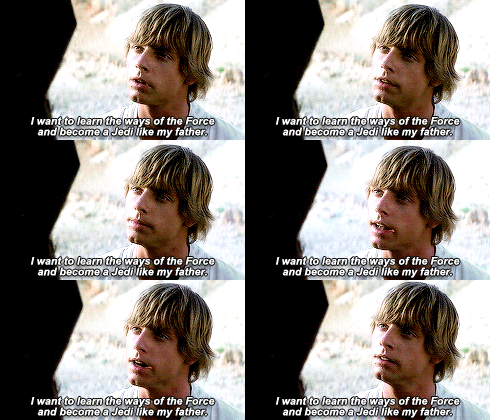
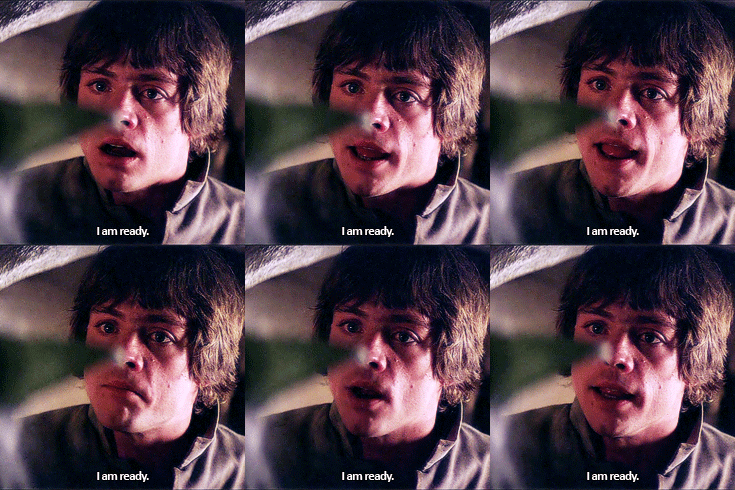
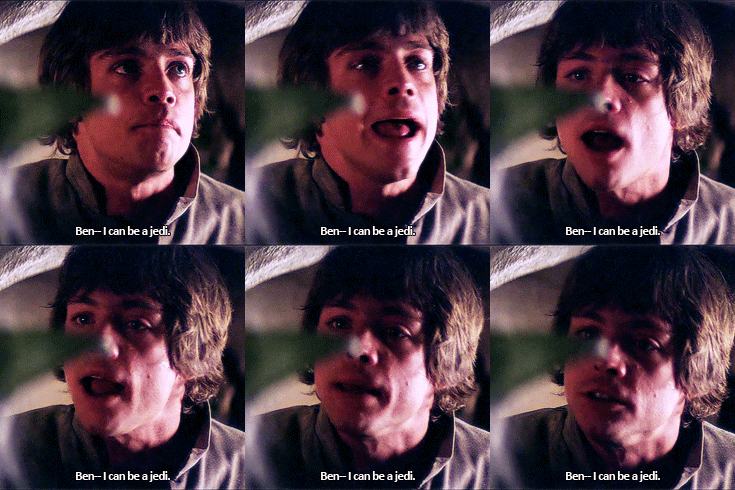
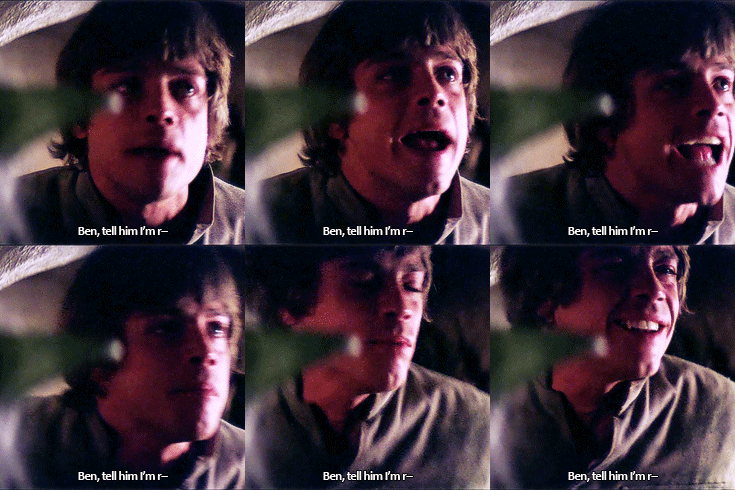
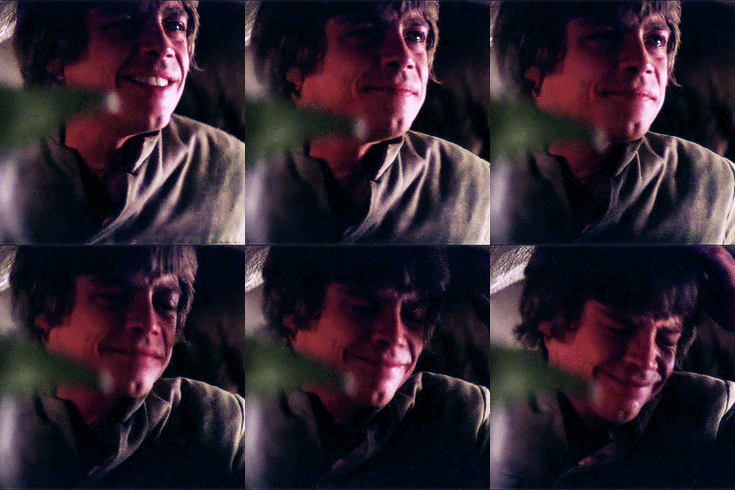
In fact, Luke is one of the most Fe-ish characters I’ve ever seen. He’s basically the ultimate burning emblem of Fe, unashamedly driven and consumed by it. I mean, there are characters out there who appear more Fe-ish. Characters who are more outwardly warm and parental and whatnot. But no one else is so ultimately defined by their Fe, with their identity and motivations so rooted in Fe, as Luke is. Whether he’s going off on a crazy mission to please his new mentor Obi-Wan and honor the memory of his father, disobeying Yoda’s instructions to go rescue his friends, temporarily risking going to the dark side out of a desire to protect his sister, or choosing not to fight in order to redeem his father, everything he does is ultimately motivated by his desire to please or protect someone else.

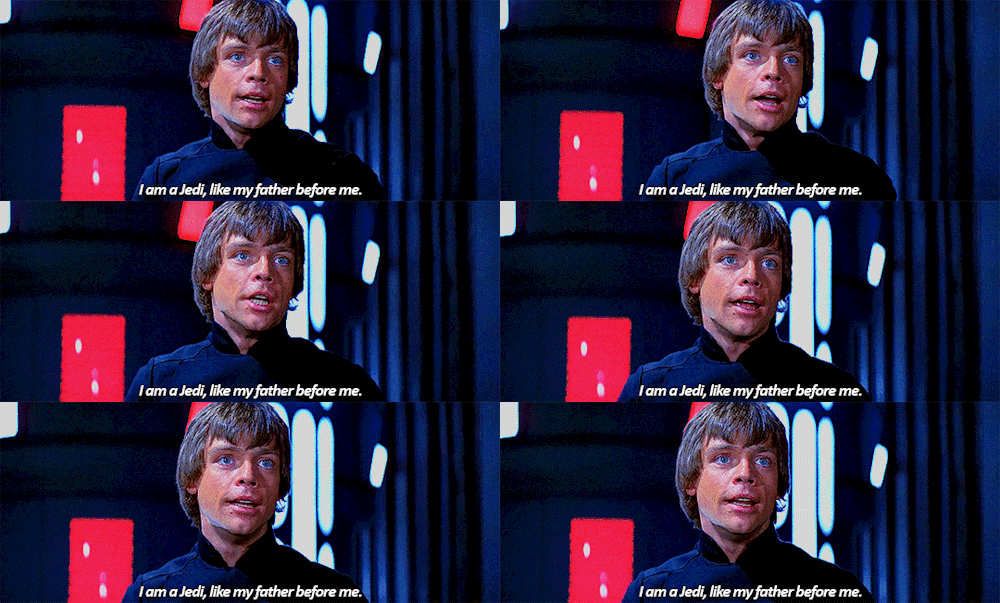
(Source: skywalkcrs.tumblr.com)

I’ve seen Luke accused of being all sorts of things from “whiny” to “clueless.” And while I think I know where such accusations are coming from, I’ve gotten a slightly different impression of such things. What’s more, they are very in line with what one would expect from someone of his age in his circumstances. Luke is very young, and he’s never known life outside the chores and everyday drudge of work on a farm. He’s an extrovert growing restless after being forced his whole life to cope with the very solitary life out in the desert.

(Source: luciusmafoy.tumblr.com)

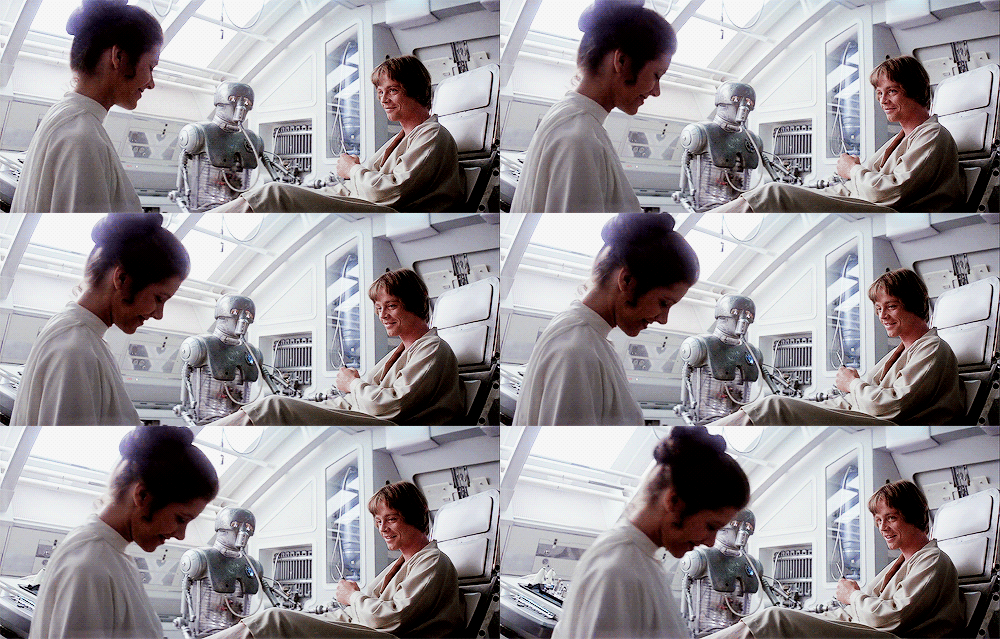
The only social life he’s known are the few people he’s run into at Tosche Station, most of whom (as we’re shown in a deleted scene) aren’t very interested in talking to him. He doesn’t understand people yet. He’s spent his entire life extremely sheltered by his aunt and uncle. And his lack of experience causes him to be very naïve, often treading into “endearingly stupid” territory. Luke is still trying to fully understand the world he’s been placed in when tragedy suddenly throws him into a new one.

(Source: winchestheart.tumblr.com)
(Source: ianmckllen.tumblr.com)

He doesn’t face this new world with snark and narcissistic overconfidence as the case is with many protagonists these days (e.g. Iron Man, Captain Jack Sparrow, Star Lord, etc.), but he also doesn’t just wander around helplessly, wide-eyed and wonder struck. He shows initiative, though often in all the wrong ways. He has a very Gryffindor-like zeal, wanting to help, but instead being bossy; wanting to prove himself, but instead rushing head-first into situations he doesn’t understand yet. He grows and learns in a very hands-on way, making mistakes along the way.

(Source: Tumblr)

The amazing thing about Luke is, despite all his naïveté and inexperience, he still manages to win just with sheer determination. From Han and Luke winging their way through their rescue of Leia, to finding a tiny weakness that can blow up the entire death star, to ewoks destroying the empire’s AT-STs, a common theme in the Star Wars movies are big, powerful things being defeated in the humblest of ways. And Luke embodies that theme so much, which I love. As one of my favorite Tumblr quotes about Luke says, “God, he’s so young. Like this impossible creature of wisdom and naïvete. Luke is just so much: fierce and over-earnest and full of zeal. Drawling smirking mercenaries are easier to love; Luke is something else.”

(Source: godyoutalkpretty.tumblr.com)


2. His Unique Character Arc

All fictional characters fit into some kind of classic trope. Some character follow the pattern of that trope to the letter, while others find a way to break that pattern and add something unique to the mix. Either of these can be done well. For example, Han Solo fits the “charming rogue who secretly has a heart of gold” trope. It’s a very successful trope in fiction, and Han Solo becomes a good character by following its pattern pretty much to the letter. There’s not really anything unique about his arc, per se. It pretty much feels like the same thing as always. It’s “the same thing as always” done particularly well, but still the same thing as always. So, there’s definitely nothing wrong with following the pattern of a trope. Having said that, I find it much more interesting when a story finds a way to be surprising and throws in something unexpected.

Luke belongs to the “young everyman who gets caught up in a hero’s journey” trope. But his character arc goes against this trope’s pattern in many ways, becoming something very unique. Besides some unique elements about his character arc that I will discuss later in the article, examples include the following:

• While most adventurer MCs are reckless because they are always living in the present moment, never looking ahead or considering consequences, Yoda says Luke is reckless for the exact opposite reasons – because he is always looking ahead instead of paying attention to the moment at hand.

(Source: leialuke-archive.tumblr.com)

• Even though most main male characters “get the girl” at the end, the girl he loved ended up being his sister and fell in love with someone else while he remained single until the end of the films.

(Source: daisyrildey.tumblr.com)

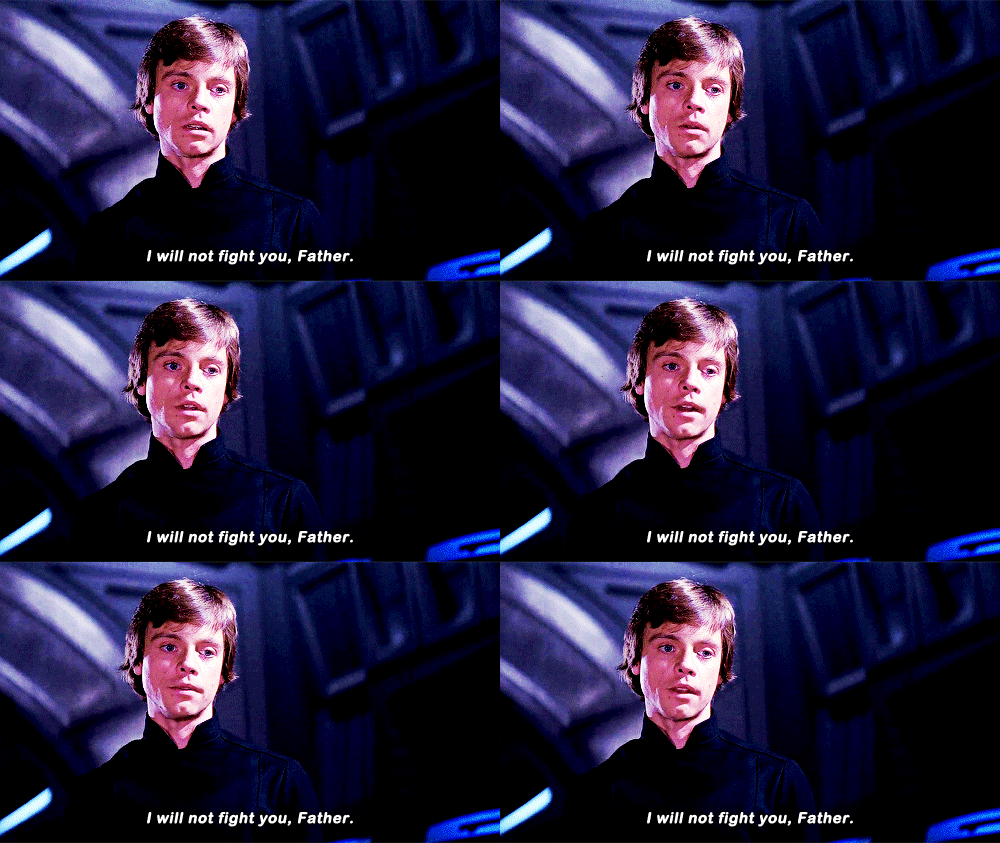
• Even though he’s an action hero, he wins by choosing not to fight, and instead chooses to save the villain so that the villain will send his own evil empire crumbling down.

(Source: skywalkcrs.tumblr.com)

Not only is his story done well, it goes in places you don’t expect.


3. His Complex Motivational Arc

Luke has one of the most tumultuous motivational arcs I’ve seen in an action/fantasy franchise. His Fe (and, along with it, his life purpose) is constantly being forcefully shifted without any way for him to stop or control it. Hardly any time passes before it ends up shifting yet AGAIN. For example:

• Life Purpose: Please his aunt and uncle.
• They die.

• Life Purpose: Please new mentor, Obi Wan.
• He dies.

• Life Purpose: Honor the great legacy of his father by becoming a Jedi.
• It turns out his father’s legacy was a lie. His father is actually evil and trying to kill his new friends.

• Life Purpose: Save new friends.
• It turns out trying to save new friends just makes things worse, and they are all about to die and there’s no way he can stop it.

• Life Purpose: Redeem father who has turned evil.
• Success? Yes!!! What to have as a Life Purpose now? …Ah! I know!

• Life Purpose: Protect newly redeemed father.
(Seriously, Luke will stay on board a ship he knows is about to be destroyed just to stay by his father’s side.)


…And he dies.


Characters are so often defined by their goals in stories, it’s interesting to see someone whose goals constantly change. Instead of knowing Luke by what he’s trying to do, we get to know him simply as a person and take the journey with him as he navigates his own ever-shifting agenda.


4. His Mystery and Morally Ambiguous Virtue

Previous readers of this blog might have guessed during my Star Wars Commentary that I’m not a huge fan of the Jedis or their philosophies. I’ve already talked a lot about how they deny vital parts of humanity and how they have displayed hypocrisy, impatience, and unfair judgment. But while I’m not personally fond of how this whole religion about the Force works, it does serve to make Luke’s story really unique. What it ends up doing is making Luke a morally ambiguous character, despite the fact that he doesn’t make morally ambiguous choices. Even though he’s good, he isn’t what the other good characters want him to be. And there’s such a question mark over whether he’ll ultimately be on the light or dark side. When I try to envision Luke’s morality or potential path before he’s tested by the Emperor, it’s like looking at Schrodinger’s Cat. But instead of shifting between good and evil, it feels more like it’s shifting between absolute good and good/evil. The possibility of evil in him is so small and yet so present. And the good in him is so solid, so indestructible, that if he did turn evil, I know it would be his desire for good that would lead him there and the purpose of his evil actions would be to bring about some good.

Most characters become morally ambiguous because of their questionable ethics – acting selfish, lacking empathy, employing trickery, or sacrificing other people for the “greater good”. But Luke isn’t any of those things. His main drive is selflessness and empathy, he’s honest and open, and his main “fault” in the second film was that he wouldn't sacrifice others for the greater good. And that’s what I find so interesting: Luke is morally ambiguous not because of how his own morality is set up but because of how the morality of this world is set up – their religion and the nature of the Force. And according to that religion, Luke’s ideals are gray in what is otherwise a very black and white world. And even though it’s a good gray, just the fact that it’s not what this world considers “white” puts him at risk for becoming what this world considers “black”.

(Source: twinklingbucky.tumblr.com)

Since this world’s version of morality is built on the idea that some virtues (calm temperament, clarity of mind, a strong connection the universe around us) are good while other virtues (passion, love, loyalty to friends, a sense of adventure) are bad and places ideals above people, the rightness of this world’s morality is at least subjective. We have to remember that just because a “wise” character on the movie says something is right or wrong, that doesn’t mean we, the viewer, have to take their word for it. Their right might actually be wrong, and Luke’s right could be correct instead. Or they might both be wrong. Or a mixture.

Because Luke has been made into a gray character who can easily tilt into white or black territory, this makes him something of a wildcard. You don’t know what side he’ll ultimately be on or even what side you really want him to be on. Personally, I want him to always just be on his own side. The dark side of the force is obviously evil. But the light side, I think, is pretty misguided. Whereas, I believe in Luke’s grayness.


5. His Neutral Good Alignment

One thing that makes Luke’s story so interesting is it’s one of the few I‘ve seen that actually explores the complex nature of the Neutral Good alignment. Neutral Good people have their own code of virtues (usually rooted in Fe – justice, mercy, and helping other people) and their own personal goals based on that code. Unlike, say, Chaotic Good people, they do their best to reach their goals while still working within the law or within the moral framework of the people and culture around them. But at the end of the day, if that law or that framework stops them from reaching their goals, they won’t hesitate to step completely outside those boundaries and do what they believe needs doing. While they greatly respect other people’s morality and will honor it if they can, their own code ultimately takes precedence over other people’s.

Neutral Good is very interesting because it’s very independent and somewhat rebellious but never too morally questionable. And that’s not an alignment I see portrayed well too often in media. Usually the characters I see in mainstream media are one of three extreme things. Either they’re a very righteous Lawful Good hero who stands up for always following the law to the letter and respecting/obeying people in charge of you and believing 100% in the ideals your betters teach you; or they’re a standard Evil villain who crushes all goodness while pursuing their own evil desires; or they’re some really extreme Chaotic Good/Chaotic Neutral character, dripping with rebellion and snark, breaking every rule they can while still being vaguely on the side of good (or at least having a lot of redeemable qualities). Neutral Good, on the other hand, is this calm, quietly rebellious alignment situated right between the Lawful Good and vaguely good Chaotic ones. It’s not, in any way, an extreme. And I think that’s why most filmmakers either don’t think about it or just aren’t interested in it. Since it’s not an extreme, they think people won’t take to it. But it is far more real and complex than the extreme alignments in my opinion, and way more interesting than people give it credit for.

Like most Neutral Good people, Luke isn’t really driven by loyalty to any side or by any ideology. He’s driven solely by his personal moral code, his desire to help/save people, his Fe. It drowns out all the issues for him that most other characters in this universe think about, such as politics and war and loyalty to certain philosophies. In fact, one really important thing about Luke that a lot of people don’t realize is just how apolitical he is. I’ve read/watched a lot of interviews about the creation of Luke’s character. And one thing that was apparently really important to the cast and crew to drive home is how little allegiance he has to any particular side. Unfortunately, a lot of the scenes they made to drive this home to viewers had to be cut due to time constraints. But one scene even showed Luke considering joining with the Empire because he had a friend who had done so. He didn’t care or stop to think about the philosophical implications of joining the Empire or helping them do what they do. All he knew was that he cared about his friend and wanted to join up with him.


And ultimately, it’s the same with his joining up with the rebellion and the Jedis too. He doesn’t have any particular passion for their cause or beliefs. In fact, all he knows of them is what Obi-Wan told him in one short conversation he was barely paying attention to. All he knows is he cares about Obi Wan and wants to follow him, and he cares about his father (or what he believed his father to be at the time) and wants to do something that would have made him proud. Luke isn’t about politics or ideologies or taking sides in anything. He’s willing to join up with a side, but deep down, his heart isn’t loyal to that side. And the only reason he joins up with a side in the first place is because someone he loves has done so and he wants to follow them so he can be around them or help/protect them.

I think the scene where the Emperor tries to turn Luke to the dark side but Luke resists the temptation and helps redeem his father instead is one you really have to watch in light of all that. A lot of people don’t, and I think that leads them to misunderstand the scene. A lot of people think, “Luke is a good guy but also kind of reckless and didn’t always listen to Yoda when he should. He makes mistakes, such as the time he was supposed to stay and train and instead went off to save his friends. But when tempted by the Emperor, Luke ultimately resists. Instead, he chooses to embrace the teachings Yoda taught him and accepts the way of the Jedis, helping redeem his father in the process.” While some of that’s true, it’s also much more complicated than that. While Luke does become a Jedi, I think he still has not fully embraced their philosophies the way Yoda would have wanted and instead still relies on his own moral code. In fact, in this regard, I don’t think Luke is particularly changed by the end of the movies. For example, if he was again presented with the choice to stay for more training as Yoda wishes or go save his friends, I believe he would once again choose to save his friends. He still has the same mindset and priorities he’s always had.

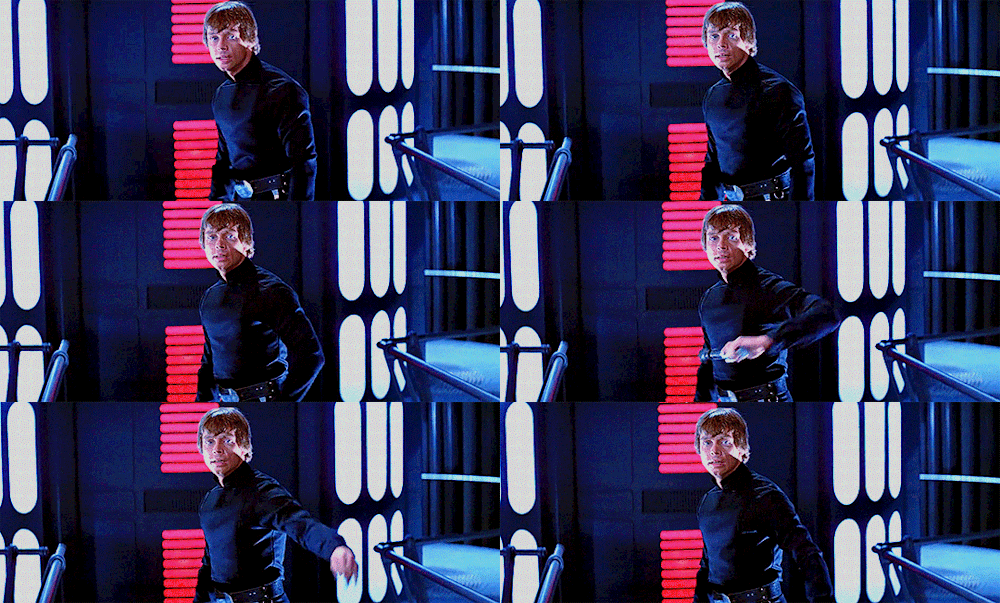
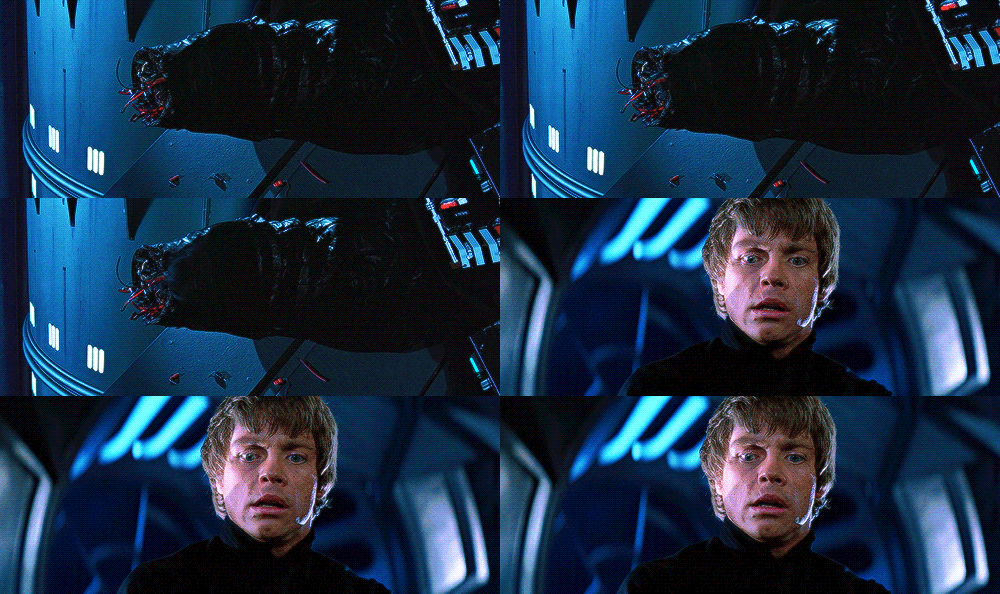
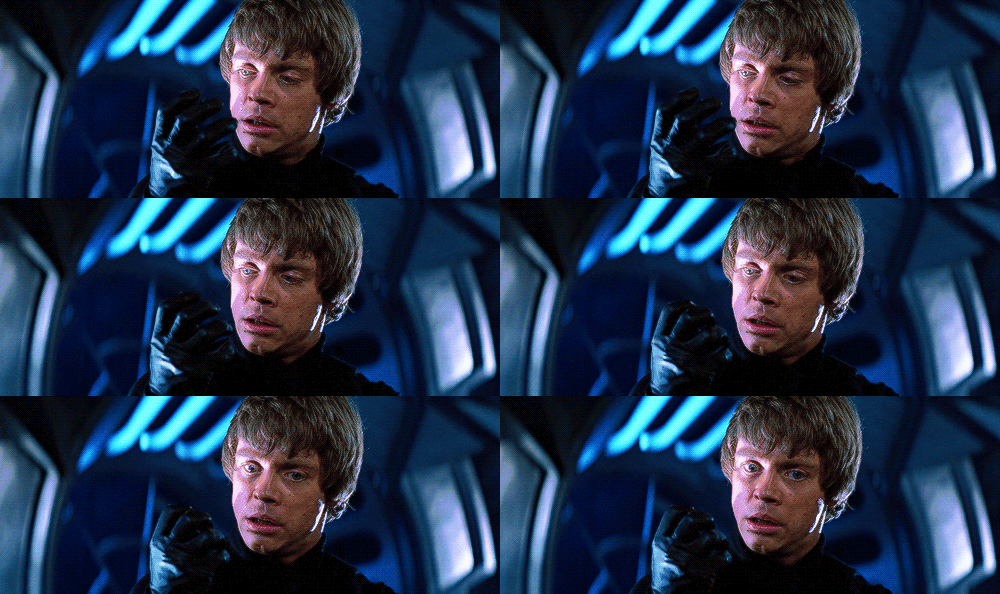
When given the choice between saving someone or doing “the right thing,” Luke will choose to save someone. Because, to him, saving someone is the right thing. Always. Even when others disagree and believe sacrificing others is necessary for the greater good. Because what’s the point of doing what others see as good if it means letting people die or failing people who count solely on you? What’s the point of living as a “good person” if you have to live without the people you love? Sure, the idea of going to the dark side scares him, makes him hesitate. Which is what we see him do when he sees his father’s hand and realizes he might be following Vader’s path.

(Source: padme4president.tumblr.com)

He definitely doesn’t want to be evil, and the possibility of turning evil is definitely making him cautious. But if the choice here was genuinely between going to the dark side while saving someone, or staying on the light side while letting people die, I think it would only be a matter of time before he went to the dark side (though I don’t think he would do so on the Emperor’s terms or view the Emperor as his master).

As I’ve said before, everything he does is completely dictated by his Fe. When the Emperor’s plan starts to work a little and they finally get Luke fighting Vader, it’s because Luke’s Fe kicks in and he’ll do anything to protect Leia. When Luke decides not to fight anymore, it isn’t because he’s conquered his Fe and realizes that “doing the right thing” is more important than saving Leia. Only by stepping back for a second and transferring his Fe to his desire to save his father does he stop himself from going to the dark side. But what would have happened if the person he was fighting wasn’t his father? What if it was someone he had no desire to save? I think there’s a very good chance he might have turned in such a case.

(Source: theforcesource.tumblr.com)

The reason he doesn’t go to the dark side is not because he’s ~so devoted~ to the light side of the force. I think, even to the end, he has that subconscious lack of allegiance to anything other than individuals he cares for. Rather, his resistance to being turned is because, in this particular case, going to the dark side would require him to give up trying to redeem his father, fight his father, and kill him. And he wants to save his father. That’s the point. It will never be about what side he’s on. It will always be about saving someone. Everything else – his morality and allegiances – will always be a question mark because it all depends on what he has to do in each situation to save whoever he wants to save.


6. His Determination To Love Others

In many ways, Luke remaining on the good side is due to luck and circumstances. But I also think it’s more than that. When something – even bad choices – is done out of love, it’s really hard to corrupt. Even Vader, who was turned to the dark side through his love for Padme, is not as firmly on the dark side as people think. He expressed a wish for the Emperor to be defeated in the second film, Luke senses strong goodness in him, and his love for his son (as well as his son’s love for him) ultimately turns him back to the good side again.

(Source: aaronpaauls.tumblr.com)

Love is such an inherently good thing that, even though it can be used to make people do bad things or even align with the bad side, sustaining that badness is very difficult because it was born out of a natural desire to do good. And I think that, while there is definitely a lot of risk involved with it, the way Luke’s morality is built is just so rooted in love that it gives him a sort of protection that others might not have. In fact, in many ways I think who he is – including the parts Yoda disapproved of – makes him more resistant to evil than what Yoda wanted him to become.

(Source: leialuke-archive.tumblr.com)

Lawful-aligned characters like Yoda definitely give an appearance of absolute righteousness and responsibility. But because his philosophies place ideals over caring for other people, that makes his focus ultimately inward on himself instead of outward. It’s all about his own growth, his own beliefs, his own feelings. When Yoda does something good he either does it out of duty, because he believes he’s “supposed” to, or he does it for himself because he wants to be a good person and wants to be on the good side of the force. Whereas, what’s very interesting about Luke is that the times he’s the most good is not when he’s trying to be good. It’s not when he’s mentally fighting the Emperor, trying to hold onto everything the Jedis have taught him. It’s not when he’s focused on himself, trying to control his emotions. The times he’s the most good is when he’s not trying at all, when he’s not even thinking about it, when his mind switches from himself and his morals to instead thinking about his father, wanting his father to be redeemed.

Luke’s goodness is built on taking his mind off himself and putting it on other people. And that’s why I prefer it. It’s about empathy and love. He’s not good because he wants to be; he doesn’t do good because he feels it’s his “duty.” It’s just natural. There’s such a genuine purity about it. And I think that’s why, no matter what sides (good or bad) he’d  join up with in his efforts to save people, he will always end up on the good side in the end. I think that’s why, more than just because of luck, he ended up on the good side in these films. His redeeming Fe doesn’t just save his father. It saves him too.

(Source: luciusmafoy.tumblr.com)