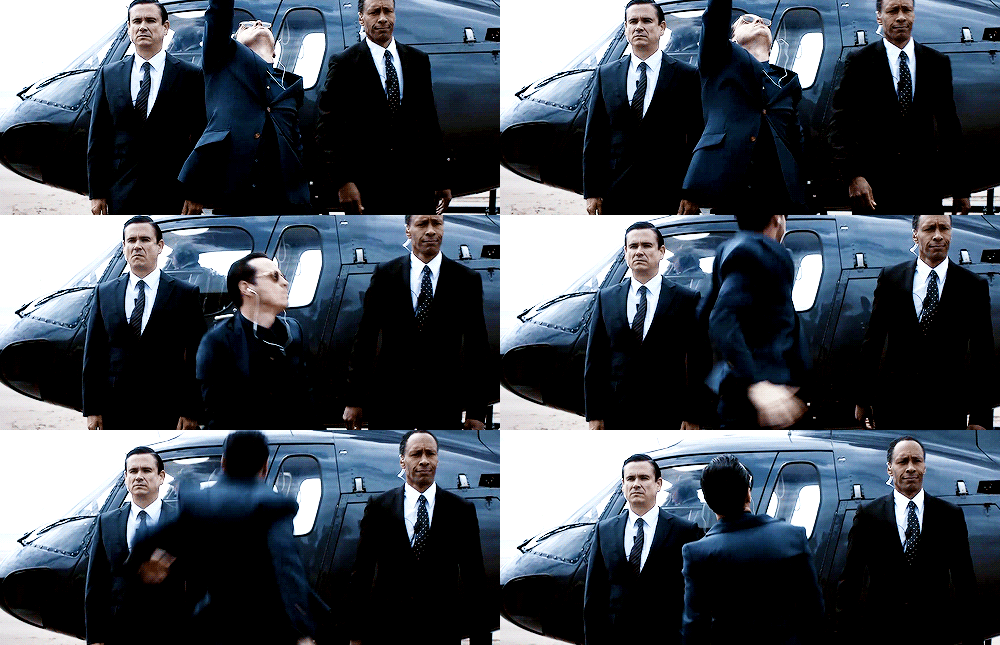
Sherlock spoilers ahead. Seriously, if you haven’t seen the show and want to, don’t read this.

First, I’m going to do a quick recap of every villain we’ve seen so far. There have been a lot. (Isn’t it exciting that the Sherlock fandom can say that now??) Feel free to skip it if you remember the details of every episode.
s1.e1: “A Study in Pink”: The Cabbie

Sponsored by Moriarty, the cabbie kills his victims by forcing them to play Russian roulette with unmarked pills.
s1.e2: “The Blind Banker”: The Black Lotus

This gang, also helped by Moriarty, kills its own members if they’re suspected of infidelity and kidnaps John in order to force him to give up information on their stolen item.
s1.e3: “The Great Game”: Moriarty

Moriarty gives Sherlock clue after clue in the form of civilians strapped into explosive vests, forcing him to solve murders to keep them from dying.
s2.e1: “A Scandal in Belgravia”: Irene Adler

“The Woman” is blackmailing a member of British nobility, so Sherlock is sent to retrieve her smartphone. In the process, she tricks him into cracking a government code for Moriarty.
s2.e2: “The Hounds of Baskerville”: Dr. Frankland

Part of a secret government project, Dr. Frankland goes rogue and tests a hallucinogenic gas developed as a weapon. He kills the man who caught him, prompting the man’s son to call Sherlock.
s2.e3: “The Reichenbach Fall”: Moriarty

After being acquitted, Moriarty frames Sherlock by conditioning a little girl and planting bits of information. Sherlock is forced to commit suicide in order to save his friends from snipers.
s3.e1: “The Empty Hearse”: Lord Moran

A train carriage is diverted and rigged with explosives, intended to blow up Parliament as they discuss a new anti-terrorism bill. It’s implied that Magnussen is behind kidnapping John.
s3.e2: “The Sign of Three”: The Photographer

With the intention of killing John’s old friend, Major Sholto, the brother of a man who was killed at war has been practicing murder. He disguises himself as a photographer and stabs the Major at John’s wedding.
s3.e3: “His Last Vow”: Charles Augustus Magnussen / Mary Watson

Sherlock is investigating Magnussen, a newspaper owner, for blackmailing Lady Smallwood’s husband. During the investigation, Mary shoots Sherlock after he finds her holding Magnussen at gunpoint, and it is revealed that she was an assassin. Later, after offering to trade state secrets for the blackmail, Sherlock finds out that Magnussen’s blackmail vault is all mental.
Christmas Special: “The Abominable Bride”: The Women’s Rights Movement


Whether you’re writing a script, novel, comic, short story, what have you, you need a protagonist and an antagonist. Consider this villain writing 101. First, the antagonists we’re talking about here are man-vs-man, not man-vs-nature or man-vs-himself. Those are totally different stories. Second, your antagonist and protagonist are the absolute most important parts of your story. Your setting, plot and descriptions are all second to your main characters. A reader (aka television watcher, audiobook listener, comic fanatic, etc., but referred to from here on out as “reader” for simplicity’s sake) can look past a lot of things, but no reader will continue reading/watching/listening to something with weak characters. So what makes a strong character? Or, more specifically, what makes a good villain?
First and foremost, a villain is a person. A villain who is a plot device is a villain useless to a story. If you don’t think of your villain as his own character, neither will readers. Your story will be one-sided and flat--neither of which are words you want in your reviews. So what does that mean?
No person ever does anything without motivation. Everyone wants something. If you don’t believe this, you shouldn’t be writing. Take a couple days. Analyze all your actions, all the actions of everyone around you. Find the motivations.
Take the photographer, for example, at John’s wedding. The Major got the photographer’s brother killed. The photographer wanted revenge. Motivation. The Women’s Rights Movement in the Christmas special. They wanted, as their name suggests, rights. They wanted to punish the men who had wronged them. Motivation. Now take Moriarty. His motivations aren’t as close to the surface; he seems to do things randomly. But there’s a pattern. Everything he does is to gain power. And, once he has power, to torment Sherlock Holmes. He wants to be the best. So he makes other people play his games, because it makes him feel powerful.

Then there’s Eurus Holmes. It would seem, at the beginning, that she wants to feel powerful. She puts everyone through her psychotic games because she wants them to be her playthings. Then she says that she wants to study human emotion because she doesn’t understand it, and that’s her motivation. She watches as the mental states of Sherlock, John and Mycroft slowly deteriorate with interest. Then it’s revealed that she only ever wanted the love and acceptance of her brothers. This is problematic. Her “true” motivations negate things she said earlier in the episode. And, more than this, any basic understanding of humanity shows that none of her actions could have been produced by what the writers claimed to be her true motivation.

Sponsored by Moriarty, the cabbie kills his victims by forcing them to play Russian roulette with unmarked pills.
s1.e2: “The Blind Banker”: The Black Lotus

This gang, also helped by Moriarty, kills its own members if they’re suspected of infidelity and kidnaps John in order to force him to give up information on their stolen item.
s1.e3: “The Great Game”: Moriarty

Moriarty gives Sherlock clue after clue in the form of civilians strapped into explosive vests, forcing him to solve murders to keep them from dying.
s2.e1: “A Scandal in Belgravia”: Irene Adler

“The Woman” is blackmailing a member of British nobility, so Sherlock is sent to retrieve her smartphone. In the process, she tricks him into cracking a government code for Moriarty.
s2.e2: “The Hounds of Baskerville”: Dr. Frankland

Part of a secret government project, Dr. Frankland goes rogue and tests a hallucinogenic gas developed as a weapon. He kills the man who caught him, prompting the man’s son to call Sherlock.
s2.e3: “The Reichenbach Fall”: Moriarty

After being acquitted, Moriarty frames Sherlock by conditioning a little girl and planting bits of information. Sherlock is forced to commit suicide in order to save his friends from snipers.
s3.e1: “The Empty Hearse”: Lord Moran

A train carriage is diverted and rigged with explosives, intended to blow up Parliament as they discuss a new anti-terrorism bill. It’s implied that Magnussen is behind kidnapping John.
s3.e2: “The Sign of Three”: The Photographer

With the intention of killing John’s old friend, Major Sholto, the brother of a man who was killed at war has been practicing murder. He disguises himself as a photographer and stabs the Major at John’s wedding.
s3.e3: “His Last Vow”: Charles Augustus Magnussen / Mary Watson

Sherlock is investigating Magnussen, a newspaper owner, for blackmailing Lady Smallwood’s husband. During the investigation, Mary shoots Sherlock after he finds her holding Magnussen at gunpoint, and it is revealed that she was an assassin. Later, after offering to trade state secrets for the blackmail, Sherlock finds out that Magnussen’s blackmail vault is all mental.
Christmas Special: “The Abominable Bride”: The Women’s Rights Movement

Sherlock tries to solve the problem of a woman who shot herself in the head but survived in an 1800s parallel of Moriarty’s death, only to find that the women’s group uses the “avenging bride” to kill men who have wronged them.
s4.e1: “The Six Thatchers”: A.J. / Vivian Norbury

A.J., one of Mary’s fellow assassins, is trying to kill Mary because he thinks she betrayed them. It’s later shown that Norbury, Lady Smallwood’s secretary, was behind the supposed betrayal and has been selling state secrets.
s4.e2: “The Lying Detective”: Culverton Smith

A drug-addled Sherlock becomes obsessed with rich serial killer Culverton Smith after (who he thought was) Smith’s daughter came to him. Sherlock ends up in the hospital where Smith tries to murder him.
s4.e3: “The Final Problem”: Eurus Holmes

After revealing herself in the previous episode as Faith Culverton and John’s therapist, Eurus Holmes runs Sherlock, Mycroft and John through a series of psychological puzzles in an attempt to gain Sherlock’s attention.
Okay. Now that you’ve been reminded of the villain in every episode, you’re probably remembering which were your favorite and which you had completely forgotten about. And maybe a few you thought were totally useless and made for terrible episodes. As a writer, I tried to figure out why I thought these things about certain villains. Why Andrew Scott’s Moriarty is miles ahead of almost every other television villain, and why Eurus Holmes made me want to throw things through my television.s4.e1: “The Six Thatchers”: A.J. / Vivian Norbury

A.J., one of Mary’s fellow assassins, is trying to kill Mary because he thinks she betrayed them. It’s later shown that Norbury, Lady Smallwood’s secretary, was behind the supposed betrayal and has been selling state secrets.
s4.e2: “The Lying Detective”: Culverton Smith

A drug-addled Sherlock becomes obsessed with rich serial killer Culverton Smith after (who he thought was) Smith’s daughter came to him. Sherlock ends up in the hospital where Smith tries to murder him.
s4.e3: “The Final Problem”: Eurus Holmes
After revealing herself in the previous episode as Faith Culverton and John’s therapist, Eurus Holmes runs Sherlock, Mycroft and John through a series of psychological puzzles in an attempt to gain Sherlock’s attention.

Yes, yes we did. (source)
Whether you’re writing a script, novel, comic, short story, what have you, you need a protagonist and an antagonist. Consider this villain writing 101. First, the antagonists we’re talking about here are man-vs-man, not man-vs-nature or man-vs-himself. Those are totally different stories. Second, your antagonist and protagonist are the absolute most important parts of your story. Your setting, plot and descriptions are all second to your main characters. A reader (aka television watcher, audiobook listener, comic fanatic, etc., but referred to from here on out as “reader” for simplicity’s sake) can look past a lot of things, but no reader will continue reading/watching/listening to something with weak characters. So what makes a strong character? Or, more specifically, what makes a good villain?
First and foremost, a villain is a person. A villain who is a plot device is a villain useless to a story. If you don’t think of your villain as his own character, neither will readers. Your story will be one-sided and flat--neither of which are words you want in your reviews. So what does that mean?
A good villain has a motivation.
No person ever does anything without motivation. Everyone wants something. If you don’t believe this, you shouldn’t be writing. Take a couple days. Analyze all your actions, all the actions of everyone around you. Find the motivations.
Take the photographer, for example, at John’s wedding. The Major got the photographer’s brother killed. The photographer wanted revenge. Motivation. The Women’s Rights Movement in the Christmas special. They wanted, as their name suggests, rights. They wanted to punish the men who had wronged them. Motivation. Now take Moriarty. His motivations aren’t as close to the surface; he seems to do things randomly. But there’s a pattern. Everything he does is to gain power. And, once he has power, to torment Sherlock Holmes. He wants to be the best. So he makes other people play his games, because it makes him feel powerful.

(source)
Then there’s Eurus Holmes. It would seem, at the beginning, that she wants to feel powerful. She puts everyone through her psychotic games because she wants them to be her playthings. Then she says that she wants to study human emotion because she doesn’t understand it, and that’s her motivation. She watches as the mental states of Sherlock, John and Mycroft slowly deteriorate with interest. Then it’s revealed that she only ever wanted the love and acceptance of her brothers. This is problematic. Her “true” motivations negate things she said earlier in the episode. And, more than this, any basic understanding of humanity shows that none of her actions could have been produced by what the writers claimed to be her true motivation.
Which brings us to our next point.
People are notoriously predictable. Even at their most unpredictable, any person’s actions will follow a pattern. This is literally the entire point of Sherlock. Every case that Sherlock solves is solved by analyzing a pattern and coming to a conclusion.
The cabbie in the first episode always kills people the same way. The Black Lotus has the same goal throughout, and every move it makes is in pursuit of that goal. Moriarty has the same cool demeanor and the same relationship with Sherlock throughout the whole series.

Now take A.J., from “The Six Thatchers.” He is a tortured super-secret assassin gone rogue. Who is somehow beat in a fist fight with Sherlock Holmes. He’s worked with Mary for most of his life but lets one instance convince him that she betrayed them all. His character doesn’t match his backstory. His actions don’t match his motivations. He’s a weak villain, both in writing and in constitution.
An unbeatable villain makes your protagonist either lose (bummer) or defy the laws of your universe to beat the villain (bad). A weak villain is just straight up boring. This also goes for groups: the sum of your protagonists needs to be equal to the sum of your antagonists.
Moriarty is perfect because he is the only one equal to Sherlock Holmes. They are matched in wits--the most important equality considering the show focuses on Sherlock’s mental capacities. But they are also matched in strength (neither is particularly brutish), manners, dress, refinement, and strength of will.
We love Mary because, whether villain or simply Mrs. Watson, she's able to converse with and even best Sherlock Holmes. Irene Adler, too, holds her own against Sherlock. Even though she’s not as smart as he is, she holds the upper hand in reading people. She’s able to baffle him because, while her strengths lie in different areas, she’s able to keep up with him in his strengths until she’s able to pull ahead using her own.
Now let’s look at Eurus Holmes again. We’re told* over and over again that she’s brilliant. She is the smartest Holmes. No one can keep up. She can even control people’s minds. Because she’s that smart. But we’re never shown that. Nothing she does in “The Final Problem” shows that she’s smart. She’s confused when Sherlock won’t shoot his friend or brother. Not something that someone smart enough to mind control people would express. Her puzzles don’t show that she’s smart: she had the information and just didn’t give it all to Sherlock. She gets out of prison and decides to go back. If she were truly as smart as they say, she would’ve found better opportunities than just going back to her cell and removing the glass.

*Everyone has heard the phrase “show don’t tell.” This episode was the perfect example of it. We’re told that Eurus is smart, that Eurus is crazy, that we should be afraid of Eurus. But nothing she does supports any of these assertions. In fact, her actions don’t show anything about her at all, other than she’s kind of mean and wants a hug from her brother. In fact, we don’t really know anything about her except that she’s supposedly smart. This is the first time she’s brought up, and it’s done poorly.
This doesn’t mean that your reader needs to know every detail of your villain’s backstory. To the contrary: the more mysterious your villain is, the more we want to know about him. But you--you the writer--need to know everything about your villain’s backstory. Otherwise, your little details don’t add up to a real person and your reader loses interest.
The wedding photographer has a dead brother and a lifetime of not being over it. The cabbie has a wife and children and a terminal disease. A good backstory leads to a motivation.
A great backstory leads to an interesting character. We get hints at Moriarty in every episode. We see him sponsoring the cabbie and giving the Black Lotus a foothold. So we know he gives people a leg up if it serves his own purposes. We see him stealing the crown jewels and just sitting there and learn that he likes to do things just because he can. We see him strapping people into explosive vests, so we know he has no scruples about killing people. We don’t know anything about his past. But that’s okay, because what we do know about him all adds up to the same interesting character. With Irene Adler, too, we’re only given small details about her recent past, but they all work together to give us a full view of her as a character.

Mary is also given a full backstory. But we learn it in bits and pieces, never quite sure of whether she's a villain or not: backstory is important for any character, not just villains. And Mary's complex backstory leads not only to motivations for her actions, but also to a wonderful and complex character.
A.J., however, is given a full backstory with little bearing on his present. Eurus is given small pieces of a backstory that don’t add up to her present. Vivian Norbury isn’t given a backstory at all and her actions come out of the blue. None of which are things you want to do when writing a villain.
In a similar vein, but important enough to merit its own point,
The most interesting part of any character is the detail, the quirks. The crooked smile of his from being punched in the face as a boy during a pickup basketball game. The streak of pink in the underside of her hair because her school wouldn’t let her have dyed hair. His love of 90s slang.
Even better is when the details are unexpected but add to the reader’s overall view of the character. The hardcore biker dude who loves to bake. The bubblegum blonde popular girl who’s been taking martial arts since she could walk. The calm, cool, collected serial killer with the 70s disco ringtone.
Moriarty is a perfect example. The writers could have told us that he was a serial killer, shown us the people in explosive vests, had him torment Sherlock, and he would have been a terrifying villain. But they gave him a soundtrack contrary to the show and contrary to his actions yet forming him as a character in our minds. They showed him casually eating fruit, only to have carved a sinister message into it. They gave him a soft voice, a temper, and a flair for the dramatic. And these little details unnecessary to the plot are one of the reasons we love him so much as a character.

Irene Adler is given a specialized text tone. A relationship with her assistant. A specific way of speaking. A personally decorated home. A favorite outfit. Nothing all that important to the plot, but crucial to establishing her as a good, interesting character.
Magnussen is given shark eyes and a cool-looking house, but we get very few details about him as a person. The few we do get are only in the capacity of how he relates with our protagonists. This doesn’t make for a memorable villain. If your villain isn’t independent of your protagonist, the reader will only remember him as an obstacle, not a character. A.J. is given no personal details, only a vendetta. So we don’t care as much about the conflict. Because it’s not a conflict between two people, it’s an obstacle Mary has to jump over. And we already know she’s good at that.
Finally,
Every human has a code of conduct that they live by. Some have stronger codes than others, and some have moral compasses that point very far from due north, but everyone lives by principles. Think of the people you know. I’m sure you have at least one friend who is always upset about something that they think is wrong. And you have one that thinks gossiping is fine but won’t shop at Wal-Mart. And one that you’ve never really seen object to anything except peas. Villains are people. People have things that they just won’t do.

The wedding photographer won’t make a scene by straight up shooting Major Sholto or blowing up the wedding--he wants to live, and he wants to live free. He values his freedom more than he values killing the Major. Pity he went up against Sherlock Holmes. Dr. Frankland doesn’t want to kill people. He killed one person and, rather than just getting rid of the witness, tries to scare him and make him believe something else. Mary--secret assassin Mary--shoots Sherlock someplace non-lethal. Moriarty is playing a game. He makes up the rules, and then he follows them. He wouldn’t be nearly as good of a villain if he made up rules and puzzles for Sherlock, only to constantly change things without warning. We would get bored of him.
Eurus Holmes doesn’t have anything she won’t do. She’s “crazy,” so her actions are totally unpredictable and don’t follow any sort of code of conduct. I can believe this to a point. But the argument could also be made that because she’s crazy, certain patterns would be stronger. But we don’t see her exhibit any kind of restraint. I suppose she doesn’t want Sherlock to die, so that’s something, but then it should also follow that she would have some reservations about Mycroft dying as well. But she doesn’t. Her only weakness is a lack of love, which doesn’t make sense because she’s supposedly a psychopath and because that doesn’t follow at all from her choices. Moriarty is able to be beaten because he follows his own rules. Eurus Holmes isn’t beaten, she gives up. That’s not something you want in a good villain.

But the worst of this is Culverton Smith. He’s a slimy, repulsive serial killer. Always a good start for a villain. We see him give money to build hospitals, so we think he wants to do good with his money, despite the fact that he kills people. That’s not a bad way to write a villain. But. It’s then revealed that he only built the hospital so that it would be easier to kill people. It’s not that he uses the hospital he built; he literally built it for killing people. And he suddenly becomes one-dimensional. He no longer has principles, and so we no longer care about him as a human being. He drugs people so that he can confess, which gives him a weak constitution and makes us respect him less. He apparently doesn’t drug them well enough, which makes for a weak plot point. If your reader doesn’t care about your villain, your conflict loses strength. And if your villain’s weaknesses stem from lazy writing, your story isn’t good.
Now think of your favorite villains in any story, and run through these questions:
Now think of a character you’re writing and do the same thing. If you can’t answer any of these questions about your villain, what can you do to fix that? If you’re at a loss, try one of these exercises:
The last season of Sherlock was a major disappointment. Do the world a favor and make sure whatever you’re writing doesn’t end up that way, too. Now go forth and write!
A good villain has consistency.
People are notoriously predictable. Even at their most unpredictable, any person’s actions will follow a pattern. This is literally the entire point of Sherlock. Every case that Sherlock solves is solved by analyzing a pattern and coming to a conclusion.
The cabbie in the first episode always kills people the same way. The Black Lotus has the same goal throughout, and every move it makes is in pursuit of that goal. Moriarty has the same cool demeanor and the same relationship with Sherlock throughout the whole series.

(source)
Now take A.J., from “The Six Thatchers.” He is a tortured super-secret assassin gone rogue. Who is somehow beat in a fist fight with Sherlock Holmes. He’s worked with Mary for most of his life but lets one instance convince him that she betrayed them all. His character doesn’t match his backstory. His actions don’t match his motivations. He’s a weak villain, both in writing and in constitution.
A good villain is equal to the protagonist.
An unbeatable villain makes your protagonist either lose (bummer) or defy the laws of your universe to beat the villain (bad). A weak villain is just straight up boring. This also goes for groups: the sum of your protagonists needs to be equal to the sum of your antagonists.
Moriarty is perfect because he is the only one equal to Sherlock Holmes. They are matched in wits--the most important equality considering the show focuses on Sherlock’s mental capacities. But they are also matched in strength (neither is particularly brutish), manners, dress, refinement, and strength of will.
We love Mary because, whether villain or simply Mrs. Watson, she's able to converse with and even best Sherlock Holmes. Irene Adler, too, holds her own against Sherlock. Even though she’s not as smart as he is, she holds the upper hand in reading people. She’s able to baffle him because, while her strengths lie in different areas, she’s able to keep up with him in his strengths until she’s able to pull ahead using her own.
Now let’s look at Eurus Holmes again. We’re told* over and over again that she’s brilliant. She is the smartest Holmes. No one can keep up. She can even control people’s minds. Because she’s that smart. But we’re never shown that. Nothing she does in “The Final Problem” shows that she’s smart. She’s confused when Sherlock won’t shoot his friend or brother. Not something that someone smart enough to mind control people would express. Her puzzles don’t show that she’s smart: she had the information and just didn’t give it all to Sherlock. She gets out of prison and decides to go back. If she were truly as smart as they say, she would’ve found better opportunities than just going back to her cell and removing the glass.

That's the best you can come up with? (source)
*Everyone has heard the phrase “show don’t tell.” This episode was the perfect example of it. We’re told that Eurus is smart, that Eurus is crazy, that we should be afraid of Eurus. But nothing she does supports any of these assertions. In fact, her actions don’t show anything about her at all, other than she’s kind of mean and wants a hug from her brother. In fact, we don’t really know anything about her except that she’s supposedly smart. This is the first time she’s brought up, and it’s done poorly.
A good villain has a good backstory.
This doesn’t mean that your reader needs to know every detail of your villain’s backstory. To the contrary: the more mysterious your villain is, the more we want to know about him. But you--you the writer--need to know everything about your villain’s backstory. Otherwise, your little details don’t add up to a real person and your reader loses interest.
The wedding photographer has a dead brother and a lifetime of not being over it. The cabbie has a wife and children and a terminal disease. A good backstory leads to a motivation.
A great backstory leads to an interesting character. We get hints at Moriarty in every episode. We see him sponsoring the cabbie and giving the Black Lotus a foothold. So we know he gives people a leg up if it serves his own purposes. We see him stealing the crown jewels and just sitting there and learn that he likes to do things just because he can. We see him strapping people into explosive vests, so we know he has no scruples about killing people. We don’t know anything about his past. But that’s okay, because what we do know about him all adds up to the same interesting character. With Irene Adler, too, we’re only given small details about her recent past, but they all work together to give us a full view of her as a character.

(source)
Mary is also given a full backstory. But we learn it in bits and pieces, never quite sure of whether she's a villain or not: backstory is important for any character, not just villains. And Mary's complex backstory leads not only to motivations for her actions, but also to a wonderful and complex character.
A.J., however, is given a full backstory with little bearing on his present. Eurus is given small pieces of a backstory that don’t add up to her present. Vivian Norbury isn’t given a backstory at all and her actions come out of the blue. None of which are things you want to do when writing a villain.
In a similar vein, but important enough to merit its own point,
A good villain has detail.
The most interesting part of any character is the detail, the quirks. The crooked smile of his from being punched in the face as a boy during a pickup basketball game. The streak of pink in the underside of her hair because her school wouldn’t let her have dyed hair. His love of 90s slang.
Even better is when the details are unexpected but add to the reader’s overall view of the character. The hardcore biker dude who loves to bake. The bubblegum blonde popular girl who’s been taking martial arts since she could walk. The calm, cool, collected serial killer with the 70s disco ringtone.
Moriarty is a perfect example. The writers could have told us that he was a serial killer, shown us the people in explosive vests, had him torment Sherlock, and he would have been a terrifying villain. But they gave him a soundtrack contrary to the show and contrary to his actions yet forming him as a character in our minds. They showed him casually eating fruit, only to have carved a sinister message into it. They gave him a soft voice, a temper, and a flair for the dramatic. And these little details unnecessary to the plot are one of the reasons we love him so much as a character.

(source)
Irene Adler is given a specialized text tone. A relationship with her assistant. A specific way of speaking. A personally decorated home. A favorite outfit. Nothing all that important to the plot, but crucial to establishing her as a good, interesting character.
Magnussen is given shark eyes and a cool-looking house, but we get very few details about him as a person. The few we do get are only in the capacity of how he relates with our protagonists. This doesn’t make for a memorable villain. If your villain isn’t independent of your protagonist, the reader will only remember him as an obstacle, not a character. A.J. is given no personal details, only a vendetta. So we don’t care as much about the conflict. Because it’s not a conflict between two people, it’s an obstacle Mary has to jump over. And we already know she’s good at that.
Finally,
A good villain has principles.
Every human has a code of conduct that they live by. Some have stronger codes than others, and some have moral compasses that point very far from due north, but everyone lives by principles. Think of the people you know. I’m sure you have at least one friend who is always upset about something that they think is wrong. And you have one that thinks gossiping is fine but won’t shop at Wal-Mart. And one that you’ve never really seen object to anything except peas. Villains are people. People have things that they just won’t do.

Yes, even him. (source)
The wedding photographer won’t make a scene by straight up shooting Major Sholto or blowing up the wedding--he wants to live, and he wants to live free. He values his freedom more than he values killing the Major. Pity he went up against Sherlock Holmes. Dr. Frankland doesn’t want to kill people. He killed one person and, rather than just getting rid of the witness, tries to scare him and make him believe something else. Mary--secret assassin Mary--shoots Sherlock someplace non-lethal. Moriarty is playing a game. He makes up the rules, and then he follows them. He wouldn’t be nearly as good of a villain if he made up rules and puzzles for Sherlock, only to constantly change things without warning. We would get bored of him.
Eurus Holmes doesn’t have anything she won’t do. She’s “crazy,” so her actions are totally unpredictable and don’t follow any sort of code of conduct. I can believe this to a point. But the argument could also be made that because she’s crazy, certain patterns would be stronger. But we don’t see her exhibit any kind of restraint. I suppose she doesn’t want Sherlock to die, so that’s something, but then it should also follow that she would have some reservations about Mycroft dying as well. But she doesn’t. Her only weakness is a lack of love, which doesn’t make sense because she’s supposedly a psychopath and because that doesn’t follow at all from her choices. Moriarty is able to be beaten because he follows his own rules. Eurus Holmes isn’t beaten, she gives up. That’s not something you want in a good villain.

Pity. (source)
But the worst of this is Culverton Smith. He’s a slimy, repulsive serial killer. Always a good start for a villain. We see him give money to build hospitals, so we think he wants to do good with his money, despite the fact that he kills people. That’s not a bad way to write a villain. But. It’s then revealed that he only built the hospital so that it would be easier to kill people. It’s not that he uses the hospital he built; he literally built it for killing people. And he suddenly becomes one-dimensional. He no longer has principles, and so we no longer care about him as a human being. He drugs people so that he can confess, which gives him a weak constitution and makes us respect him less. He apparently doesn’t drug them well enough, which makes for a weak plot point. If your reader doesn’t care about your villain, your conflict loses strength. And if your villain’s weaknesses stem from lazy writing, your story isn’t good.
Now think of your favorite villains in any story, and run through these questions:
- What’s his motivation?
- Where do you see consistency in her actions? Are there any inconsistencies? How would that be fixed?
- What are his strengths, and how does that compare to the protagonist?
- Does she have a backstory? Does it make sense with her current actions? What little details are you given about her?
- What code of conduct does he follow? What are some things that he won’t do? Why?
Now think of a character you’re writing and do the same thing. If you can’t answer any of these questions about your villain, what can you do to fix that? If you’re at a loss, try one of these exercises:
- Separate your villain from your story and pretend he’s on a first date. Run him through the gamut of first date questions: Where’d he grow up? What’s his favorite food? What kinds of books does he like? Then think about his actions. Where would he take a girl on a first date and why? Would he be nervous or confident? What little quirks and tics would he have while he’s talking? This should get you thinking about your villain as a person, rather than a force opposing your protagonist. If you don’t care about your villain, why should your reader?
- Get into a conversation with your villain. Ask her what she wants, why she’s doing what she’s doing. If you have to force her answers, she’s not fleshed out enough as a character. Spend a little bit of time getting to know her, giving her a more complete backstory and motivation. She should have a response to everything you ask her, even if it’s just to scoff at you and walk away.
- Walk away from your writing and read. Seriously. It’s said over and over, “If you want to write, read.” And it will always be true. If you feel your own writing starting to lag, stop. Read what some of the greats have written. Read in the genre you’re writing, and read as far out of the genre you’re writing as it gets. If you’re writing a supernatural romance, read a classic sci-fi. If you’re writing a high literature experimental piece, read a trashy romance novel. It will help with your character development to get out of your own head and see what other people are doing. And, once you’re done with whatever you chose to read, analyze the characters and see what you can take from it to help your own.
The last season of Sherlock was a major disappointment. Do the world a favor and make sure whatever you’re writing doesn’t end up that way, too. Now go forth and write!